
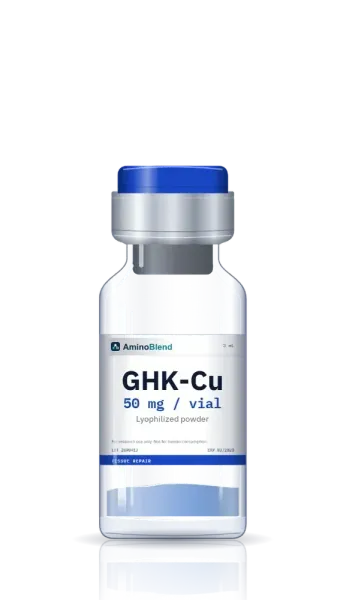
GHK-Cu
From $49
Research use only. AminoBlend supplies research compounds for laboratory and in-vitro use, not for human or animal consumption. By continuing you confirm you are 18 or older and buying for research.
Work out the concentration of a reconstituted GHK-Cu vial and convert any amount into millilitres and U-100 syringe units. The calculator is set to our GHK-Cu 50mg vial; switch to 100mg or enter your own values.
GHK-Cu comes in much larger fills than most peptides, so its solutions are strong. A GHK-Cu 50mg vial with 2 mL of bacteriostatic water gives 25 mg per mL, and the 100mg vial with 3 mL gives about 33 mg per mL. At those strengths each unit on a U-100 syringe holds a quarter of a milligram or more, so small amounts take only a few units.
Concentration for each vial size and water volume. On a U-100 insulin syringe, 10 units is 0.1 mL and 100 units is 1 mL.
| Vial | Bac water added | Concentration | Per 10 units (0.1 mL) | Per 1 unit |
|---|---|---|---|---|
| 50 mg | 2 mL | 25 mg/mL | 2.5 mg (2500 mcg) | 250 mcg |
| 50 mg | 3 mL | 16.667 mg/mL | 1.667 mg (1666.667 mcg) | 166.667 mcg |
| 100 mg | 2 mL | 50 mg/mL | 5 mg (5000 mcg) | 500 mcg |
| 100 mg | 3 mL | 33.333 mg/mL | 3.333 mg (3333.333 mcg) | 333.333 mcg |
On this page, GHK peptide dosage means the mass of GHK-Cu you measure out of a stock solution for an experiment, expressed in milligrams, micrograms or a molar concentration in the final medium. It is laboratory arithmetic, not an amount for people or animals.
Cell culture papers on GHK-Cu often report working concentrations in the nanomolar range, which is tiny compared with a 25 mg/mL stock. The copper complex weighs roughly 404 g/mol (check the figure on your certificate, since salt forms vary), so a 25 mg/mL stock is about 62 mM. A 1 micromolar solution holds about 0.4 mcg per mL, meaning 10 mL of medium at 1 micromolar needs about 4 mcg of GHK-Cu. Measuring that straight from the stock would take well under a microlitre, so dilute 1 in 1,000 first to 25 mcg/mL and then transfer about 0.16 mL.
GHK-Cu peptide mixing instructions are short, and the blue colour makes mistakes easy to spot. Let the vial reach room temperature so no condensation forms on the cake. Wipe the stopper with an alcohol swab, then run the bacteriostatic water slowly down the inside wall of the vial rather than onto the powder. Swirl or roll gently until the cake has gone; shaking can foam the solution. The result should be clear and evenly blue, with no specks. Write the concentration and date on the label, store it at 2 to 8 °C away from light, and use it within 28 days. The full bench method is in our guide on how to reconstitute peptides.
For the GHK-Cu peptide 50mg reconstitution, 2 mL is the usual choice because it lands on a round 25 mg per mL. Labs that measure small amounts often prefer 3 mL, giving 16.667 mg per mL, so each target spans more graduations. The GHK-Cu Starter Kit already pairs the 50 mg vial with a 3 mL water vial.
The copper in GHK-Cu is held by coordination bonds that strong acids, reducing agents and chelators can break. In the lab, keep GHK-Cu stock away from ascorbic acid and thiols such as glutathione, which reduce the copper, and from EDTA and other chelators, which pull it out of the complex. Low-pH buffers weaken the binding too. A stock that turns pale or colourless has lost copper.
Questions such as can I mix copper peptides with retinol, can you mix copper peptides with vitamin C or can you mix copper peptides with niacinamide come from skincare rather than the bench; our GHK-Cu serum guide covers what the formulation chemistry shows. As for whether you can mix GHK-Cu with other peptides, we would not combine separately reconstituted research stocks in one vial, because nobody has tested the stability of that mixture. Where a protocol already pairs them, the fixed-ratio GLOW and KLOW blends are made and tested as one product.
concentration (mg/mL) = GHK-Cu in vial (mg) ÷ water added (mL)
units on a U-100 syringe = amount (mg) ÷ concentration (mg/mL) × 100
Amounts in micrograms are divided by 1,000 first. The calculator does this arithmetic only; it does not recommend an amount, and GHK-Cu from AminoBlend is supplied for laboratory research use only.
Searches for GHK-Cu peptide dosage, GHK peptide dosing or a GHK-Cu peptide injection dosage chart PDF usually lead to tables written for people. We do not publish those: GHK-Cu is sold here as a laboratory reagent, and a GHK peptide dose in this context means the amount measured into an experiment. What this page gives instead is the chart researchers actually need, concentration per mL and the matching U-100 units for the 50 mg and 100 mg fills, so any GHK Cu peptide dose in micrograms can be measured accurately from a reconstituted vial.
Two numbers decide every GHK-Cu peptide dosage calculation at the bench: the vial fill and the water added. Change either and every volume on the chart moves, which is why the calculator above recalculates each time a value is edited.
A request for a GHK Cu peptide injection dose gets the same lab-only answer. Here, GHK Cu peptide dosing means the volume drawn from a stock of known strength into a culture well or assay tube, nothing more.
A GHK-Cu peptide dosage per day, a GHK-Cu peptide injection dosage per day or a GHK-Cu peptide dosage for hair growth is a figure for people, and we do not publish one. Copper peptides dosage tables found online have no approved basis in Australia, where GHK-Cu is not a registered medicine. In laboratory terms, the equivalent decision is the working concentration for each experiment, set by the published method being replicated. Our GHK-Cu side effects review explains why injected use sits outside the evidence.
The 50 mg vial is $49 and the 100 mg vial is $79, which works out at about 98 cents and 79 cents per milligram. The starter kit with a 50 mg vial, water and a syringe is $59. For a single short study the 50 mg fill avoids waste inside the 28 day window; for repeated assays from one lot and one certificate, the 100 mg vial is better value. Each lot is checked as described on our lab tested peptides page, and every other compound with its own calculator is listed under the main peptide calculator.
Settled on a concentration? Buy the GHK-Cu 50mg vial for $49 or the 100mg for $79, or shop the GHK-Cu starter kit with water and a syringe included. Every blue cake comes with a lot certificate you can read online first, which beats any copper peptide near me search for a lab-grade source.
GHK-Cu fills are five to ten times larger than most peptides, so the concentration line usually reads in tens of milligrams per mL. The mcg per 0.1 mL figure, concentration times 100, therefore runs into thousands. The volume and unit lines show how little blue solution holds a given target, and on a U-100 syringe each unit is 0.01 mL.
A standard vial stops at about 3 mL, so the 100mg GHK-Cu fill can never be diluted below 33 mg/mL inside it, and 1 mg still takes only 3 units. For amounts that small, draw a measured volume of the blue stock into a separate tube and dilute it tenfold or more, then run the calculator again, entering the milligrams transferred and the new total volume.
The weighed fill is the copper complex, about 404 g/mol, not the bare GHK tripeptide, so molar figures must use the complex weight. On that basis the 100mg vial in 3 mL is roughly 82 mM, and the same fill in 2 mL about 124 mM. Background on the complex is in what GHK-Cu is.
2 to 3 mL in a standard 3 mL vial. 2 mL gives 25 mg per mL and 3 mL gives about 16.7 mg per mL. More water spreads the peptide over more units, which makes small amounts easier to measure.
Up to about 3 mL, the capacity of a standard vial, which gives about 33 mg per mL. Each unit on a U-100 syringe then holds about 0.33 mg.
The copper ion bound to the peptide gives the solution its blue colour. A clear, blue solution is normal; cloudiness or particles are not.
It means the mass of GHK-Cu held in a measured volume of your reconstituted stock, for preparing assays and dilutions. Enter the vial size, the water added and a target amount, and the calculator returns the volume and U-100 units that contain it. It does not recommend any amount for human or animal use.
Keep GHK-Cu stock away from reducing agents such as ascorbic acid and glutathione, from chelators such as EDTA, and from low-pH buffers. Each can loosen or strip the bound copper, and a solution that turns pale or colourless has lost it. We also advise against combining separately reconstituted peptide stocks in one vial, since that mixture has no stability data.
AminoBlend sells GHK-Cu as a 50 mg vial for $49 and a 100 mg vial for $79, about 98 and 79 cents per milligram. The GHK-Cu Starter Kit, with a 50 mg vial, 3 mL of bacteriostatic water and a U-100 syringe, is $59. Every lot has a certificate for identity and purity in the COA library.
