
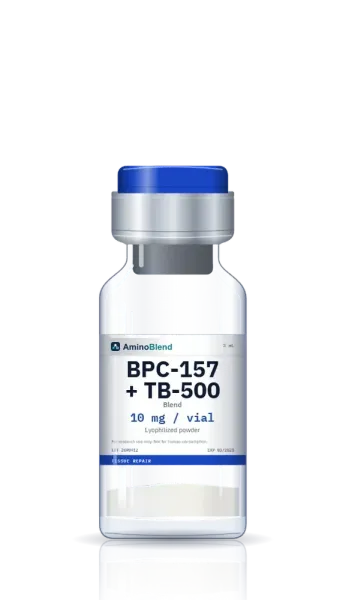
Wolverine Blend (BPC-157 + TB-500)
10 mg vial
$69
Research use only. AminoBlend supplies research compounds for laboratory and in-vitro use, not for human or animal consumption. By continuing you confirm you are 18 or older and buying for research.
Buy peptide blends in Australia from AminoBlend, with the Wolverine Blend (BPC-157 with TB-500), the CJC-1295 and ipamorelin blend, the tesamorelin and ipamorelin blend, and the GLOW and KLOW copper peptide blends, each holding two to four compounds in one vial. Prices start at $65. Every blend is lab-tested for each component, matched to a certificate of analysis by lot number, and dispatched from within Australia.
5 products
10 mg vial
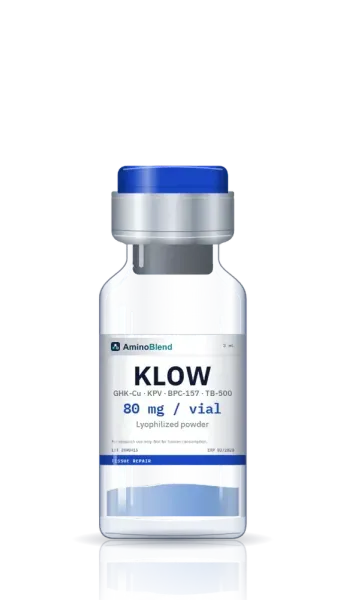
80 mg vial
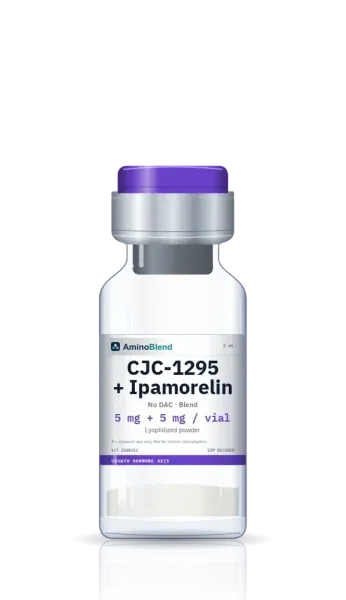
10 mg vial
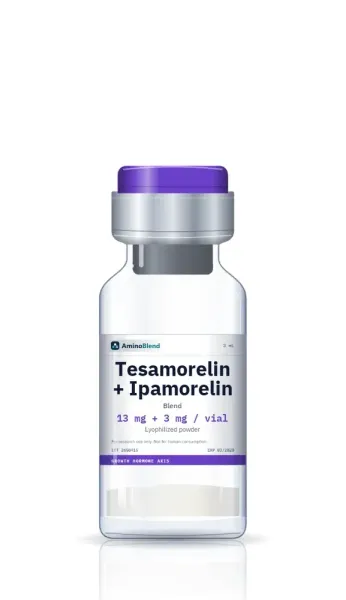
13 mg + 3 mg vial
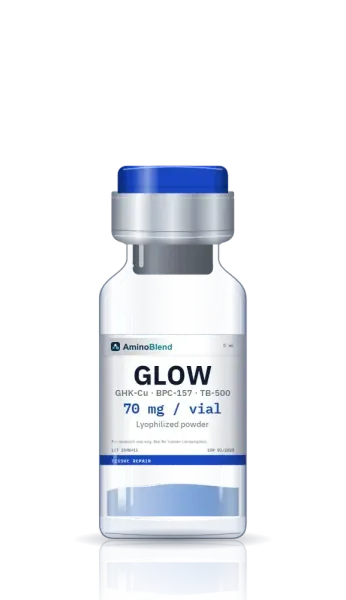
70 mg vial
Shop a blend when two or more peptides belong in a single vial as one lyophilised cake. The lab reconstitutes once, tracks one lot number and handles one container instead of several. The trade-off is the ratio, which is fixed at manufacture, so the components cannot be varied independently. Peptide blends suit designs where the combination itself is the test article and the protocol already specifies the proportions. Where a study compares one compound against another, single vials are the better choice.
Order single vials as controls next to any blend. Because every component shares one cake, they also share one storage history and one set of handling steps, which removes a source of variation between arms. On the other hand, a blend cannot show which component produced an effect, so the single compound controls are what let a design trace each result back to its source.
Buy the Wolverine Blend as a 10 mg vial holding 5 mg each of BPC-157 and TB-500 for $69. BPC-157 is a 15 amino acid chain from a gastric juice protein, and TB-500 is derived synthetically from thymosin beta-4. The two are studied through different mechanisms in tendon, muscle and wound models, and are combined so often that many labs prefer them as one vial. Our BPC-157 vs TB-500 guide explains how the two compare on their own.
GLOW adds the copper peptide GHK-Cu to the same pair, giving a 70 mg vial for $129, most of it GHK-Cu. KLOW holds all three plus KPV, the tripeptide Lys-Pro-Val studied in inflammation models, in an 80 mg vial for $139. Both powders are blue from the bound copper, which is expected. Order KLOW if KPV belongs in the design, since it costs $10 more but works out cheaper per milligram, about $1.74 against $1.84 for GLOW.
Order the CJC-1295 and ipamorelin blend for pulsatile release studies. It combines CJC-1295 No DAC, a GHRH analogue also called Modified GRF 1 to 29 with a half-life of roughly 30 minutes, and ipamorelin, a selective ghrelin receptor agonist. That puts two separate pituitary pathways in one 10 mg vial for $65, and the short acting CJC component keeps each pulse brief.
The tesamorelin and ipamorelin blend is the only one with unequal parts, 13 mg of tesamorelin, the full 44 amino acid GHRH analogue, and 3 mg of ipamorelin, for $129. It is ordered mainly for body composition designs that want a heavy GHRH share alongside the ghrelin receptor route. Shop more secretagogues as single vials in our growth hormone peptides range.
Shop the Wolverine Blend for combined tissue repair models with no copper component. Where skin remodelling and repair are studied together, choose GLOW, and move to KLOW when an inflammation endpoint is part of the protocol. For pulsatile growth hormone release, the CJC-1295 and ipamorelin blend is the natural fit, while the tesamorelin and ipamorelin blend suits designs weighted toward GHRH. If your method needs to change one component's share, buy the parts separately. The blend usually costs less than the equivalent singles, but separate vials let you set the ratio yourself, so the best peptide blends for any study are the ones whose fixed ratio the protocol already names.
Order bacteriostatic water with any blend, and read the total fill weight on the listing before mixing, because the concentration of each component depends on its share of the vial. In the two equal part blends each compound makes up half the fill, while the tesamorelin and ipamorelin vial is split 13 to 3. Lyophilised blends keep best frozen at minus 20 °C and away from light, with 2 to 8 °C acceptable for short periods. Once mixed, a vial belongs in the fridge and is normally used within 28 days, as our peptide storage guide explains.
Buy a blend only when every part is verified, since a blend is only as reliable as its weakest component. An independent laboratory runs mass spectrometry on each lot for every compound it should contain, alongside HPLC for purity. Look up the lot number from the vial in the COA library to read the certificate. Orders cleared for payment before 3pm on a business day ship that day with tracking to all states and territories. To work out the concentration after mixing, the peptide calculator accepts the total fill weight. Every blend is sold for laboratory research only, with no TGA approval and no guidance on use in people or animals.
| Product | Sizes | Form | Price |
|---|---|---|---|
| Wolverine Blend | 10 mg (5 mg BPC-157, 5 mg TB-500) | Lyophilised blend, glass vial | $69 |
| CJC-1295 and Ipamorelin Blend | 10 mg | Lyophilised blend, glass vial | $65 |
| Tesamorelin and Ipamorelin Blend | 13 mg + 3 mg | Lyophilised blend, glass vial | $129 |
| GLOW | 70 mg | Lyophilised blend, glass vial | $129 |
| KLOW | 80 mg | Lyophilised blend, glass vial | $139 |
Peptide blends are vials holding two or more research peptides lyophilised together as one cake. AminoBlend sells five, the Wolverine Blend, the CJC-1295 and ipamorelin blend, the tesamorelin and ipamorelin blend, GLOW and KLOW. They save reconstitution steps and keep the components on one lot, at the cost of a fixed ratio.
Usually, yes. The Wolverine Blend costs $69, against $74 for the same 5 mg of BPC-157 and 5 mg of TB-500 worked out pro rata from single vials, and the CJC-1295 and ipamorelin blend costs $65 against $69. Singles cost more but let you set each compound's share yourself.
The Wolverine Blend holds 5 mg of BPC-157 and 5 mg of TB-500 in one 10 mg lyophilised vial, priced at $69. BPC-157 comes from a gastric juice protein and TB-500 is a synthetic peptide based on thymosin beta-4, and the two are studied through different mechanisms in tendon, muscle and wound models.
An independent laboratory tests every blend lot, using mass spectrometry to confirm each component and HPLC to measure purity. The lot number on the label opens the matching certificate in our COA library, so the batch in your hands can be checked before you reconstitute it.
Start from the total fill weight printed on the label. Adding 2 mL of bacteriostatic water to the 10 mg Wolverine Blend vial, for instance, gives 5 mg per mL of total peptide, or 2.5 mg per mL of each component. The AminoBlend peptide calculator handles any fill weight and volume.