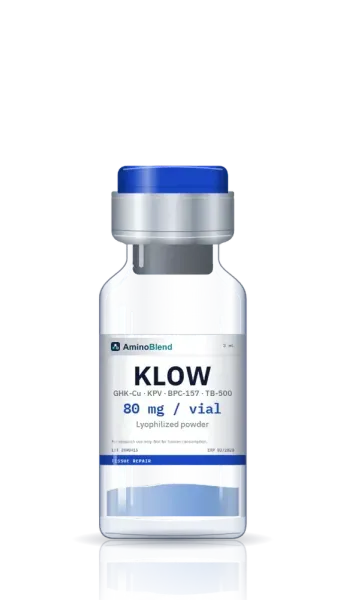
KLOW
80 mg vial
$139
Research use only. AminoBlend supplies research compounds for laboratory and in-vitro use, not for human or animal consumption. By continuing you confirm you are 18 or older and buying for research.
In stock, ready to ship from Australia
Size: 70 mg vial
Buy GLOW peptide online in Australia as a single 70 mg vial for $129, holding 50 mg of GHK-Cu with 10 mg each of BPC-157 and TB-500, freeze-dried together as one cake. The copper tripeptide makes up most of the fill and turns the cake blue, while the two repair peptides complete a 50 to 10 to 10 ratio that many tissue remodelling protocols already specify. Order the trio pre-mixed and you have one vial to reconstitute and one certificate to file instead of three of each. Every lot is tested by mass spectrometry to confirm all three components and by HPLC for purity, and the certificate opens before checkout. Shop the KLOW blend if you want KPV added as a fourth peptide in the same vial. The powder ships dry with no diluent, so add bacteriostatic water and work out concentrations with the peptide calculator. Store the sealed vial at -20 °C in the dark. This research reagent is sold to adults aged 18 and over.
For laboratory research use only. Not for human or veterinary use. Not TGA approved. See our research use policy.
| Name | GLOW blend (GLOW 70) |
|---|---|
| Sizes and prices (AUD) | 70 mg vial, $129 |
| Sequence or structure | GHK-Cu (Gly-His-Lys copper complex) 50 mg, BPC-157 (15 amino acids) 10 mg and TB-500 (synthetic thymosin beta-4 fragment) 10 mg |
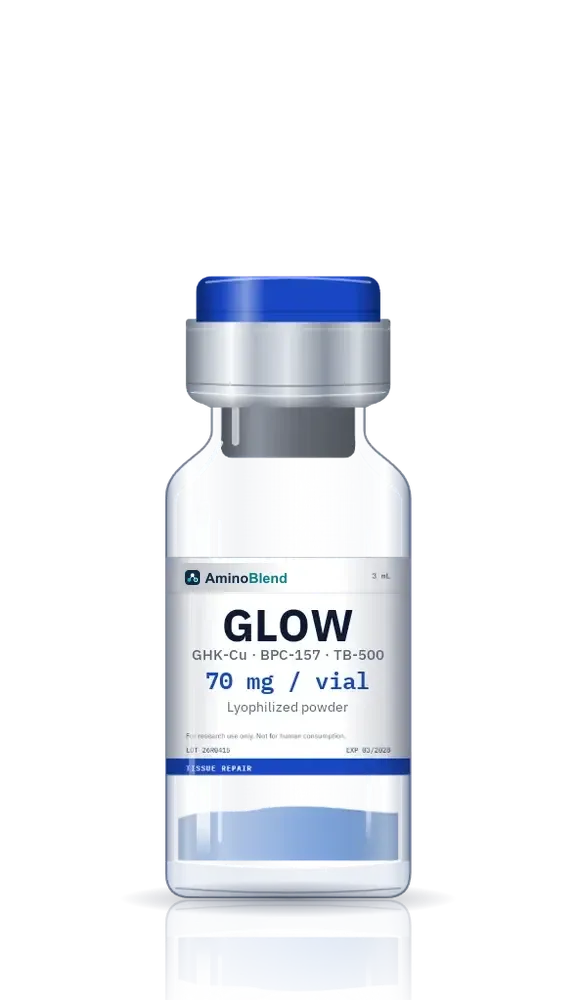
| Form | Blue lyophilised blend in a sealed 3 mL glass vial under a blue cap |
| Testing | Mass spectrometry confirms each of the three peptides and HPLC measures purity, one certificate per lot |
| Contents | One 70 mg vial of the three-peptide blend, diluent sold separately |
| Storage | -20 °C sealed and dark, then 2 to 8 °C after reconstitution |
| Availability | In stock |
| Use | Laboratory in vitro research only |
Order GLOW when your study design needs all three peptides in a fixed ratio under one lot record. The vial is held in Australian stock and released only after the full panel of checks.
GLOW peptide is a ready-mixed research blend of three compounds in one vial: the copper carrier GHK-Cu, the gastric-derived BPC-157 and TB-500, the short actin-binding fragment of thymosin beta-4. It is a GHK Cu glow peptide in the literal sense, essentially copper peptide with two repair peptides mixed through it, and no new molecule forms when the three are dried together.
Wound repair in research models is usually described in four overlapping phases: clotting, inflammation, proliferation and remodelling. GLOW targets the last two. During proliferation, cells have to travel into the damaged zone and new capillaries have to follow them, which is the territory of TB-500 and BPC-157 respectively. During remodelling, fibroblasts lay down collagen and then reorganise it, and that matrix turnover is where GHK-Cu has its longest record. Leaving out an anti-inflammatory partner is a deliberate choice, and it is the main structural difference from the four-peptide KLOW. Each component's own background is on its single-compound page, including GHK-Cu, the copper carrier and TB-500, the thymosin fragment.
A fair question for any copper blend is whether the metal migrates to the other peptides once everything is in solution. Neither BPC-157 nor TB-500 contains histidine or cysteine, the two residues that bind copper most strongly in peptides, so the copper is expected to remain with GHK. That makes this particular trio chemically sensible to co-formulate, which is not true of every blend sold under a catchy name.
Those figures settle most GHK Cu peptide vs GLOW peptide debates. By molecule count the blend is overwhelmingly copper peptide, so in a fibroblast assay it will behave much like GHK-Cu with small additions. Most glow peptide for skin research therefore runs in dermal fibroblast cultures, skin explants and wound closure studies in rats and mice, where the interesting readout is whether the two minor partners shift closure speed or capillary density beyond what the copper peptide achieves alone. Our advice: if that is your question, run a single-compound GHK-Cu arm at the matching concentration, 25 mg/mL from 2 mL in this vial, because without it the blend's result has nothing to be measured against.
GLOW combines three compounds with separate research histories. GHK-Cu is the copper tripeptide isolated from human plasma and studied in fibroblast collagen synthesis, BPC-157 is a 15 residue sequence derived from a gastric protein and researched in tendon, gut and soft tissue models, and TB-500 is a synthetic fragment modelled on thymosin beta-4 and studied for actin binding and cell migration. That makes it a glow copper peptide blend with two repair partners rather than a single molecule.
Mixing them introduces no new mechanism. It simply places three established ones in one solution so a lab can ask what the combination does in a wound closure, fibroblast or angiogenesis model without preparing three stocks. Because the copper peptide sets the colour and most of the mass, concentrations for the two minor components are best worked out from their own share of the fill. Shop it as a research reagent with no cosmetic or medical status in our peptide blends range. The name has nothing to do with glowing peptides or fluorescence, and labels such as glow skin peptide describe the branding only, never a claimed effect.
Hold the vial up to the light and you see one compact blue cake filling the base of a 3 mL glass vial, sealed under a blue cap. By mass it is mostly copper peptide: 50 of the 70 mg are GHK-Cu, with BPC-157 and TB-500 making up the remaining 20 mg in equal parts. There is no liquid, buffer or fourth peptide inside, and the three compounds cannot be pulled back apart after filling. GLOW is a catalogue name for that mixture, not a molecule with its own developer or literature, so its regulatory picture is simply the sum of three ingredients.
Two of the three ingredients are prescription-only substances. BPC-157 has been in Schedule 4 of the Poisons Standard since 1 June 2024, and thymosin beta-4 and its TB-500 fragment also carry Schedule 4 entries. The third, the GHK Cu glow peptide share, appeared by name in the TGA's April 2026 advisory on unapproved peptide products. As of October 2026 none of the three is in a medicine on the ARTG, so no pharmacist can lawfully dispense a registered version, and a product containing two WADA-listed peptides (BPC-157 under S0, TB-500 under S2) is equally off limits in tested sport. Copper tripeptide-1 skincare on retail shelves is a separate, cosmetic category and tells you nothing about a vial like this.
That is why anyone searching to buy GLOW peptide in Australia ends up at research suppliers. AminoBlend holds the 70 mg glow peptide GHK Cu blend in Australian stock purely as a laboratory reagent, for in vitro protocols, ordered by adults 18 and over and never for human or veterinary use. For studies where the copper peptide must be isolated from the two repair peptides, the GHK-Cu Starter Kit is the cleaner starting point, and the GHK-Cu explainer covers the dominant ingredient.
GLOW is sold in a single format, the 70 mg vial at $129. Buying the same quantities separately would mean three vials, each with its own diluent and paperwork, so the blend suits protocols where the ratio is fixed in advance. Buy the GHK-Cu, BPC-157 and TB-500 vials individually if one component has to vary.
One vial reconstituted with 2 mL gives enough solution for a typical cell culture series inside the 28 day window. Order every vial a series needs together so they share one lot wherever stock allows and one certificate. Sales are limited to adults aged 18 and over, with the age check carried out at checkout.
When three peptides share a vial, testing has to prove each one is present, not only the dominant one. The certificate for each lot lists mass spectrometry results for GHK-Cu, BPC-157 and TB-500 together with the HPLC trace and the analysis date. A strong blue cake is expected, while a pale or white one would point to low copper peptide content.
GHK-Cu outweighs each other component five to one, so its peak dominates the chromatogram, and the smaller BPC-157 and TB-500 peaks are the ones to look for in the report. For a lab, the best glow peptide is a vial whose certificate shows every component, whatever the label promises. Match the lot code on the label to its entry in the COA library, where multi-peak blend reports sit alongside single-peptide ones.
AminoBlend sells online only, so GLOW is ordered from this page and sent from Australian stock to any address in the country by tracked delivery. Orders received before 3pm on a business day leave that afternoon.
To reconstitute, let the vial reach room temperature, add bacteriostatic water down the glass wall and swirl gently until the blue solution clears. With 2 mL the vial holds 35 mg of combined peptide per mL, made up of 25 mg/mL GHK-Cu, 5 mg/mL BPC-157 and 5 mg/mL TB-500. The peptide calculator gives figures for any other volume.
Keep sealed vials frozen at -20 °C and protected from light. After mixing, store the solution at 2 to 8 °C in aliquots, use it within 28 days and discard it if it clouds or the colour fades. Stand the vial upright in the fridge so the stopper stays dry between draws, and see the reconstitution guide for technique.
The blend is also listed as GLOW 70, the GLOW stack, glow blend peptides GHK-Cu or simply by its contents as GHK-Cu, BPC-157 and TB-500 in one vial. You may also see it written as GHK Cu GLOW peptide or peptide glow GHK Cu, and some catalogues spell out the components as copper tripeptide-1, body protection compound 157 and thymosin beta-4 fragment. Some catalogues call it a skin glow peptide, and lists of skin glow peptides often group it with copper blends, yet here it is a laboratory reagent studied in fibroblast and wound models only.
All those labels describe the same 50 to 10 to 10 mixture in a 70 mg fill. Research terms attached to it, such as tissue remodelling, angiogenesis, fibroblast migration and extracellular matrix, describe study areas rather than different products, and none of the names implies another ratio or testing standard.
Choose GLOW when your protocol needs the copper peptide and the two repair peptides together. Choose GHK-Cu by itself when copper is the only variable you want to test, since a fixed blend cannot be rebalanced once mixed. Choose KLOW when you also want KPV, the alpha-MSH derived tripeptide studied in inflammation models, which lifts the fill to 80 mg.
The guide GLOW vs KLOW compares the two blends side by side. If neither ratio fits, separate vials of each component give full control, at the cost of more preparation and more certificates to track.
GLOW joins GHK-Cu, BPC-157 and TB-500, freeze-dried together in a 50 to 10 to 10 ratio for a 70 mg fill.
A sealed vial of blue powder costs $129. Diluent is not inside, so put bacteriostatic water in the same order.
Labs use the blend in fibroblast, wound closure and blood vessel formation models where all three compounds are wanted at once, for research purposes alone.
KLOW holds the same three peptides plus KPV for an 80 mg fill, while GLOW leaves KPV out.
Keep the unopened vial at -20 °C. Once reconstituted, refrigerate it in aliquots and finish it within 28 days.
Mass spectrometry confirms all three peptides in every lot and HPLC reports purity, with the certificate filed in the COA library.
Buy it directly from AminoBlend, which ships the 70 mg vial from Australian stock for $129 with same-day dispatch on orders placed before 3pm on a business day. The lot certificate is available before you pay, so you can confirm all three components first. Add bacteriostatic water to the cart, because the blend arrives as dry powder.
From the AminoBlend online store, which sends tracked parcels to every state and territory. There is no shop to visit, so labs in any city or regional area order the same way, from the same local stock, with the certificate ready to read well before they commit to the purchase.
Each 70 mg vial contains 50 mg of GHK-Cu, 10 mg of BPC-157 and 10 mg of TB-500, freeze-dried as one cake. The copper in GHK-Cu turns the powder blue. With 2 mL of diluent the solution carries 35 mg of combined peptide per mL, and the peptide calculator rescales that for other volumes.
Yes, each lot is tested by mass spectrometry to confirm all three peptides are present and by HPLC for purity. The certificate is filed in the COA library under the lot code on your vial, so you know exactly what the blend contains before you place an order.
Order GLOW when your protocol needs GHK-Cu, BPC-157 and TB-500 in a fixed ratio. Order GHK-Cu alone when copper is the single variable under test. Order KLOW when you also want KPV, the alpha-MSH derived tripeptide, in the same vial. For any other ratio, buy the components as separate vials.
No, GLOW is a research blend sold for in vitro laboratory work only, to adults aged 18 and over. It is not a cosmetic, therapeutic good or skin treatment, carries no claim of any outcome, and is not supplied for human or veterinary use.