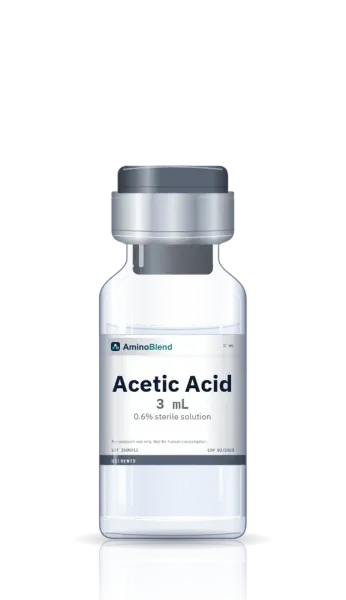
Acetic Acid 0.6%
3 mL
$9
Research use only. AminoBlend supplies research compounds for laboratory and in-vitro use, not for human or animal consumption. By continuing you confirm you are 18 or older and buying for research.
In stock, ready to ship from Australia
Shop the best bac water for peptides online in Australia in 3 mL ($9), 10 mL ($14) and 30 mL ($24) glass vials, or take any size with one U-100 syringe for $12, $17 or $27. Each vial holds sterile water with 0.9% benzyl alcohol (C7H8O, 108.14 g/mol, CAS 100-51-6), about 9 mg per millilitre, a preservative that keeps bacteria from multiplying once the stopper is pierced, so one vial serves many draws. Order it with your peptides, because every compound in our catalogue ships as dry powder without diluent. Labels carry a lot number and expiry date for your records, and the peptides you dissolve have their own HPLC certificates in the COA library. Use the peptide calculator to convert the volume you add into a concentration, and add a pack of insulin syringes for measured draws. Store the sealed vial at room temperature away from light, then refrigerate it after first use. Available as a laboratory supply to adults 18 and over.
For laboratory research use only. Not for human or veterinary use. Not TGA approved. See our research use policy.
| Name | Bacteriostatic water |
|---|---|
| Sizes and prices | 3 mL at $9 (or $12 with one syringe), 10 mL at $14 (or $17 with one syringe), 30 mL at $24 (or $27 with one syringe) |
| Composition | Sterile water containing 0.9% benzyl alcohol, about 9 mg per mL |
| Preservative | Benzyl alcohol, C7H8O, 108.14 g/mol, CAS 100-51-6 |
| Form | Clear liquid in a multi-draw glass vial with a rubber stopper and grey flip-off cap |
| Labelling | Contents, volume, lot number and expiry date |
| Contents | One vial of the chosen volume, plus one sterile U-100 1 mL 29G insulin syringe on the syringe options |
| Storage | Sealed at 15 to 25 °C away from light and never frozen. After the first puncture keep at 2 to 8 °C and discard after 28 days |
| Availability | In stock |
| Use | Reconstitution of research peptides in the laboratory only |
Add a vial to the cart with your peptides, since no lyophilised powder goes into solution without a diluent and a series stalls before it starts. Pick the size below by how much your bench will use within 28 days.
Put simply, bacteriostatic water is purified, sterilised water carrying a small dose of benzyl alcohol, so microbes that reach the liquid cannot multiply. It is the liquid labs use to turn a freeze-dried peptide cake back into a solution, and it is built for vials that will be opened again and again.
Benzyl alcohol is the simplest aromatic alcohol: a benzene ring carrying a CH2OH group. It mixes into water up to roughly 4 per cent, so the 0.9 per cent used here is fully dissolved and invisible. Its antimicrobial action comes mainly from slipping into the lipid membranes of bacteria and fungi and making them leaky, which halts growth and division. At 0.9 per cent that effect is enough to hold organisms in check between draws, while staying gentle on short peptide chains.
That last point has limits, and they are where the question of the best bacteriostatic water for peptides gets more interesting than brand or price. Formulation scientists at the University of Colorado showed in the mid-2000s that 0.9 per cent benzyl alcohol made a freeze-dried recombinant protein, the interleukin 1 receptor antagonist, aggregate more on reconstitution than plain water did. The alcohol binds weakly to exposed hydrophobic patches, loosens the folded structure and lets partly unfolded molecules clump together. Short linear peptides such as BPC-157 or Selank have no folded core to disturb. Larger folded chains are a different matter.
So what is the best bacteriostatic water for peptides? Any sterile, correctly labelled 0.9 per cent product will do the job for short peptides, and the differences that matter are a sound stopper, a printed expiry and a volume your bench will finish in time. Our firmer advice concerns the exceptions. For long or folded chains, run a small test vial first and look for haze or a drop in recovered concentration before committing a whole lot to preserved water. And trust your nose: benzyl alcohol slowly oxidises to benzaldehyde, which smells of bitter almonds, so an old vial with that scent should be replaced. The full guide comparing bac water with sterile water covers shelf life and when to switch diluents.
Bacteriostatic water is sterile water preserved with 0.9% benzyl alcohol. At that strength the alcohol does not kill bacteria. It stops any organism carried in on a needle from multiplying, though it cannot rescue a solution that is already contaminated, so clean technique still matters at every draw.
Order it for that preservative. A peptide vial reconstituted with preserved water can be drawn from over several weeks in the fridge, while unpreserved water suits a single draw. It dissolves almost every water-soluble peptide we sell, from short tripeptides to long metabolic chains, and it sits with syringes and acid diluent in our lab supplies range. Buying GHK Cu peptide bac water for a copper peptide vial is the same purchase, as the blue tripeptide dissolves readily in it.
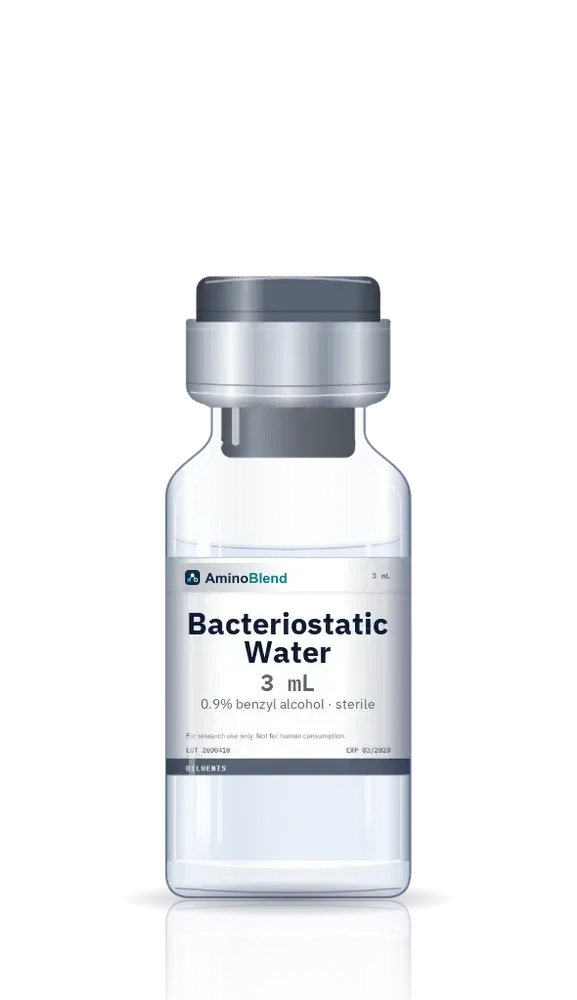
Every size is a clear glass vial with a grey flip-off cap over a rubber stopper, filled with a colourless liquid that should look exactly like plain water. The 3 mL, 10 mL and 30 mL fills differ only in volume, and the three "+ 1 syringe" options add a single sterile U-100 1 mL syringe to the same vial, not a different formula. The only ingredient besides water is benzyl alcohol at 0.9%, the same preservative strength used in pharmaceutical bacteriostatic water for injection, where overseas labels typically carry a prescription-only statement and a warning against use in neonates.
How is bacteriostatic water normally obtained in Australia? Not, as a rule, over a retail pharmacy counter. Australian pharmacies mainly supply Water for Injections, a preservative-free product entered on the Australian Register of Therapeutic Goods and packed in single-use ampoules, which is the wrong tool for a vial that will be drawn from for weeks. Benzyl alcohol itself does not appear in the Poisons Standard as a scheduled substance as of October 2026, which we confirmed in the October 2026 instrument, so the preserved diluent sits outside the scheduling system. Our guide on whether Australian chemists stock bac water looks at the retail side in more detail.
That gap is why most labs buy bacteriostatic water online from the same research supplier as their peptides. AminoBlend holds all three sizes in Australian stock as a laboratory diluent for reconstituting research peptides, sold to adults 18 and over and not for human or veterinary use. Bacteriostatic water for sale here is matched to our vial fills, and labs dissolving acid-loving compounds can add a 3 mL vial of 0.6% acetic acid instead.
All three vials hold the same formula, so the right choice is simply the volume your lab will finish within 28 days of the first puncture. Per millilitre, the 3 mL vial costs $3.00, the 10 mL vial $1.40 and the 30 mL vial $0.80.
Shop any size with one sterile U-100 1 mL 29G syringe for $3 more, the same as the single syringe price. Taking several vials from one lot wherever stock allows keeps a single diluent lot number across a whole study. Sale is limited to buyers aged 18 and over.
As a supply rather than a peptide, the water is not sent for mass spectrometry or HPLC. What counts is that it is sterile, carries the stated 0.9% benzyl alcohol and can be traced. A stopper and flip-off cap seal each vial, and the printed lot and expiry let you record which diluent went into each reconstitution beside the peptide lot.
The peptides are the analysed items, each with identity by mass spectrometry, purity by HPLC and one certificate per lot, and our guide to reading a certificate of analysis explains those reports. Before mixing, check that the water is clear with no particles and that the cap is intact. Discard any cloudy vial or one with a damaged stopper.
Pharmacies tend to stock single-use sterile water rather than preserved multi-draw vials, which makes AminoBlend the best place to buy bac water for peptides in the same cart as the peptides themselves. We are an online store shipping Australia-wide from local stock, with same-day dispatch for orders paid before 3pm on business days, and transit times are on the delivery information page.
As a worked example, 2 mL added to a 10 mg peptide vial gives 5 mg per mL, so one 10 mL vial covers five such reconstitutions. The reconstitution guide walks through the technique, which is to swab the stopper, let the water run slowly down the glass, then swirl rather than shake.
Keep sealed vials at 15 to 25 °C out of direct light and never freeze them, since ice can crack the glass or loosen the seal. After the first puncture, date the label, refrigerate at 2 to 8 °C and discard after 28 days. Reconstituted peptide that will be drawn over many sessions is best divided into aliquots.
Labs shorten it to bac water, BAC water or BW, and catalogues also list it as preserved sterile water or benzyl alcohol water. Chemical suppliers give the preservative its own synonyms, phenylmethanol and phenylcarbinol, and both simply mean benzyl alcohol.
Two neighbouring products are easy to mix up with it. Bacteriostatic sodium chloride uses the same preservative in a 0.9% saline base, and plain sterile water contains no preservative at all. Whatever the label says, the defining figures here are sterile water, 0.9% benzyl alcohol and a stoppered multi-draw vial.
Sterile water has no preservative and should be used straight after its seal is broken, so it suits one reconstitution consumed the same day. Bacteriostatic water is the right purchase whenever a peptide vial will be drawn more than once, and the bacteriostatic water vs sterile water guide compares the two in detail.
Two cases call for something else. Cell cultures sensitive to benzyl alcohol usually take a preservative-free sterile buffer, and the few peptides that resist neutral pH dissolve better in acetic acid 0.6%, with IGF-1 LR3 the main example. To measure water into a vial, our U-100 insulin syringes read straight against calculator units.
Bacteriostatic water is sterile water preserved with 0.9% benzyl alcohol and used to dissolve freeze-dried peptides. The preservative lets one vial be drawn from many times.
Choose 3 mL for $9, 10 mL for $14 or 30 mL for $24. Any size can come with one U-100 syringe for $3 more.
It turns lyophilised research peptides into a measurable solution for in vitro work. It is a laboratory supply, not for human or veterinary use.
Sterile water carries no preservative and suits one draw only. Bacteriostatic water is the choice when a vial will be drawn from repeatedly.
Keep sealed vials at 15 to 25 °C and never freeze them. After the first puncture, refrigerate and discard after 28 days.
Every vial is printed with lot and expiry, so your diluent batch can be recorded next to each peptide lot and its certificate.
Choose the 3 mL, 10 mL or 30 mL vial on this page, with or without a syringe, and add it to the same cart as your peptides. Prices run from $9 to $27. Stock ships from Australia, and orders paid before 3pm on a business day leave the same day with order tracking to every state and territory.
The strongest choice is preserved bacteriostatic water with 0.9% benzyl alcohol in a stoppered multi-draw vial, because it lets one reconstituted peptide vial be drawn from over several weeks. Buy it here in 3 mL, 10 mL or 30 mL sizes, each printed with lot and expiry, and order it with your peptides so everything arrives together.
Choose the vial your lab will empty within 28 days of first piercing it. For benches mixing most weeks that is the 30 mL size at $24, while the 10 mL vial covers four or five reconstitutions at 2 mL each and the 3 mL vial suits one or two peptide vials.
No, because it is a sterile diluent rather than a peptide, it is not analysed by HPLC or mass spectrometry. Each vial is sealed and printed with a lot number and expiry date for traceability. The peptides you dissolve in it each have a lot certificate in the COA library.
Choose bacteriostatic water whenever a reconstituted vial will be drawn from more than once, because its 0.9% benzyl alcohol stops bacteria multiplying between draws. Sterile water has no preservative and suits a single use only, for example when the entire solution is consumed on the day it is made.
Discard it 28 days after the first puncture of the stopper. Until it is opened, keep the vial at 15 to 25 °C away from light and do not freeze it. Once opened, store it at 2 to 8 °C and write the opening date on the label so the deadline is easy to track.