
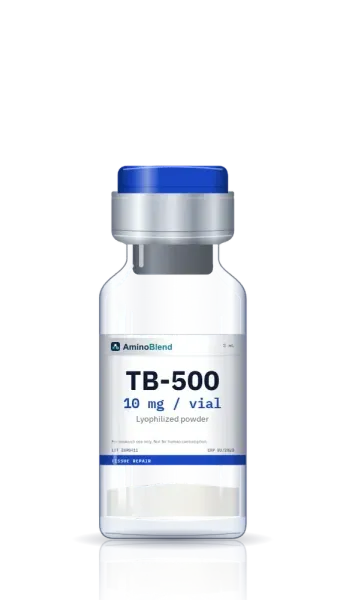
TB-500
10 mg vial
$79
Research use only. AminoBlend supplies research compounds for laboratory and in-vitro use, not for human or animal consumption. By continuing you confirm you are 18 or older and buying for research.
Convert TB-500 amounts into millilitres and units on a U-100 insulin syringe for any vial size and water volume. The calculator is set to our TB-500 10mg vial.
TB-500 amounts are usually written in milligrams rather than micrograms, so the volumes involved are larger than for BPC-157. With a 10mg TB-500 vial and 2 mL of bacteriostatic water, the solution is 5 mg per mL and a full 1 mL syringe holds 5 mg. If a calculation shows more than 100 units, the volume is larger than a 1 mL syringe holds.
TB-500 is often studied alongside BPC-157; see the blend calculator for the two in one vial, and our guide to BPC-157 vs TB-500.
Concentration for each vial size and water volume. On a U-100 insulin syringe, 10 units is 0.1 mL and 100 units is 1 mL.
| Vial | Bac water added | Concentration | Per 10 units (0.1 mL) | Per 1 unit |
|---|---|---|---|---|
| 5 mg | 1 mL | 5 mg/mL | 0.5 mg (500 mcg) | 50 mcg |
| 5 mg | 2 mL | 2.5 mg/mL | 0.25 mg (250 mcg) | 25 mcg |
| 5 mg | 3 mL | 1.667 mg/mL | 0.167 mg (166.667 mcg) | 16.667 mcg |
| 10 mg | 1 mL | 10 mg/mL | 1 mg (1000 mcg) | 100 mcg |
| 10 mg | 2 mL | 5 mg/mL | 0.5 mg (500 mcg) | 50 mcg |
| 10 mg | 3 mL | 3.333 mg/mL | 0.333 mg (333.333 mcg) | 33.333 mcg |
concentration (mg/mL) = TB-500 in vial (mg) ÷ water added (mL)
units on a U-100 syringe = amount (mg) ÷ concentration (mg/mL) × 100
Amounts in micrograms are divided by 1,000 first. The calculator does this arithmetic only; it does not recommend an amount, and TB-500 from AminoBlend is supplied for laboratory research use only.
The TB-500 10mg vial sells for $79, and the maths above assumes exactly that fill. Buy it online alongside a 3 mL bac water vial and the numbers on this page carry straight onto the bench. Labs that pair it with BPC-157 can compare the Wolverine Blend before ordering. No local stockist near me needed: every lot is in the COA library.
Searches for dosage for TB500 usually want a human figure, which we do not publish. What this page gives is the laboratory version: how much TB-500 sits in each 0.1 mL of a reconstituted 10mg vial at the water volume you choose, and the matching U-100 mark. Buy the TB-500 10mg vial online once the concentration suits the study.
Concentration in mg/mL is the 10mg TB-500 fill divided by the water you put in. Multiply it by 100 and you get the micrograms held in 0.1 mL, which is the stretch from zero to 10 units on a U-100 syringe. The volume line shows how many millilitres hold your milligram target, and the units line is that same volume read off the syringe scale, 100 units per mL.
Because TB-500 targets are usually written in milligrams, the risk is running past the 100 unit mark rather than squinting at tiny volumes. A 4 mg aliquot from a 10mg vial made up with 3 mL needs 1.2 mL, or 120 units, which a 1 mL syringe cannot hold in one draw. Using 1 or 2 mL of water keeps larger TB-500 amounts on a single barrel, while 3 mL only pays off for fractions of a milligram.
The TB-500 name is used for more than one sequence, from full thymosin beta-4 at roughly 4,963 g/mol to much shorter fragments built around the LKKTETQ region. The same 5 mg/mL stock therefore has very different molarity depending on which structure your lot actually is. Read the identity and mass on the certificate for your lot before converting micromolar targets, and see what TB-500 is for the background on these variants.
1 to 3 mL in a standard vial. 2 mL gives 5 mg per mL, so 10 units on a U-100 syringe holds 0.5 mg. Less water gives a stronger solution and smaller volumes.
At 5 mg per mL, 2 mg is 0.4 mL, which is 40 units on a U-100 syringe. At 3.33 mg per mL (10mg in 3 mL) it is 0.6 mL, or 60 units.
Yes. TB-500 dissolves readily in bacteriostatic water. Add the water slowly down the side of the vial and swirl gently until the solution is clear.
10 mg vial
