
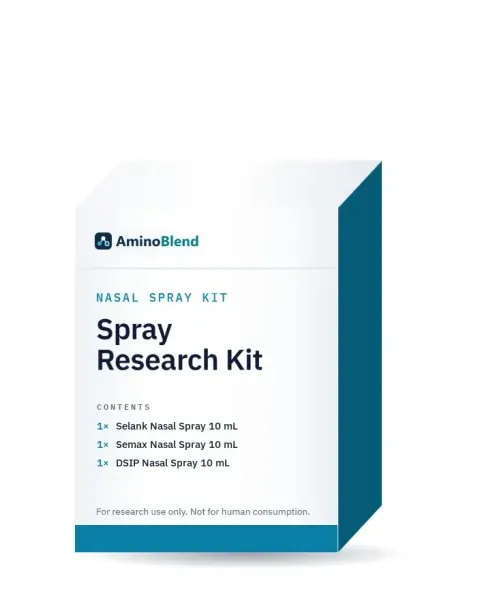
Spray Research Kit
Kit
$179
Research use only. AminoBlend supplies research compounds for laboratory and in-vitro use, not for human or animal consumption. By continuing you confirm you are 18 or older and buying for research.
In stock, ready to ship from Australia
Size: Kit
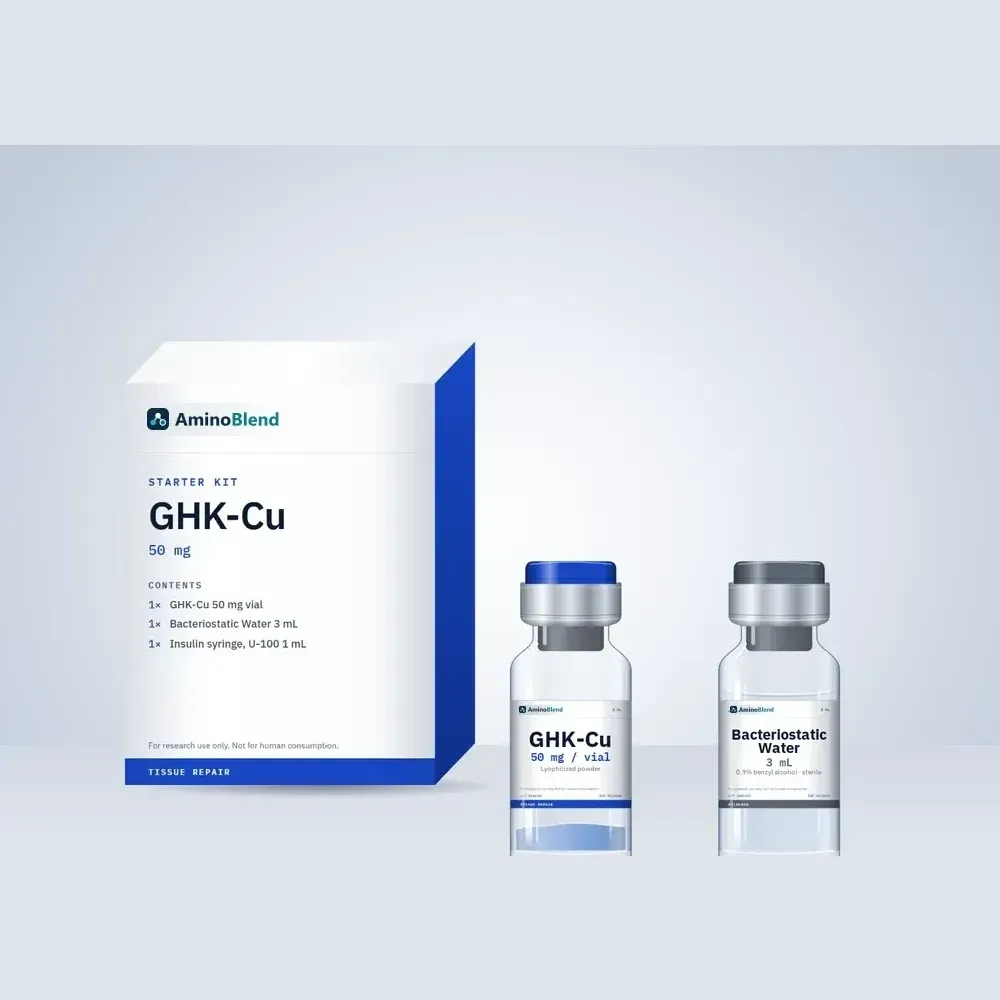
Buy the GHK Cu peptide kit online in Australia for $59, a single carton holding a 50 mg GHK-Cu vial, 3 mL of bacteriostatic water and one U-100 insulin syringe with a 1 mL barrel. GHK-Cu is the copper(II) complex of the tripeptide glycyl-L-histidyl-L-lysine, first isolated from human plasma in 1973, and it holds copper through its histidine and glycine nitrogens, which turns the powder blue. The identity data to check is C14H22CuN6O4, 401.9 g/mol and CAS 89030-95-5. Each GHK-Cu lot is confirmed by mass spectrometry and measured for purity by HPLC, with the certificate open before checkout. Use the GHK-Cu calculator to turn the supplied water volume into a concentration. Shop the Radiance Bundle instead if your study also needs KPV and BPC-157. The diluent is already boxed, so keep the sealed peptide vial frozen at -20 °C and out of light until work begins. A research reagent for adults aged 18 and over, listed in our skin and hair peptides range.
For laboratory research use only. Not for human or veterinary use. Not TGA approved. See our research use policy.
| Name | GHK-Cu Starter Kit |
|---|---|
| Size and price | One carton at $59 |
| Sequence or structure | Gly-His-Lys complexed with copper(II) |
| Length | 3 amino acids |
| Molecular formula | C14H22CuN6O4 |
| Molar mass | 401.9 g/mol |
| CAS number | 89030-95-5 |
| Form | Blue lyophilised powder in a sealed glass vial |
| Testing | GHK-Cu lot confirmed by mass spectrometry and measured by HPLC, with a certificate per lot |
| Contents | One 50 mg GHK-Cu vial, one 3 mL bacteriostatic water vial (0.9% benzyl alcohol) and one sterile U-100 1 mL insulin syringe |
| Storage | Sealed peptide vial at -20 °C long term or 2 to 8 °C for near use, away from light. Water and syringe at room temperature |
| Availability | In stock |
| Use | Laboratory in vitro research only |
Order the carton as a first copper peptide purchase. Nothing inside is a sample size, since the three items cost $61 bought one by one, and the blue vial holds the same material sold on the standalone GHK-Cu page.
The GHK-Cu Starter Kit is a single carton holding the copper peptide itself, the preserved water used to dissolve it and a graduated syringe for measuring that water, so one order covers the whole step from dry powder to a working solution. Each of the three items has a specific job, and each has a look-alike that would cause trouble if swapped in.
The 50 mg vial contains GHK-Cu, a three-residue peptide carrying one copper ion, freeze-dried so the complex stays stable until water is added. Freeze-drying removes moisture under vacuum at low temperature, which is why the cake is light and porous and dissolves in seconds. Background on the compound itself, its plasma origin and its matrix research, lives on the single GHK-Cu product page, so we will not repeat it here.
It is sterile water containing benzyl alcohol at a concentration of 0.9%. Benzyl alcohol is bacteriostatic, meaning it holds back bacterial growth rather than sterilising, which allows the stopper to be pierced again over the following weeks. Two look-alikes are worth knowing. Sterile water for injection has no preservative and is designed to be drawn from once, and sodium chloride 0.9% (saline) adds salt that some peptides tolerate poorly. For a copper complex, plain preserved water is the cleanest choice because it brings no chelating additives and no phosphate buffer, which can precipitate copper.
The label U-100 tells you the barrel scale is printed so that 100 units equal 1 mL, making each unit 0.01 mL. The needle is fixed to the barrel, which leaves very little dead space and wastes less liquid than a detachable-needle syringe.
That last point is the one first-time buyers get wrong most often. A unit marking on the barrel says nothing about milligrams until you have fixed the concentration, so write the volume of water you added on the vial label before drawing anything out. Labs that already keep diluent and syringes on the shelf can skip the carton, and our comparison of preserved and plain sterile water covers the diluent choice in more depth.
Loren Pickart isolated GHK from human plasma in 1973 and showed that it binds copper(II) with high affinity. The copper complex has since become one of the most studied small peptides in connective tissue research. The question a lab usually buys it to answer concerns matrix biology, namely how a copper-carrying tripeptide shifts collagen, elastin and glycosaminoglycan output in cultured fibroblasts.
Groups also order it for rodent wound models and for gene expression work on tissue remodelling. The vial in this carton is a research reagent rather than a cosmetic ingredient or a medicine, and it comes with the diluent and syringe needed to put it into solution on the day it lands.
Lift the lid of the carton and there are three separate pieces, each sealed on its own. First, the 50 mg peptide vial: a blue copper complex cake under a flip-off cap, carrying the lot code that links to its certificate. Second, a 3 mL glass vial of bacteriostatic water, sterile water preserved with 0.9% benzyl alcohol so the stopper can be punctured more than once. Third, one sterile, single-use U-100 insulin syringe with a 1 mL barrel. Nothing in the kit is premixed, which keeps the peptide dry and stable until the bench work starts.
The three items sit in quite different regulatory corners. GHK-Cu itself has no registered medicine on the ARTG as of October 2026, and the TGA named it in an April 2026 advisory on unapproved peptide products, which is why a GHK-Cu kit in Australia comes from a reagent supplier and not a pharmacy shelf. Bacteriostatic water is also hard to find at retail chemists, which tend to carry single-use Water for Injections ampoules instead, a product with no preservative. Insulin syringes, by contrast, are an everyday pharmacy item and are supplied free to registered insulin users through the NDSS, a scheme that does not extend to laboratory buyers. Our insulin syringe buying guide explains those channels.
Bundling the three solves a practical problem rather than a legal one: the diluent volume and syringe scale are matched to the 50 mg fill. When you buy the GHK-Cu kit in Australia from AminoBlend, the carton comes from local stock as research equipment for in vitro work, sold to adults aged 18 and over and not for human or veterinary use. Labs that later need only the peptide can reorder the 100 mg GHK-Cu vial on its own.
The kit has one configuration, and its volumes are matched to the vial. At $59 it works out to $1.18 per milligram of GHK-Cu with the supplies included, $2 below the price of the three parts. Adding 2 mL of the supplied water gives 25 mg per mL, while the full 3 mL gives about 16.7 mg per mL, and either fits inside the single water vial.
Buy several cartons together for a longer series, and we pack them from one GHK-Cu lot under one certificate wherever stock allows. Once your bench holds water and syringes, the standalone 100 mg vial at $79 becomes the cheaper reorder at $0.79 per milligram. Checkout confirms every buyer is 18 or older.
The tripeptide coordinates copper through the imidazole nitrogen of histidine, the alpha-amino nitrogen of glycine and the deprotonated amide nitrogen between them, leaving lysine free to interact with cell surface receptors. The complex absorbs red light, so genuine GHK-Cu looks blue as a powder and in solution. A white or grey cake sold under this name warns that the copper is missing.
Colour is a quick first check, but only analysis confirms the compound. On the certificate, look for a measured mass consistent with 401.9 g/mol and the HPLC purity reported for the lot. Each report is filed in the COA library under the lot number on the vial, so you can open the carton, see the blue colour and then match the lot to its certificate.
Copper peptide creams are easy to find in shops, whereas a lyophilised research vial with matched diluent is not. AminoBlend sells online only, with no shopfront, and ships across Australia from local stock, so a lab ordering peptides in Adelaide works from the same lots as one in Darwin. Cartons paid before 3pm on a business day are packed and sent that afternoon, and the delivery information page lists transit times by state.
To prepare the vial, bring it to room temperature, swab the stoppers, draw 2 mL of water with the supplied syringe in two full 1 mL draws and let it run down the glass before swirling gently. That gives 25 mg per mL, and the GHK-Cu reconstitution calculator handles other volumes. The step-by-step method is in how to reconstitute peptides.
If the work is weeks away, move the sealed vial to -20 °C on arrival, and for nearer use 2 to 8 °C is fine. Keep it out of light. Reconstituted GHK-Cu goes in the fridge, ideally in aliquots, and the water vial is discarded 28 days after its first puncture.
GHK-Cu also appears as copper tripeptide-1 in ingredient lists, as Cu-GHK or GHK copper in papers, and by its chemical description, glycyl-L-histidyl-L-lysine copper(II). Its non-proprietary drug name is prezatide copper. All of these describe one complex with CAS 89030-95-5.
The carton itself is sometimes called the GHK-Cu kit or copper peptide starter kit. Whatever name is used, the defining contents stay the same, a 50 mg blue vial, 3 mL of preserved water and one U-100 syringe.
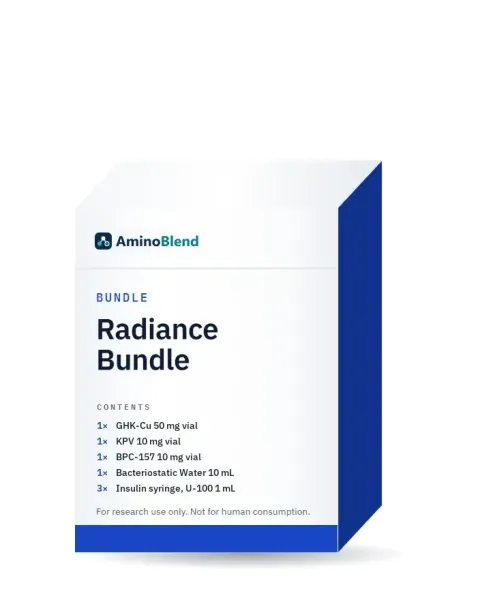
Pick this carton when GHK-Cu is the only compound in your design. When a study compares the copper peptide with an anti-inflammatory tripeptide and a tissue repair pentadecapeptide, the Radiance Bundle adds KPV 10 mg and BPC-157 10 mg in separate vials, with 10 mL of water and three syringes, for $179.
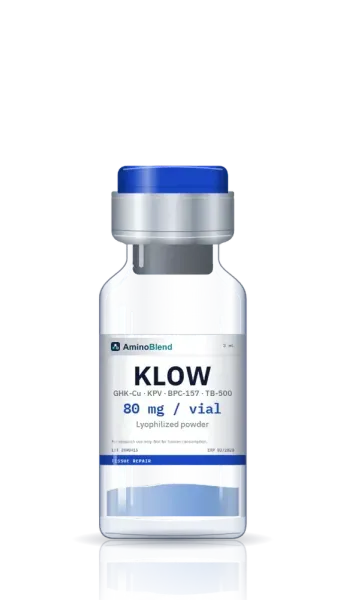
Labs that prefer a fixed ratio in one vial can look at the GLOW blend, which combines GHK-Cu with BPC-157 and TB-500. Our GLOW vs KLOW comparison explains how the pre-mixed blends differ from separate vials.
GHK-Cu is glycyl-histidyl-lysine bound to copper(II), which gives it a blue colour. The carton includes everything needed for a first reconstitution.
A 50 mg vial, 3 mL of bacteriostatic water and a U-100 syringe, $2 cheaper than buying the three items separately.
Labs use it in fibroblast cultures for collagen and elastin work and in rodent wound models. Research use only.
This kit covers GHK-Cu alone. The Radiance Bundle adds KPV and BPC-157 in separate vials for a three-compound design.
Freeze the sealed vial at -20 °C for longer holds or refrigerate it for near use. Reconstituted solution stays at 2 to 8 °C.
Check the blue colour on arrival, then match the lot number to its mass spectrometry and HPLC report.
Add the $59 carton to your cart from this page and check out. It ships from Australian stock, and orders paid before 3pm on a business day are packed and dispatched that afternoon. The 50 mg vial, 3 mL of bacteriostatic water and a U-100 syringe are all inside, so nothing else is needed to begin.
Buy it online from AminoBlend, which delivers to every state and territory from local stock. Shops sell copper peptide creams, not lyophilised research vials with matched diluent, and AminoBlend has no shopfront, so ordering the carton from this page is the direct route wherever your lab is based.
Yes, the GHK-Cu vial comes from a lot with its own certificate. Mass spectrometry confirms identity and HPLC measures purity, and the report sits in the COA library under the lot number printed on the vial. The water and syringe are sterile supplies labelled with lot and expiry.
Buy the $59 kit if GHK-Cu is the only peptide in your study. Choose the $179 Radiance Bundle when you also need KPV and BPC-157, because it packs all three as separate vials with 10 mL of water and three syringes, which costs less than buying the parts individually.
The blue colour comes from the copper(II) ion bound to the tripeptide, which absorbs red light. Genuine GHK-Cu is blue as a powder and in solution. A white or grey cake sold under this name suggests the copper is missing, which is one reason to check the certificate as well.
It is a complete carton for reconstituting GHK-Cu for in vitro and animal model research on collagen, elastin and tissue remodelling. Sale is limited to adults aged 18 and over, as laboratory material only. It is not a cosmetic or a medicine and is not for human or veterinary use.
Kit
Bundle

80 mg vial