
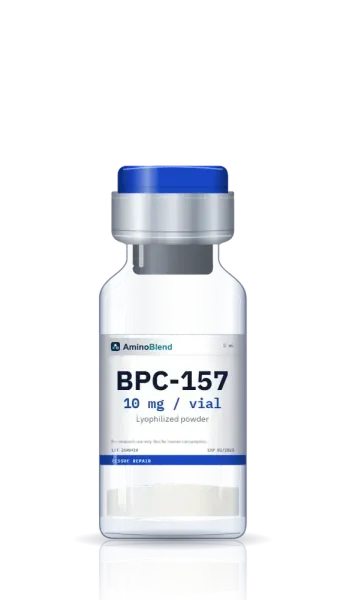
BPC-157
From $69
Research use only. AminoBlend supplies research compounds for laboratory and in-vitro use, not for human or animal consumption. By continuing you confirm you are 18 or older and buying for research.
Convert BPC-157 amounts in mcg or mg into millilitres and units on a U-100 insulin syringe, for any vial size and water volume. The calculator is set to our BPC-157 10mg vial.
BPC-157 research amounts are usually written in micrograms, which is where most mistakes happen: 250 mcg is 0.25 mg, not 2.5 mg. The calculator converts mcg to mg for you before working out the volume. Our BPC-157 10mg vial is lyophilized and dissolves readily in bacteriostatic water; the chart below also covers the 5mg vials many protocols are written around.
BPC-157 is also supplied as 500 mcg capsules, which need no calculator: each capsule holds a fixed amount. For BPC-157 combined with TB-500 in one vial, use the BPC-157 and TB-500 blend calculator.
Concentration for each vial size and water volume. On a U-100 insulin syringe, 10 units is 0.1 mL and 100 units is 1 mL.
| Vial | Bac water added | Concentration | Per 10 units (0.1 mL) | Per 1 unit |
|---|---|---|---|---|
| 5 mg | 1 mL | 5 mg/mL | 0.5 mg (500 mcg) | 50 mcg |
| 5 mg | 2 mL | 2.5 mg/mL | 0.25 mg (250 mcg) | 25 mcg |
| 5 mg | 3 mL | 1.667 mg/mL | 0.167 mg (166.667 mcg) | 16.667 mcg |
| 10 mg | 1 mL | 10 mg/mL | 1 mg (1000 mcg) | 100 mcg |
| 10 mg | 2 mL | 5 mg/mL | 0.5 mg (500 mcg) | 50 mcg |
| 10 mg | 3 mL | 3.333 mg/mL | 0.333 mg (333.333 mcg) | 33.333 mcg |
concentration (mg/mL) = BPC-157 in vial (mg) ÷ water added (mL)
units on a U-100 syringe = amount (mg) ÷ concentration (mg/mL) × 100
Amounts in micrograms are divided by 1,000 first. The calculator does this arithmetic only; it does not recommend an amount, and BPC-157 from AminoBlend is supplied for laboratory research use only.
With the concentration settled, buy the matching vial: the BPC-157 10mg vial is $69, and labs comparing oral formats can shop the 500 mcg capsules on the same page. Add bacteriostatic water to the order if the bench is out. Searching for BPC-157 near me rarely turns up a lab-grade source; ordering online from our Australian stock does, with the lot certificate readable first.
The first figure is how many milligrams of BPC-157 sit in each millilitre once the vial is reconstituted. The mcg per 0.1 mL line is that strength multiplied by 100, the amount held between the zero mark and the 10 unit mark on a U-100 syringe. The last two outputs give the volume that contains your target microgram amount, first in millilitres and then in syringe units, where 1 mL equals 100 units.
With 1 mL of water, a 250 mcg BPC-157 aliquot lands at 2.5 units, halfway between graduations and hard to judge by eye. Diluting the same 10mg cake to 3 mL stretches that mass across 7.5 units, three times the travel along the barrel, so a half-unit misreading costs proportionally less. A 0.3 mL U-100 syringe widens the spacing again for such short draws.
BPC-157 has a molecular weight of about 1,419.5 g/mol, so the 5 mg/mL stock made with 2 mL of water is roughly 3.5 mM. One micromolar of BPC-157 equals about 1.42 mcg per mL, which lets you convert a molar working concentration from a cell culture paper into a microgram target for the calculator. Compare against the mass reported for your lot in the COA library, since counter-ions in the powder add weight that is not peptide.
Any volume from 1 to 3 mL works in a standard vial. 2 mL is a common choice because it gives 5 mg per mL, so every 10 units on a U-100 syringe holds 500 mcg, which keeps the arithmetic simple.
Adding 1 mL gives 5 mg per mL and 2 mL gives 2.5 mg per mL. At 2.5 mg per mL, each unit on a U-100 syringe holds 25 mcg.
It depends on the concentration. At 5 mg per mL, 250 mcg is 0.05 mL, or 5 units. At 2.5 mg per mL it is 0.1 mL, or 10 units. Enter your own values in the calculator to check.
No. The calculator only converts amounts into volumes. AminoBlend supplies BPC-157 for laboratory research use only and does not give dosing advice.
