Bacteriostatic Water
From $9
Research use only. AminoBlend supplies research compounds for laboratory and in-vitro use, not for human or animal consumption. By continuing you confirm you are 18 or older and buying for research.
Buy lab supplies in Australia from AminoBlend, starting with bacteriostatic water in 3 mL, 10 mL or 30 mL vials, each available with or without one syringe. The range adds a 0.6% acetic acid diluent for sequences that will not dissolve in water, and U-100 insulin syringes sold singly in three barrel sizes or as a 30 pack. Prices start at $3, and everything ships from within Australia in the same parcel as your peptides.
3 products
Buy bacteriostatic water as the default diluent for lyophilised research peptides. It is sterile water containing 0.9% benzyl alcohol, and that preservative keeps bacteria from growing, so one vial can be punctured several times. Sterile water without a preservative suits single use only, and our bacteriostatic water vs sterile water guide sets out the difference. For most labs this is the best bac water for peptides, because it handles repeat draws from one bottle.
Shop three bottle sizes. The 3 mL vial ($9) covers one or two peptide vials. The 10 mL vial ($14) suits a lab mixing several peptides a month. The 30 mL vial ($24) is for weekly reconstitution, at $0.80 per mL against $3.00 for the smallest size. Each size can also be ordered with one U-100 syringe for $3 more, at $12, $17 and $27. Buy the bottle you will finish, because an opened vial is normally discarded 28 days after first puncture.
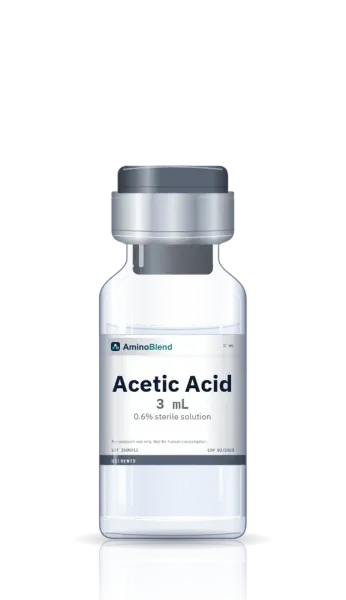
Order acetic acid only when a sequence stays cloudy or clumps at neutral pH. Acetic acid 0.6% is a weak acid solution of roughly pH 3 that brings most of these into solution, after which many protocols top up the acidic stock with bacteriostatic water. IGF-1 LR3 is the usual example. Treat it as a fallback rather than a default, starting with bac water and switching only when the powder will not clear or the method names an acid diluent. It is supplied as a 3 mL vial for $9.
Shop U-100 insulin syringes for transferring diluent and drawing measured volumes at the bench. They read in units, where 100 units equals 1 mL and 10 units equals 0.1 mL. The 1 mL syringe with a 29G 12.7 mm needle is the general choice for transferring diluent into a vial. A finer 31G 6 mm needle comes on the other three syringes, in 1, 0.5 and 0.3 mL barrels, and the two smaller barrels space their markings further apart, so small volumes are easier to read. The needle is fixed to the barrel, leaving very little dead space where liquid can be lost between hub and needle, which matters when volumes are small.
Buy singles at $3 each, or the 30 pack at $20, which brings the cost to about $0.67 per syringe. Our insulin syringes guide compares the barrels in more detail.
Shop by how many vials you prepare each month. For a single 10 mg peptide vial, the 3 mL bacteriostatic water vial with one syringe, the $12 option, is all you need. Labs preparing three or more vials a month do better with the 10 mL bottle and the 30 pack of syringes, $34 together. Labs working with high fill vials such as 500 mg NAD+ or 1,500 mg glutathione need more liquid per vial, so the 10 mL or 30 mL bottle makes sense even for a single order. Add acetic acid only for sequences known to resist water.
Plan the concentration before adding liquid, since 2 mL into a 10 mg vial makes a 5 mg per mL solution, and the peptide calculator handles any other fill weight. Order one of our peptide kits and bundles if you would rather not choose components at all, as each packs a peptide with matching water and a syringe. The full bench method is in how to reconstitute peptides.
Unopened bacteriostatic water and acetic acid keep at room temperature, out of direct heat and sunlight. Write the date on a water vial when its stopper is first pierced, so you always know when the 28 days run out. Syringes are sterile and single use, so draw with a fresh one each time and discard it afterwards. Once a peptide has been reconstituted, refrigerate it at 2 to 8 °C, and see our peptide storage guide for the rest.
Buy supplies in the same parcel as your peptides, so one order covers the whole bench setup and the bacteriostatic water Australia labs use for reconstitution arrives with the vials it is meant for. Each peptide in that parcel has a lot number that leads to its certificate of identity and purity in the COA library. Payments received before 3pm on a business day are dispatched that day with tracking to every Australian state. These supplies are sold for preparing research peptides in the laboratory, not for administering anything to people or animals.
| Product | Sizes | Form | Price |
|---|---|---|---|
| Bacteriostatic Water | 3 mL, 10 mL, 30 mL, each with or without 1 syringe | Preserved sterile water in glass | $9 to $27 |
| Insulin Syringes | 1 mL 29G, 1 mL 31G, 0.5 mL 31G, 0.3 mL 31G, 30 pack | Sterile single-use syringe | $3 to $20 |
| Acetic Acid 0.6% | One 3 mL vial | Dilute acid solution, glass vial | $9 |
Buy bacteriostatic water from AminoBlend in three sizes, 3 mL for $9, 10 mL for $14 and 30 mL for $24. Any size can include one U-100 syringe for an extra $3. It ships from Australian stock, and orders settled by 3pm on a working day are sent the same day with tracking.
You need a diluent, usually bacteriostatic water, and a U-100 insulin syringe to transfer it into the peptide vial, plus alcohol swabs for the stoppers. For one 10 mg vial, the 3 mL water vial with a syringe at $12 covers it. Our peptide calculator then works out the resulting concentration.
Only when a peptide will not dissolve cleanly at neutral pH or the method specifies an acid diluent. IGF-1 LR3 is the common example. The 0.6% solution, around pH 3, usually clears the powder, after which many labs dilute further with bacteriostatic water. Order a 3 mL vial for $9.
For adding diluent to a vial, the 1 mL 29G syringe is the general choice. For measuring small volumes, the 0.5 mL or 0.3 mL barrels with 31G needles space their markings further apart and read more precisely. Singles cost $3 each, or buy the 30 pack for $20.
An opened vial is usually discarded 28 days after the stopper is first punctured, even though the benzyl alcohol limits bacterial growth. Unopened vials keep at room temperature away from heat and light. Choose a bottle size your lab will use within that window to avoid waste.