
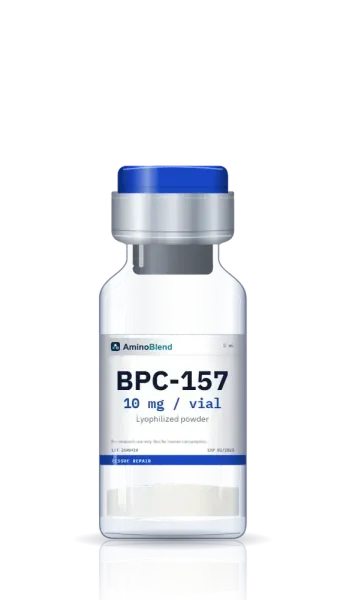
BPC-157
From $69
Research use only. AminoBlend supplies research compounds for laboratory and in-vitro use, not for human or animal consumption. By continuing you confirm you are 18 or older and buying for research.
What is GHK-Cu? It is glycyl-L-histidyl-L-lysine, a three amino acid peptide that binds a copper(II) ion, first identified in human plasma by Loren Pickart in 1973. It is studied for its effects on collagen production, wound repair and gene expression, and it is the copper peptide sold in skincare as copper tripeptide-1.
GHK is a tripeptide: glycine, histidine and lysine, in that order. On its own it is colourless. It has a strong affinity for copper(II) ions and binds them spontaneously to form the complex written GHK-Cu, which is the form sold for research and the form used in cosmetics under the name copper tripeptide-1. The copper is held by the histidine and the peptide backbone, tightly enough to carry it through tissue fluid but loosely enough to pass it on to cells.
The copper is also why the compound looks the way it does. Most lyophilized peptides are a white powder; GHK-Cu is blue, and so is the solution made from it. For a research lab, that colour is the first identity check on any vial.
What is GHK peptide on its own? It is the bare tripeptide, sold in cosmetics as tripeptide-1, with no metal attached. GHK and GHK-Cu are often used interchangeably in casual writing, but they are different reagents: one is a colourless peptide, the other a blue metal complex with a different mass. A lab ordering the peptide GHK-Cu needs the complex, and the certificate should confirm the copper-bound form.
Blue copper peptide is an informal name for the same GHK-Cu complex, taken from the colour of the powder and its solutions. It does not refer to a separate compound. When a product is described as blue copper peptide, the ingredient list should still show copper tripeptide-1.
GHK was first described by Loren Pickart and Martin Thaler in Nature New Biology in 1973. Pickart had found that a fraction of human plasma albumin made liver tissue from older donors synthesise proteins in the pattern of younger tissue. The active factor was tentatively identified as the tripeptide glycyl-L-histidyl-L-lysine. Its copper binding was characterised in later work.
GHK occurs naturally. Pickart's reviews report plasma levels of about 200 ng/mL at age 20 falling to about 80 ng/mL by age 60, a decline that has driven much of the interest in it as an ageing research target.
Most searches ask about GHK-Cu peptide benefits. In research terms, these are the lines of work with published data, from strongest human evidence to most preliminary:
The honest summary of GHK-Cu benefits is that the cell and gene data are broad, while the human evidence is limited to topical skincare trials with small numbers. Our article on GHK-Cu before and after studies sets out each trial and what it measured. Browse the source papers in our GHK-Cu research library.
The GHK-Cu peptide mechanism of action has not been pinned to a single receptor, which sets it apart from compounds such as BPC-157 or the GLP-1 agonists. Three ideas run through the literature. First, GHK binds copper(II) and can pass it to cells and copper-dependent enzymes, among them lysyl oxidase and superoxide dismutase. Second, the cell data shows GHK shifting the activity of large gene sets, which would explain why effects show up across several pathways at once. Third, early work reported GHK attracting immune and endothelial cells to a wound site. How copper peptide works in any given model probably involves more than one of these.
In skin models, what copper peptide does is mostly measured in dermal fibroblasts: collagen, elastin and glycosaminoglycan output, plus wound contraction in rodents. For hair, the research uses dermal papilla cells and mouse hair cycle studies; there is no large controlled human hair trial behind the claims made for copper peptide hair products. The cosmetic side of both questions is covered in our GHK-Cu serum and copper peptide cream guide, and what is and is not known about reactions is in the GHK-Cu side effects summary.
Three caveats apply to almost every claim you will read about GHK-Cu. First, much of the literature is summarised in reviews written by Pickart himself, the peptide's discoverer, so independent replication is thinner than the volume of citations suggests. Second, the human trials used creams, often at low concentrations, not injections. Third, gene expression data shows which genes move in cultured cells, which is not the same as showing a clinical effect.
None of that makes GHK-Cu uninteresting. It makes it a compound with a real research record that is still mostly preclinical outside of cosmetics.
Skincare containing copper tripeptide-1 is sold in Australia as cosmetics, which is a separate category from therapeutic goods. For anything beyond that, check the TGA's current guidance and the current Poisons Standard (SUSMP) rather than relying on supplier websites. AminoBlend supplies GHK-Cu only as a research chemical for laboratory use.
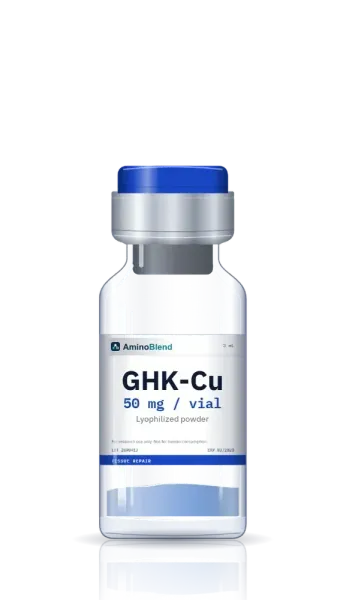
AminoBlend stocks GHK-Cu in two fills. The 50 mg vial suits new work and method development; the 100 mg vial suits labs running repeated assays from one lot and one certificate. Both are sealed in a 3 mL glass vial and are best stored frozen at minus 20 °C before reconstitution. Our GHK-Cu peptide calculator works out concentrations for either fill. GHK-Cu sits within our wider list of research peptides for sale in Australia, grouped by research area.
Look at the cake first: it should be blue. Then match the lot number on the label to its certificate of analysis, which should confirm identity by mass spectrometry and purity by HPLC. Every AminoBlend lot is tested this way by an independent laboratory, and the certificates are on our lot-matched COA lookup. Our guide on reading a certificate of analysis explains each line of the report.
We sell GHK-Cu strictly for laboratory research; it is not for use in people or animals.
A copper peptide is a short peptide that binds a copper ion, and GHK-Cu is the best studied one. What does GHK-Cu peptide do in the lab? It is reported to raise collagen and glycosaminoglycan output in fibroblast cultures, to influence wound contraction in animal models, and to shift the expression of genes linked to repair and antioxidant defence. What is copper peptide research beyond GHK-Cu? Mostly analogues such as AHK-Cu, measured against GHK-Cu as the reference.
Copper peptides are used in two places that rarely overlap. In cosmetics, copper tripeptide-1 goes into serums, creams and hair products at parts per million, and our peptides for skin guide puts it alongside the other cosmetic peptides. In laboratories, pure GHK-Cu is used as a reference compound in fibroblast, wound, gene expression and copper transport studies, bought as a dry powder with a lot certificate, as explained on our lab tested peptides page.
Every copper peptide is a peptide, but very few peptides carry copper. A peptide is any short chain of amino acids joined by peptide bonds; the peptide glossary defines the terms. A copper peptide is one whose sequence happens to grip a copper ion, as the histidine in GHK does. Signal peptides such as palmitoyl pentapeptide-4 and neurotransmitter-type peptides such as acetyl hexapeptide-8 contain no metal at all, which is why a multi-peptide serum and a copper peptide serum are different products.
Buying GHK-Cu comes down to how much work one lot has to cover. For method development, buy the 50 mg GHK-Cu vial at $49; once an assay runs repeatedly, the 100 mg fill at $79 brings the cost per milligram down by about a fifth. Labs new to reconstitution should buy the GHK-Cu Starter Kit ($59), which pairs the 50 mg vial with a small vial of diluent and one insulin syringe. For skin and repair studies that combine compounds, the GLOW blend is a 70 mg vial built around 50 mg of GHK-Cu plus BPC-157 and TB-500. Shop online from Australian stock, look for the blue cake once the vial is in hand, and place your order with the lot certificate already checked.
GHK without copper weighs about 340 daltons, and adding the copper ion brings the complex to roughly 400. That makes it one of the smallest compounds in the range: BPC-157 is about 1,419 daltons, and many research peptides are larger still. Its small size and single defined mass make the mass spectrometry check on a GHK-Cu certificate straightforward to read.
Before mixing, the cake should be an even blue, with no white patches. Dissolved in bacteriostatic water, it should give a clear blue solution with no cloudiness or specks. Adding 2 mL to the 50 mg fill gives 25 mg per mL, and the same volume in the 100 mg vial gives 50 mg per mL; the GHK-Cu calculator works out other volumes.
The dry blue cake is held at minus 20 °C for long-term storage, or at 2 to 8 °C for short periods, and shielded from light. Once reconstituted, the blue solution goes into the fridge at 2 to 8 °C and is used within 28 days. Copper complexes can be disturbed by strong acids and reducing agents, so GHK-Cu stock is best kept apart from those in the lab.
Copper tripeptide-1 is the cosmetic ingredient name for the same complex, used at low levels in creams and serums that AminoBlend does not make or sell. The research vial is the pure compound with a lot certificate. GHK-Cu also appears as the largest part of the GLOW blend and as one of four components in KLOW, and as the 50 mg vial in the GHK-Cu Starter Kit.
GHK-Cu is the tripeptide glycyl-L-histidyl-L-lysine (glycine, histidine, lysine) bound to a copper(II) ion. The peptide itself is colourless; the bound copper makes the powder and its solution blue. In cosmetic ingredient lists the same complex is called copper tripeptide-1.
In research, GHK-Cu stimulates collagen synthesis in fibroblast cultures, has been studied in animal wound healing models, and changes the expression of a large number of human genes in cell data. Small human trials of topical creams reported increased skin density and reduced wrinkle depth over 8 to 12 weeks. Injected use has limited human data.
The best documented are increased collagen production in cell culture and in one small biopsy study, and improvements in wrinkle depth, skin density and thickness in topical cream trials of 40 to 71 women. Wound healing findings come mainly from animal models, and gene expression findings from cell-based data.
GHK-Cu is not an approved medicine in Australia and has no ARTG entry for therapeutic use. GHK-Cu was one of the unapproved peptide products listed in an April 2026 TGA safety alert, which noted that none had been assessed for safety, quality or effectiveness. Copper tripeptide-1 skincare is sold as cosmetics. Check current TGA guidance for your situation; this is not legal advice.
The blue colour comes from the copper(II) ion bound to the peptide. Plain GHK without copper is colourless, so a white cake in a vial labelled GHK-Cu suggests the copper complex is missing. A genuine vial shows a blue powder and gives a clear blue solution when reconstituted.
AminoBlend sells GHK-Cu online for laboratory research from Australian stock, in 50 mg ($49) and 100 mg ($79) vials or as a starter kit with diluent and a syringe ($59). Independent identity and purity results for every lot sit in the COA library. We supply only the research form, not copper peptide serums or cosmetics.
10 mg vial
