
BPC-157
From $69
Research use only. AminoBlend supplies research compounds for laboratory and in-vitro use, not for human or animal consumption. By continuing you confirm you are 18 or older and buying for research.
In stock, ready to ship from Australia
Size: 10 mg vial
Buy TB-500 online in Australia as a single 10 mg lyophilised vial for $79, shipped from local stock with its lot certificate already published. You are ordering the acetylated heptapeptide Ac-Leu-Lys-Lys-Thr-Glu-Thr-Gln, the actin-binding motif found at positions 17 to 23 of thymosin beta-4, not the full 43-residue protein. Its identity markers are C38H68N10O14, 889.0 g/mol and CAS 885340-08-9, and the measured mass on each certificate shows at a glance which molecule the vial holds. Every lot is checked by mass spectrometry and HPLC before it reaches the shelf. Order with the TB-500 calculator open, since it gives the concentration for any volume of diluent. To compare two repair pathways in one order, add BPC-157, the gastric pentadecapeptide studied for growth factor signalling. The powder arrives without liquid, so bacteriostatic water belongs in the same cart. Store the sealed vial at -20 °C, dark and dry, and move the solution to the fridge once mixed. Supplied as a research reagent to buyers aged 18 and over.
For laboratory research use only. Not for human or veterinary use. Not TGA approved. See our research use policy.
| Name | TB-500 (acetylated thymosin beta-4 fragment 17-23) |
|---|---|
| Sizes and prices (AUD) | 10 mg lyophilised vial at $79 |
| Sequence or structure | Ac-Leu-Lys-Lys-Thr-Glu-Thr-Gln (Ac-LKKTETQ) |
| Length | 7 amino acids, N-terminally acetylated |
| Molecular formula | C38H68N10O14 |
| Molar mass | 889.0 g/mol |
| CAS number | 885340-08-9 |
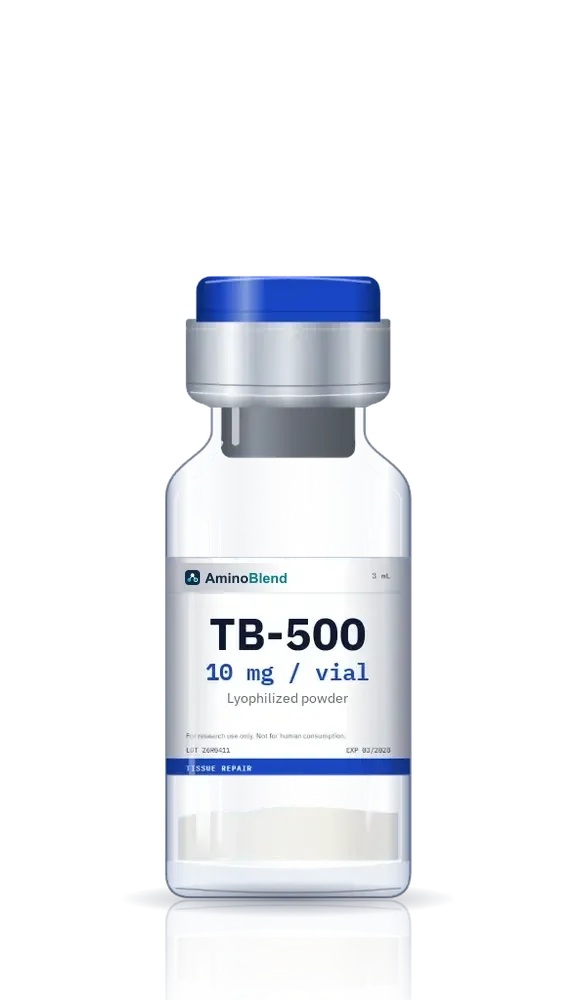
| Form | White freeze-dried cake in a sealed 3 mL glass vial with a blue flip-off cap |
| Testing | Mass spectrometry for identity and HPLC for purity, with a certificate published for each lot |
| Contents | One vial of 10 mg TB-500 powder per unit, with bacteriostatic water sold as a separate item |
| Storage | Sealed at -20 °C away from light and moisture, then 2 to 8 °C after reconstitution |
| Availability | In stock |
| Use | In vitro laboratory research only |
Order TB-500 knowing exactly what the vial contains. The name is used loosely across the market, while ours always means the 889 g/mol heptapeptide, proven lot by lot. One fill keeps the choice simple and the paperwork short.
TB 500 is a short synthetic heptapeptide that reproduces the part of thymosin beta-4 responsible for gripping actin, the protein cells assemble into filaments whenever they crawl, divide or change shape. Think of it as the working tip of a much larger tool, cut out and made on its own so that labs can ask whether the tip does the job unaided.
Actin exists in two states inside a cell. Single units, called G-actin, float free in the cytoplasm, and filaments, called F-actin, form when those units click together at the leading edge of a moving cell. Thymosin beta-4 binds the free units one to one and parks them, which keeps a ready stockpile on hand without letting filaments grow out of control. When a cell needs to move toward a scratch or wound edge, that stockpile is released and filaments extend quickly. The LKKTETQ stretch is the contact point for that binding, and a near-identical LKKTET motif turns up in the WH2 domains of other actin regulators, which tells you how central the sequence is to actin handling across many proteins.
The best evidence that the motif carries real activity by itself comes from Deborah Philp, Hynda Kleinman and colleagues, who reported in The FASEB Journal in 2003 that the actin-binding heptapeptide matched full-length thymosin beta-4 in endothelial cell migration and aortic ring sprouting assays, while versions missing part of the motif were inactive. That is cell and tissue explant work, not an animal efficacy trial, but it is the paper that justifies studying the fragment at all.
Here is the misunderstanding we see most. People treat TB500 peptide and thymosin beta-4 as one compound with one literature, then read a cardiac or corneal paper as if it applied to the vial. It usually does not. Pick assays where the actin connection can be measured directly, add a scrambled heptapeptide as a negative control, and the fragment's own data will stand up. Our full guide to the TB-500 fragment lists the protein-level studies that are so often borrowed.
Thymosin beta-4 was first isolated from calf thymus by Allan Goldstein's group and later found in almost every cell, where it holds monomeric G-actin in reserve. Mapping studies traced much of that actin-binding activity to the short LKKTETQ stretch, and TB-500 is a synthetic copy of that motif with an acetyl cap that shields it from aminopeptidases.
Buy it to test a sharp question. How much of the parent protein's effect on cell migration does the seven-residue motif carry on its own? The answer is still open, since most published work used full-length thymosin beta-4. TB-500 is a research reagent, holds no TGA approval and is not a medicine. Browse the recovery peptides range for neighbouring compounds.
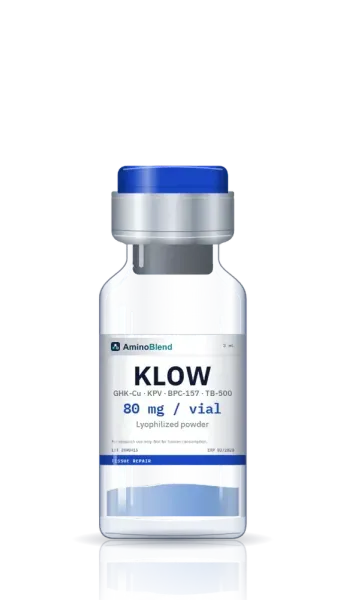
Each TB-500 unit is one 3 mL glass vial holding 10 mg of white lyophilised powder and nothing else: no diluent, no carrier peptide, no second compound. The heptapeptide also appears as one ingredient in three premixed vials on this site, namely the Wolverine Blend, KLOW and GLOW, but this listing is the stand-alone fragment for studies that need it measured on its own.
Regulators treat it far more strictly than its small size suggests. Following a referral to the Advisory Committee on Medicines Scheduling, the TGA added thymosin beta-4 and TB-500 to the Poisons Standard as Schedule 4 (prescription only) substances, and as of October 2026 no medicine containing either is approved by the TGA or registered on the ARTG. Healthy Male, the Australian men's health organisation, notes that calling a vial "for research only" does not make it lawful to possess or use without a prescription. So TB-500 Australia listings come almost entirely from research suppliers, because no registered product exists to sell through any other channel.
Thymosin beta-4 is familiar to Australians for another reason: it was the substance at the centre of the Essendon Football Club supplements case, in which the Court of Arbitration for Sport found 34 players guilty of anti-doping violations in January 2016. WADA lists thymosin beta-4 and its derivatives, TB-500 included, under S2 (peptide hormones, growth factors and related substances), prohibited at all times, and Sport Integrity Australia applies that list here.
If you plan to buy TB500 for a lab project, AminoBlend holds the 10 mg vial in Australian stock as a research reagent for in vitro work, sold only to adults aged 18 and over and never for human or veterinary use. Our TB-500 background guide covers the fragment's origins and the papers behind it.
Shop a single fill, the 10 mg vial at $79, which works out at $7.90 per mg. That size covers a typical cell migration series or a rodent study plan, and because reconstituted peptide is best used within weeks, a moderate fill limits waste if a project pauses.
Ordering several vials in one checkout keeps them on one lot wherever stock allows, so one certificate documents every run in the series. Only adults aged 18 or older may buy TB 500, confirming their age and laboratory purpose before payment.
The heptapeptide is rich in lysine and threonine, which keeps it very soluble in water, and its N-terminal acetyl group adds 42 mass units to the bare chain. Those details matter on the certificate, where the measured mass should read close to 889 g/mol, far from the roughly 4963 g/mol of full-length thymosin beta-4.
Buy after checking the HPLC trace and its purity figure, which sit on the same report, filed by lot number in our certificate library. Read it before ordering, then compare the code on your label when the vial arrives.
The same check protects your write-up. Before setting your data beside a published paper, confirm which molecule the authors actually used, since many thymosin studies worked with the full recombinant or synthetic protein rather than the fragment. A lab that records the lot code, the measured mass and the HPLC figure in its notebook can show reviewers exactly what went into every well and every animal group. That record is the strongest reason to buy from a supplier that publishes its certificates instead of describing them.
There is no counter to visit and no click-and-collect. TB-500 is ordered online from this page and dispatched from our Australian stock to any address, city or regional, including labs sourcing research peptides in Perth. Place the order before 3pm on a business day and it goes out the same afternoon, with progress shown on the order tracking page.
Order bacteriostatic water as well if your bench supply is low. Bring the vial to room temperature, add a measured volume against the glass wall and roll it slowly until clear, without foaming. With 2.5 mL in the 10 mg vial you get 4 mg/mL, and the TB-500 concentration calculator works out every other volume.
Keep unopened vials frozen at -20 °C in the dark. The solution lives in the fridge at 2 to 8 °C, ideally divided into small aliquots so one portion thaws at a time.
Labels vary, and TB-500, TB 500, TB500 and thymosin beta-4 fragment all appear, as do the sequence forms Ac-LKKTETQ and acetyl-LKKTETQ-OH. Some catalogues also call it thymosin beta-4 (17-23) or the Tb4 actin-binding fragment. Each of these refers to the acetylated seven-residue chain with CAS 885340-08-9.
Full-length thymosin beta-4, also referred to by its gene name TMSB4X, is a different and much larger molecule. The receptor-free vocabulary around the fragment centres on G-actin sequestration, lamellipodia and cell motility.
Pick TB-500 when the question is about the cytoskeleton, actin turnover and how cells crawl into a wound edge in culture. Pick BPC-157, at $69 for 10 mg, when the focus is growth factor signalling, nitric oxide or gut lining models. Separate vials let you set each amount and keep single-compound controls. The BPC-157 vs TB-500 comparison covers both mechanisms in more depth.
Shop the Wolverine Blend for a protocol that has already settled on equal amounts of both, as it combines 5 mg of each in one vial.
TB-500 copies the short stretch of thymosin beta-4 that grips actin, the protein scaffold cells use to move. It is a synthetic, acetylated heptapeptide.
Buy one sealed 10 mg vial of dry powder for $79. No liquid comes with it, so bacteriostatic water is added to the cart as its own item.
It is used in cell culture and animal models to study how cells migrate and how tissue reorganises after injury. These are research mechanisms, not medical uses.
BPC-157 is twice as long and comes from a stomach protein, acting through other pathways. Full thymosin beta-4 is six times longer than TB-500.
Freezer for the powder, fridge for the solution, darkness for both. Aliquots avoid the repeated freeze and thaw cycles that wear a peptide down.
Each lot is tested by HPLC and mass spectrometry, and a reading near 889 g/mol confirms the fragment. Certificates are public before purchase.
Buy the 10 mg vial by adding it to your cart for $79 and completing checkout on this page. The vial ships from Australian stock, leaving the same afternoon when the order is placed before 3pm on a business day. Include bacteriostatic water if you need diluent, and confirm at checkout that you are 18 or older.
You buy it online here, because AminoBlend has no retail shop or pickup point anywhere. The same 10 mg vial, with its published lot certificate, reaches a lab in Perth, Cairns or Wagga Wagga, with tracked delivery from local stock and timeframes listed on our delivery information page.
Proof of identity matters most. The best TB500 peptide for a study is the one whose certificate shows a measured mass near 889 g/mol, an HPLC purity figure and a lot code that matches the vial. Every lot we sell is analysed by an independent laboratory and published in our COA library before you order.
Choose TB-500 for actin, cytoskeleton and cell migration questions, and BPC-157 for growth factor, nitric oxide or gut lining work. They are unrelated molecules, so many labs order both as separate vials with their own controls. A protocol fixed at equal amounts can use the Wolverine Blend instead.
No. Thymosin beta-4 is a 43 amino acid protein of about 4963 g/mol, while our TB-500 is its acetylated 17 to 23 fragment of 889 g/mol. The certificate mass tells the two apart instantly, which matters when you compare your results with papers that used the full protein.
It is a tool for isolating the actin-binding motif of thymosin beta-4. Labs use it in scratch assays, endothelial and keratinocyte migration studies and rodent tissue models to ask whether the short fragment reproduces effects reported for the whole protein. It is supplied for in vitro and laboratory research only.
10 mg vial
10 mg vial
80 mg vial