
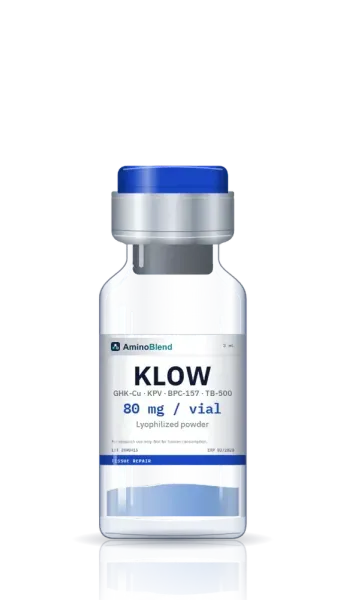
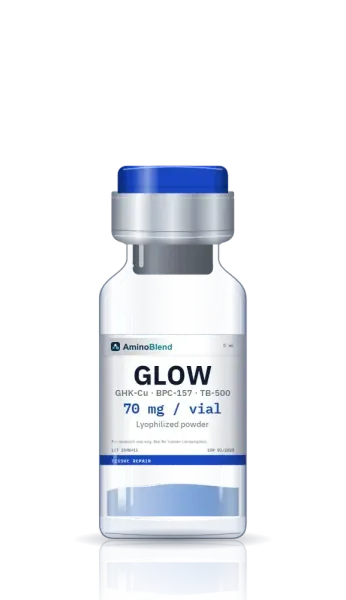
KLOW
80 mg vial
$139
Research use only. AminoBlend supplies research compounds for laboratory and in-vitro use, not for human or animal consumption. By continuing you confirm you are 18 or older and buying for research.
In stock, ready to ship from Australia
Buy GHK Cu peptide online in Australia in 50 mg ($49) and 100 mg ($79) vials of blue lyophilised powder. Labs that buy GHK Cu peptide Australia wide receive tested lots from local stock. Each vial holds glycyl-L-histidyl-L-lysine bound to a copper(II) ion, a tripeptide first found in human plasma in 1973 and today the most studied of all copper peptides in collagen, matrix and copper transport research. Check the identity data before you order, namely C14H22CuN6O4, 401.9 g/mol and CAS 89030-95-5. Every lot is tested by mass spectrometry for identity and by HPLC for purity, with the certificate open ahead of checkout. The GHK-Cu calculator converts your diluent volume into a concentration. Shop the GLOW blend in the same order to study the copper peptide beside two repair peptides. Vials ship as powder without diluent, so add bacteriostatic water or pick the starter kit that includes it. Keep the sealed vial at -20 °C and away from light. This is a research reagent only, sold to adults aged 18 and over.
For laboratory research use only. Not for human or veterinary use. Not TGA approved. See our research use policy.
| Name | GHK-Cu (copper tripeptide-1) |
|---|---|
| Sizes and prices (AUD) | 50 mg vial $49, 100 mg vial $79 |
| Sequence or structure | Gly-His-Lys complexed with copper(II) |
| Length | 3 amino acids |
| Molecular formula | C14H22CuN6O4 |
| Molar mass | 401.9 g/mol |
| CAS number | 89030-95-5 |
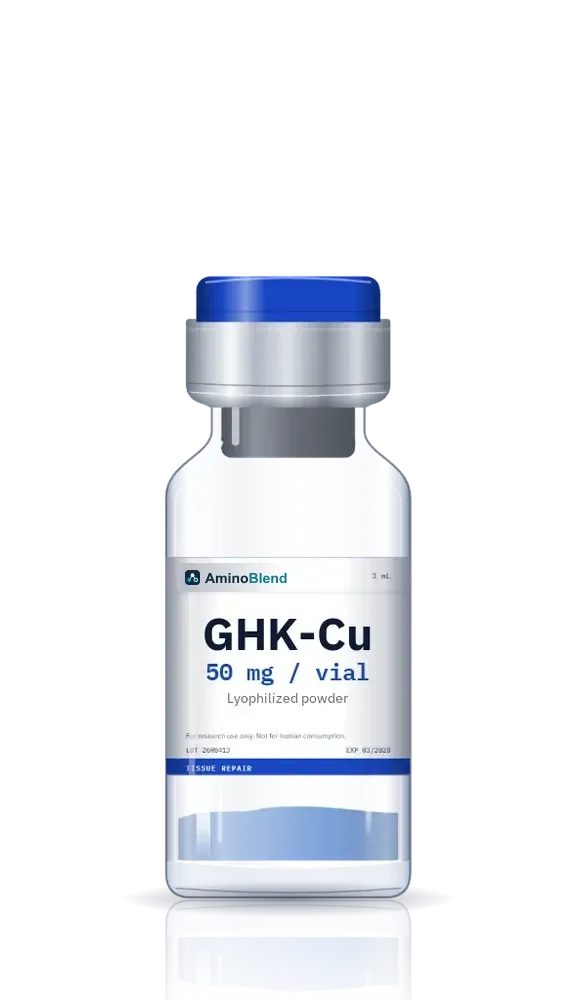
| Form | Blue lyophilised powder in a sealed 3 mL glass vial with a blue cap |
| Testing | Mass spectrometry for identity and HPLC for purity, certificate issued per lot |
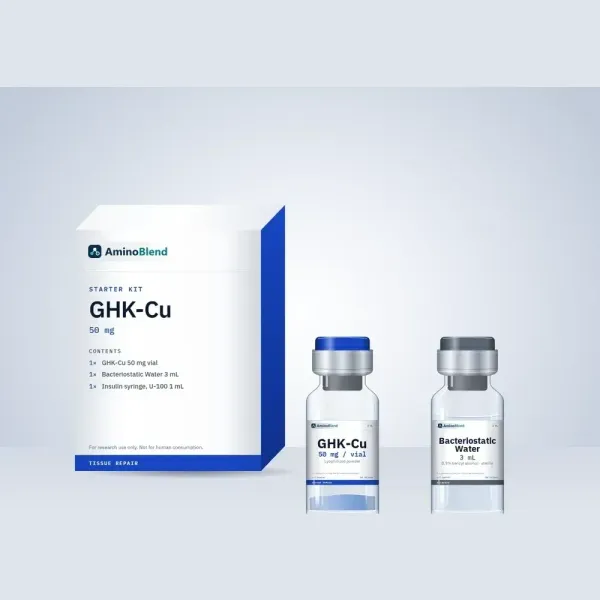
| Contents | One vial of 50 mg or 100 mg GHK-Cu, diluent sold separately or in the starter kit |
| Storage | -20 °C sealed, dark and dry, then 2 to 8 °C in solution |
| Availability | In stock, 50 mg and 100 mg fills |
| Use | Laboratory in vitro research only |
Order the fill that matches your assay load, the 50 mg vial for a first order or the 100 mg vial for repeated runs. The blue colour of the cake comes from the bound copper and is the first thing to check when the parcel arrives. Both sizes sit in Australian stock with a certificate published for every lot.
GHK-Cu is a tiny peptide built from just three amino acids (Gly, His and Lys) that holds a single copper ion, and it acts in research models as a carrier that moves copper to where cells and enzymes need it. Unlike most compounds in our catalogue, it also occurs naturally, circulating in human plasma at measurable levels.
The copper sits in a pocket formed by three nitrogen atoms at the glycine-histidine end of the chain. The lysine at the far end stays free, with its long positively charged side chain available to interact with cell surfaces. That arrangement grips copper(II) firmly, yet published comparisons put its affinity in roughly the same range as the high-affinity copper site on serum albumin, so the two can trade copper back and forth. In other words GHK is a shuttle, not a vault. Copper is a working part of enzymes that build and protect connective tissue, including lysyl oxidase, the enzyme that ties neighbouring collagen strands together, and the antioxidant enzyme superoxide dismutase, and handing it over in a soluble, non-toxic form is the leading explanation for much of what the peptide does in culture.
Plasma is not the only source. In 1994 Lane, Iruela-Arispe, Sage and colleagues showed in The Journal of Cell Biology that breaking down SPARC, a matrix protein secreted around injured tissue, releases GHK and the longer KGHK, and that these fragments stimulated new blood vessel growth in their assays. The same tripeptide sequence also sits inside the alpha 2 chain of type I collagen. One working idea, still a hypothesis, is that damaged matrix frees GHK at exactly the place where repair has to start, which is why copper peptides for wound healing became the earliest strand of this research.
Here is the design point most copper peptide skin studies miss. Free copper salts have biological effects of their own, so a result from GHK-Cu alone cannot tell you whether the peptide or the metal did the work. We recommend three arms as a minimum: the GHK Cu peptide complex, the bare GHK tripeptide and a copper salt such as copper(II) chloride matched for copper content. Serum in the medium also carries albumin that will swap copper with the peptide, so record the serum percentage in every method. The full guide to GHK-Cu covers its discovery and the gene expression data.
Loren Pickart described the Gly-His-Lys tripeptide in 1973 after isolating it from the albumin fraction of human plasma, and his early papers on copper binding still anchor the field. What you receive is the synthetic version, supplied as the ready-formed complex in which nitrogen atoms of the peptide hold the Cu2+ ion and tint the powder and its solutions blue. Plasma levels of GHK were later reported to fall with age, a finding that shaped much of the research that followed.
Laboratories buy this copper peptide GHK-Cu to ask how a small copper carrier influences fibroblast output of collagen, elastin, decorin and glycosaminoglycans, and how it tips the balance between matrix metalloproteinases and their inhibitors. Rodent wound models extend the cell data, and gene expression datasets such as the Connectivity Map have linked GHK to broad expression changes that remain correlative. Copper peptides for skin research and copper peptides hair follicle studies both draw on that work, yet the vial is a research reagent, not a cosmetic or medicine. Shop related compounds in the skin and hair peptides range.
How do copper peptides work in these models? The leading view is that GHK delivers copper to enzymes such as lysyl oxidase, which cross-links collagen and elastin. Copper peptides for hair research centres on dermal papilla cells and follicle explants, where copper peptide hair growth studies measure follicle size and cell proliferation in culture and in mice. Copper peptides skin studies track fibroblast output instead, and copper peptide skin explant models add tissue structure to those readouts. Published copper peptides collagen data come almost entirely from cells and animals, and copper peptides for wound healing work in rodents is the oldest strand of GHK Cu peptide research. The peptides for skin guide sets these study types side by side, while the GHK-Cu lab results guide explains what GHK Cu peptide studies can and cannot show.
Many people first meet this molecule on a skincare label, where it appears under its cosmetic ingredient name, copper tripeptide-1, usually at a small percentage inside a serum or cream base. A research vial is a different object entirely. Ours holds 50 mg or 100 mg of the neat copper complex as a dry blue cake, with no emulsifier, preservative, fragrance or carrier, and it is labelled and sold as a laboratory reagent rather than a finished consumer product. The two share an active molecule and nothing else.
That distinction drives the regulation. A cosmetic that makes only cosmetic claims is handled in Australia under the industrial chemicals scheme run by AICIS and consumer law, not as a therapeutic good. Pure GHK-Cu offered for injection or other therapeutic use falls under the TGA, and in April 2026 the TGA named GHK-Cu, alongside BPC-157, TB-500, retatrutide and CJC-1295, in an advisory on unapproved peptide products that are not included in the ARTG and have not been assessed for safety, quality or efficacy. As of October 2026 there is no registered GHK-Cu medicine in Australia, which is why GHK-Cu Australia searches for the pure compound lead to research suppliers rather than pharmacies.
So when labs ask about GHK-Cu peptide where to buy in Australia, the realistic answer is a reagent supplier with its own analytical data. You can buy GHK Cu peptide Australia stock from AminoBlend in either fill, held locally as a research chemical for in vitro work, sold to adults aged 18 and over, and not for human or veterinary use. The same copper complex is what colours the KLOW four-peptide vial, and our GHK-Cu background guide covers its discovery and chemistry in more depth.
The 50 mg vial at $49 suits method development, smaller assay runs and labs new to copper peptides, and it is the same fill used in the GHK-Cu Starter Kit with diluent and a syringe. The 100 mg vial at $79 costs noticeably less per milligram and suits teams running repeated plates over several weeks. That puts the GHK Cu peptide price at $49 or $79 depending on fill, and the GHK Cu peptide cost per milligram drops with the larger vial.
Buy GHK copper peptide for a whole series in one go so every vial shares a single lot wherever stock allows and one certificate covers the work. Tripeptide synthesis is short, so GHK-Cu peptides are handled in tens of milligrams rather than single figures, which explains why these fills are larger than most of our range. Checkout is open only to adults aged 18 and over.
Two quick checks confirm you hold the complex and not the bare peptide. The cake should be clearly blue, and the measured mass on the certificate should match the copper-bound form near 401.9 g/mol, whereas a white cake suggests the copper is missing. HPLC then reports the purity figure for that specific lot beside the date of analysis. The same blue copper peptide tint is the GHK Cu peptide colour to expect in every GHK Cu peptide vial we ship, lot after lot.
Reports are listed by lot code in the COA library and can be read before you order. Labs comparing GHK Cu peptides from several suppliers can line those certificates up against this one. When preparing stock solutions by weight, remember that chromatographic purity and net peptide content are separate figures, which matters to anyone after a pure copper peptide powder with a known peptide mass.
The GHK Cu copper peptides we stock are sold online only, with no shopfront, and every order is packed from Australian stock and sent by tracked delivery nationwide. Anything ordered before 3pm on a business day is dispatched that day. For labs weighing GHK-Cu peptide where to buy in Australia, the answer is a supplier holding local stock with a published certificate, which is also how to get GHK Cu peptide to the bench without an import wait. Buy copper peptides from this page and we send GHK peptide Australia wide, so the copper peptide Australia labs receive is the same tested complex in either fill. Most teams make the GHK Cu peptide buy decision on fill size alone.
Let the vial reach room temperature, add bacteriostatic water slowly along the glass and swirl, since GHK-Cu dissolves quickly. As an example, 2 mL in the 50 mg vial gives 25 mg/mL, and 2 mL in the 100 mg vial gives 50 mg/mL. Avoid buffers containing EDTA or reducing agents, which strip or alter the copper. The GHK-Cu reconstitution calculator handles other volumes.
How to store GHK Cu peptide comes down to cold, dark and dry conditions for the GHK-Cu peptide powder. Freeze the sealed vial at -20 °C, protected from light. Keep solutions at 2 to 8 °C in aliquots and use them within 28 days, and discard any solution that turns green, clouds over or loses its blue colour.
The same complex appears as GHK-Cu, GHKCu, the GHKCu copper peptide, GHK copper peptide, copper GHK, copper tripeptide-1 (its cosmetic ingredient name) and glycyl-L-histidyl-L-lysine copper(II). Papers often shorten it to GHK peptide or simply GHK, and supplier lists group it with other copper peptides such as AHK-Cu, which is a different sequence. You will also see peptide GHK-Cu and copper peptides GHK Cu used for this same vial. Order listings may read GHK Cu peptide 50mg or GHK Cu peptide 100mg, and older catalogues file GHKCu copper peptides, GHK copper peptides or Cu GHK peptide under the same entry. The difference between peptides and copper peptides is the bound metal ion, since GHK without copper is the bare tripeptide and behaves differently in assays.
All of these names point to CAS 89030-95-5 and the formula C14H22CuN6O4. Reviews that list GHK-Cu peptide benefits are summarising cell culture and animal findings, not claims made for this product. The same holds for copper peptide benefits, the benefits of GHK peptide and the benefits of copper peptides for skin cells described in the literature, each measured in culture, tissue explants or animal models. Matrix biology terms that travel with it include fibroblast, collagen I and III, decorin, MMP and TIMP, and copper chaperone.
Buy GHK-Cu on its own when copper is the variable you want to isolate or when the tripeptide concentration must be set independently. Buy GLOW when a protocol already calls for GHK-Cu with BPC-157 and TB-500 at a 50 to 10 to 10 ratio in one vial. A blend cannot be rebalanced after mixing, so separate vials keep more control.
The guide GLOW vs KLOW sets out how the two blends differ, and both contain the same copper peptide this page sells alone.
GHK-Cu is glycine, histidine and lysine holding a single copper ion, a small molecule first detected in human plasma and now made synthetically.
The 50 mg vial is $49 and the 100 mg vial is $79. Both contain blue powder with no diluent, so add bacteriostatic water or choose the starter kit.
It is studied in fibroblast culture and animal wound models for collagen production, matrix turnover and copper transport, strictly inside the laboratory. GHK Cu peptide for skin research relies on dermal fibroblasts and explants.
GLOW mixes GHK-Cu with BPC-157 and TB-500 in one vial, while the single vial lets you work with the copper peptide alone.
Freeze the sealed vial, then refrigerate the solution in aliquots. Throw out any solution that turns green or fades.
Mass spectrometry and HPLC check every lot, and the certificate is stored in the COA library under the lot code on the vial.
Buy it here, from the AminoBlend online store, which delivers to every Australian state and territory from local stock. Choose the 50 mg or 100 mg vial, add it to your cart and check out, with same-day dispatch for orders placed before 3pm on a business day. There is no shop or collection point, so every lab orders the same way.
AminoBlend has no shopfront, so the research vial is ordered online and sent by tracked delivery from Australian stock to any suburb or regional town. Retail skincare shelves carry formulated cosmetics, which belong to a different category from this lyophilised reagent. Ordering online also lets you read the lot certificate before paying.
The 50 mg vial at $49 is the sensible first order for pilot runs and method work. The 100 mg vial at $79 gives better value per milligram for teams running repeated assays, provided the solution can be used within 28 days of mixing. Order several vials together if you want them on one lot wherever stock allows.
The colour comes from the copper(II) ion held by the histidine and glycine nitrogens of the tripeptide. A strong blue cake in a GHK-Cu vial is expected and shows the complex has formed. A white or very pale cake points to missing copper, and a green or cloudy solution should be discarded.
Yes, mass spectrometry confirms the copper complex and HPLC measures purity on every lot, and the certificate is posted in the COA library under the lot code on your vial. Check that the powder is blue on arrival too, then file the lot code with your study notes.
No, it is supplied as a research reagent for in vitro laboratory work and sold only to adults aged 18 and over. It is not formulated, labelled or approved as a cosmetic, therapeutic good or skin treatment, and it is not intended for human or veterinary use.
80 mg vial
Kit
Bundle
70 mg vial