
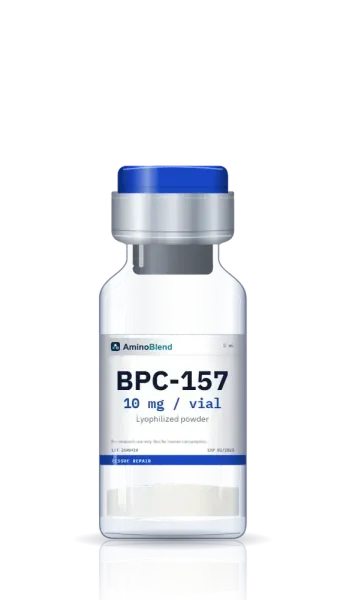
BPC-157
From $69
Research use only. AminoBlend supplies research compounds for laboratory and in-vitro use, not for human or animal consumption. By continuing you confirm you are 18 or older and buying for research.
To reconstitute a peptide, let the sealed vial reach room temperature, wipe the rubber stopper with an alcohol swab, then add a measured volume of bacteriostatic water slowly down the inside wall of the glass and swirl gently until the powder disappears into a clear solution. The concentration you finish with is the peptide mass divided by the water volume, so 10 mg in 2 mL gives 5 mg/mL. Write that figure and the date on the label and keep the vial at 2 to 8 °C. The rest of this page covers diluent choice, exact volumes for each vial size, and what to do when a cake refuses to dissolve.
Set everything out before the first cap comes off. Hunting for a swab halfway through is how stoppers get touched and volumes get forgotten.
One buying tip from the orders we pack: a single 5 mg or 10 mg vial rarely needs more than 3 mL of diluent. The 30 mL bottle only makes sense when a lab is reconstituting several vials over a few weeks, otherwise most of it sits unused past its use window.
Choose the diluent first, because it decides how long the solution stays usable and whether some sequences dissolve at all.
| Diluent | Composition | Use it when | Limitation |
|---|---|---|---|
| Bacteriostatic water | Sterile water with 0.9% benzyl alcohol | The vial will be drawn from several times over a few weeks at 2 to 8 °C | The benzyl alcohol can be a confounder in some cell culture work |
| Sterile water | Sterile water, no preservative | The stock is used once, or aliquoted and frozen on the day | Nothing slows microbial growth once the stopper is pierced |
| 0.6% acetic acid | Dilute sterile acetic acid, mildly acidic | A basic or hydrophobic sequence stays cloudy in neutral water | The lower pH may need buffering before it suits an assay |
Our recommendation for almost everything in the catalogue is bacteriostatic water. Keep a 3 mL vial of 0.6% acetic acid on the shelf as a fallback rather than a first choice.
The water never changes how much peptide is in the vial. It only sets the concentration. Two formulas cover every case:
Convert units before dividing: 1 mg is 1,000 mcg and 1 mL is 1,000 µL. Half the errors we see in customer emails come from switching between mcg and mg mid-calculation.
| Vial size | Diluent added | Concentration | Peptide in 0.1 mL | Volume holding 250 mcg |
|---|---|---|---|---|
| 5 mg | 1 mL | 5 mg/mL | 500 mcg | 0.05 mL |
| 5 mg | 2.5 mL | 2 mg/mL | 200 mcg | 0.125 mL |
| 10 mg | 2 mL | 5 mg/mL | 500 mcg | 0.05 mL |
| 10 mg | 2.5 mL | 4 mg/mL | 400 mcg | 0.0625 mL |
| 20 mg | 2 mL | 10 mg/mL | 1,000 mcg | 0.025 mL |
| 50 mg | 2.5 mL | 20 mg/mL | 2,000 mcg | 0.0125 mL |
Pick a volume that keeps the arithmetic clean. Adding 2 mL to a 10 mg vial gives round numbers; 3 mL leaves you carrying 3.33 through every dilution. If the volume you need to measure falls below about 0.02 mL, add more diluent so the transfer stays within the accurate range of your syringe or pipette. Our peptide reconstitution calculator runs these numbers for any vial size.
Blend vials such as the Wolverine Blend or the CJC-1295 and Ipamorelin Blend hold two compounds in one cake. Calculate on the component you are measuring, using the per-component amount on the label, not the vial total, or every figure will be out by the ratio of the blend. NAD+ (500 mg) and glutathione (1,500 mg) come in 10 mL vials precisely because their fill weight needs more liquid to dissolve, so plan on a larger diluent volume for those.
Every lyophilised vial in our range needs a diluent before use. Three formats do not: the BPC-157 and SLU-PP-332 capsules come ready in 60-count bottles, and the DSIP, Selank and Semax nasal sprays come as 10 mL solutions. If you are ordering vials, add a matching diluent to the same order rather than buying it separately later. All products are supplied for laboratory research only and are not for human or veterinary use. Once your stock is made up, the peptide storage guide explains how long it keeps and how to aliquot it.
Everything this method calls for can be bought online from one Australian stock list. Buy bacteriostatic water in 3, 10 or 30 mL vials from $9, with a U-100 syringe bundled if you need one, and buy 0.6% acetic acid at $9 for peptides such as IGF-1 LR3 that dissolve better in dilute acid. A 30 pack of insulin syringes costs $20 and covers both the water transfer and small-volume measuring. Then shop the peptide itself, from BPC-157 to the metabolic range, with a lot-matched certificate for every vial. Shop the lab supplies range for the rest, and order the diluent with the vial so both are on the bench when you start step one.
Reconstitution turns the dry lyophilised cake back into a solution by adding a measured volume of liquid. The peptide itself is unchanged; the liquid simply gives it a known concentration so a lab can draw exact amounts. Once dissolved, though, it is far less stable than the powder was.
For nearly every compound we sell, bacteriostatic water is the right starting point, because its 0.9% benzyl alcohol lets the vial be drawn from repeatedly. Reach for 0.6% acetic acid only when a sequence stays cloudy in water or its solubility notes call for it.
Choose a volume that lands on a round concentration. Adding 2.5 mL to a 5 mg vial gives 2 mg/mL, while 1 mL into the same vial gives 5 mg/mL. Round figures mean fewer arithmetic slips later, and the peptide reconstitution calculator handles any awkward combination.
A 1 mL barrel with fine graduations measures small volumes far better than a large syringe. Our U-100 insulin syringes are 1 mL, 29G and marked in units, with 10 units equal to 0.1 mL, which suits adding diluent to a 3 mL peptide vial.
Made with bacteriostatic water and kept at 2 to 8 °C away from light, a mixed vial is generally used within 28 days. Made with plain sterile water, plan on a few days only, or split it into single-use aliquots and freeze them on the day of mixing.
Most labs add 2 mL to a 10 mg vial, which gives a 5 mg/mL stock where every 0.1 mL holds 500 mcg. There is no single correct volume, though. Use 1 mL for a stronger stock, or 4 to 5 mL if you need to measure very small amounts accurately. Whatever you choose, write the volume and concentration on the label straight away.
Yes, sterile water dissolves peptides equally well, but it has no preservative, so a pierced vial can grow bacteria within days. It suits single-use preparations or cell work where benzyl alcohol would interfere. Freeze any sterile water stock you are not using that day as small aliquots. For a vial you will draw from over several weeks, bacteriostatic water is the better choice.
Cloudiness means the peptide has not fully dissolved or has started to aggregate. Warm the vial to room temperature, roll it gently for a few minutes and let it stand. A blue tint in GHK-Cu, KLOW or GLOW is normal, but a solution that stays milky or shows flakes should not be used for measurement.
No. Shaking whips air into the solution, and peptides can unfold and clump at the air and liquid boundary that forms in foam. Swirl the vial in small circles or roll it between your palms instead. If powder remains after ten minutes, chill the vial briefly and swirl again rather than shaking harder.
Short peptides such as KPV, BPC-157 or ipamorelin usually dissolve within one to two minutes of gentle swirling. Longer chains such as tesamorelin or thymosin alpha-1 can take five to ten minutes. Large-fill vials like the 1,500 mg glutathione need more diluent and more time. Avoid heating the vial to speed things up, since warmth accelerates degradation.
Yes. AminoBlend lists bacteriostatic water, 0.6% acetic acid, insulin syringes and lyophilised research peptides in one online store, all from Australian stock, so a vial and its diluent go in a single order. Each peptide lot has an independent identity and purity certificate. None of it is for human or veterinary use; it is laboratory material only.
10 mg vial
