
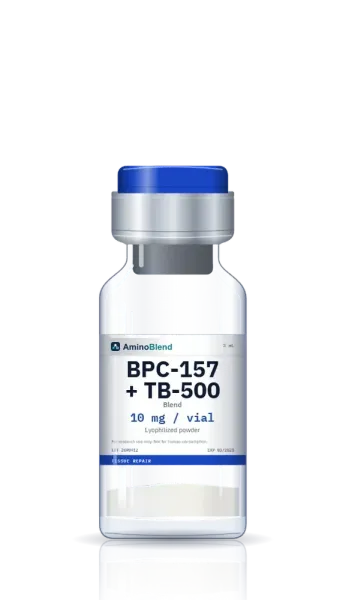
Wolverine Blend (BPC-157 + TB-500)
10 mg vial
$69
Research use only. AminoBlend supplies research compounds for laboratory and in-vitro use, not for human or animal consumption. By continuing you confirm you are 18 or older and buying for research.
Work out the concentration of a reconstituted BPC-157 and TB-500 blend, also called the Wolverine blend, and convert amounts into millilitres and units on a U-100 syringe. The calculator is set to our 10mg blend vial.
A blend calculation works on the total peptide in the vial. Our Wolverine blend holds 10mg in total, so 2 mL of bacteriostatic water gives 5 mg per mL of combined peptide. Each component is present in the ratio shown on the label and the lot certificate, so the amount of BPC-157 or TB-500 in any volume is that share of the total.
If your protocol needs a different ratio, a blend cannot be rebalanced once mixed: use separate BPC-157 and TB-500 vials and their own calculators, BPC-157 and TB-500.
Concentration for each vial size and water volume. On a U-100 insulin syringe, 10 units is 0.1 mL and 100 units is 1 mL.
| Vial | Bac water added | Concentration | Per 10 units (0.1 mL) | Per 1 unit |
|---|---|---|---|---|
| 10 mg | 1 mL | 10 mg/mL | 1 mg (1000 mcg) | 100 mcg |
| 10 mg | 2 mL | 5 mg/mL | 0.5 mg (500 mcg) | 50 mcg |
| 10 mg | 3 mL | 3.333 mg/mL | 0.333 mg (333.333 mcg) | 33.333 mcg |
concentration (mg/mL) = BPC-157 and TB-500 Blend in vial (mg) ÷ water added (mL)
units on a U-100 syringe = amount (mg) ÷ concentration (mg/mL) × 100
Amounts in micrograms are divided by 1,000 first. The calculator does this arithmetic only; it does not recommend an amount, and BPC-157 and TB-500 Blend from AminoBlend is supplied for laboratory research use only.
The Wolverine Blend is $69 for 5mg of each peptide, $5 under the same amounts from single vials, and the share arithmetic above is written for that vial. Buy it online when the study needs a fixed 1:1 ratio; shop the single BPC-157 and TB-500 vials instead when each needs its own concentration. Researchers searching for the blend near me can order from Australian stock in a few minutes.
For the Wolverine blend, every output refers to combined peptide: BPC-157 and TB-500 counted together. Concentration is the 10mg total divided by the water added, the mcg per 0.1 mL line is that figure times 100, and the volume and units lines show how much liquid holds your combined target, with 100 units to each millilitre on a U-100 syringe.
Each component's concentration is the combined figure multiplied by its share of the 10mg fill, using the split printed on the label and lot certificate of the BPC-157 and TB-500 blend. The vial holds 5mg of each peptide, so every share is half: 2 mL of water gives 2.5 mg/mL of BPC-157 plus 2.5 mg/mL of TB-500, and 10 units carries 250 mcg of each. Any other split follows the same rule, component mg divided by 10mg, times the combined concentration.
Two compounds share every graduation here, so a half-unit reading error moves both by the same proportion. At 1 mL, a 500 mcg combined aliquot is only 5 units; at 2 or 3 mL it spans 10 to 15 units, where the marks are easier to read and the per-component amounts come out as round numbers.
The blend is defined by mass, not by molar ratio. BPC-157 weighs about 1,419.5 g/mol, while TB-500 sequences are heavier, so 5mg of each does not mean equal numbers of molecules. Convert each share to molarity separately using its own molecular weight, or use separate BPC-157 and TB-500 vials when a molar design matters.
It treats the vial as one peptide with the combined fill. Divide the total mg by the water added to get the concentration, then convert amounts to mL and units. Each component is present in the ratio stated on the label and certificate.
Between 1 and 3 mL in a standard vial. 2 mL gives 5 mg per mL of combined peptide, so 10 units on a U-100 syringe holds 0.5 mg in total.
Yes. Wolverine blend or Wolverine stack is a common name for BPC-157 and TB-500 combined in one vial.
10 mg vial
