
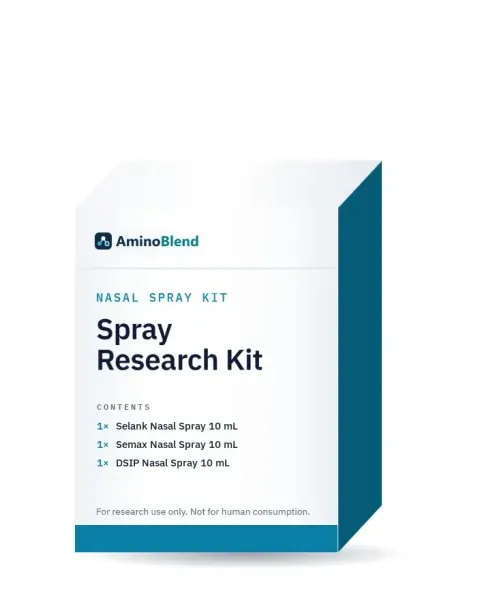
Spray Research Kit
Kit
$179
Research use only. AminoBlend supplies research compounds for laboratory and in-vitro use, not for human or animal consumption. By continuing you confirm you are 18 or older and buying for research.
In stock, ready to ship from Australia
Size: Bundle
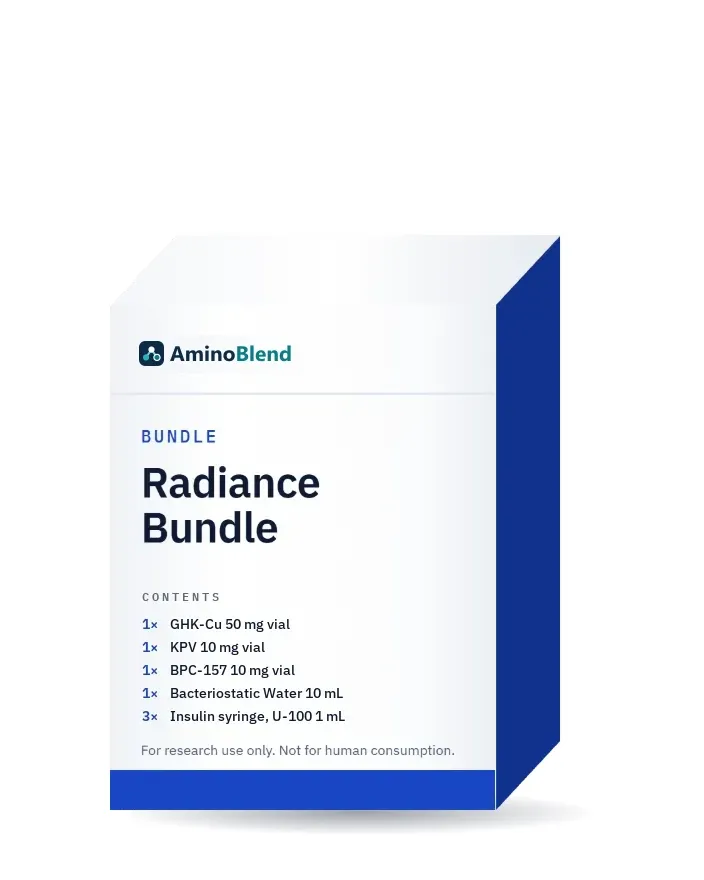
Shop the Radiance peptide bundle online in Australia for $179, with GHK-Cu 50 mg, KPV 10 mg and BPC-157 10 mg as three separate vials, plus 10 mL of bacteriostatic water and three U-100 1 mL syringes in one carton. GHK-Cu is the copper(II) complex of Gly-His-Lys (C14H22CuN6O4, CAS 89030-95-5), KPV is the Lys-Pro-Val tripeptide from the C-terminus of alpha-MSH (C16H30N4O4, CAS 67727-97-3), and BPC-157 is a 15-residue sequence drawn from a gastric protein (C62H98N16O22, CAS 137525-51-0). Each peptide lot is confirmed by mass spectrometry and measured for purity by HPLC, which gives three certificates to read before checkout. The GHK-Cu calculator and BPC-157 calculator convert water volumes into concentrations. Order the smaller GHK-Cu Starter Kit if you need only the copper peptide. The diluent is included, and the sealed vials keep at -20 °C away from light. Research reagents, available to adults 18 and over.
For laboratory research use only. Not for human or veterinary use. Not TGA approved. See our research use policy.
| Name | Radiance Bundle |
|---|---|
| Size and price | One carton at $179 |
| Sequences | GHK-Cu is Gly-His-Lys with copper(II). KPV is Lys-Pro-Val. BPC-157 is Gly-Glu-Pro-Pro-Pro-Gly-Lys-Pro-Ala-Asp-Asp-Ala-Gly-Leu-Val |
| Molecular formulas | GHK-Cu C14H22CuN6O4, KPV C16H30N4O4, BPC-157 C62H98N16O22 |
| Molar masses | GHK-Cu 401.9 g/mol, KPV 342.4 g/mol, BPC-157 1419.5 g/mol |
| CAS numbers | GHK-Cu 89030-95-5, KPV 67727-97-3, BPC-157 137525-51-0 |
| Form | Lyophilised powder in three sealed glass vials |
| Testing | Each peptide lot confirmed by mass spectrometry and measured by HPLC, with a certificate per lot |
| Contents | GHK-Cu 50 mg, KPV 10 mg and BPC-157 10 mg vials, one 10 mL bacteriostatic water vial (0.9% benzyl alcohol) and three sterile U-100 1 mL insulin syringes |
| Storage | Sealed vials at -20 °C long term or 2 to 8 °C for near use, away from light. Water and syringes at room temperature |
| Availability | In stock |
| Use | Laboratory in vitro research only |
Order the carton when a design calls for all three compounds and you want them kept apart. Separate vials let a study measure, combine or leave out any one peptide, which a fixed blend cannot do.
The Radiance peptide bundle is a boxed set of three single research peptides, GHK-Cu, KPV and BPC-157, each in its own vial, packed with the preserved water and syringes needed to dissolve and measure them. Think of it as a ready-made toolkit for skin and tissue models rather than a formula: nothing is premixed, and every compound can be used alone.
Each peptide speaks to a different layer of what happens when skin or soft tissue is damaged in a model. GHK-Cu is the matrix piece, a copper carrier studied for collagen output and remodelling in fibroblasts. KPV is the inflammation piece, a three-residue tail of alpha-MSH that dampened NF-kappa B signalling inside epithelial cells in published culture work. BPC-157 is the blood supply piece, with a long rodent record tied to nitric oxide and new vessel growth. Put side by side, they let one study ask which layer drives a given result. Full background on the less familiar two sits on the pages for KPV, the alpha-MSH tripeptide and BPC-157 in vial and capsule form.
A premixed blend can only ever be tested as a whole. Three independent vials open up a full factorial design, which is the strongest reason to buy this skin research peptide bundle over a blended alternative.
That design only works if concentrations are set with care, and the trap is molar mass. KPV is about one quarter the mass of BPC-157, so a milligram of KPV contains roughly four times as many molecules as a milligram of BPC-157, and GHK-Cu sits close to KPV. Matching the three by weight therefore loads the two tripeptides far more heavily than the pentadecapeptide. Our recommendation: decide whether your hypothesis is about equal mass or equal molecule count before you mix anything, write that choice into the protocol, and convert the stock concentrations once on paper rather than at the bench. It is also the main way the Radiance carton differs from KLOW, which swaps the separate vials for one fixed four-peptide cake and adds TB-500.
The three compounds share a research area but not a mechanism. GHK-Cu appears in fibroblast culture and rodent wound studies of collagen and elastin. KPV is studied in cell and rodent models of inflammation, including experimental colitis. BPC-157 has a rodent literature on tendon, gut and soft tissue repair going back to the early 1990s.
Packing them in one carton answers a common lab question, which is how a copper peptide, a melanocortin fragment and a gastric pentadecapeptide compare, alone and together, in the same tissue model. The vials are research reagents, and the bundle name implies no cosmetic or therapeutic outcome. Browse the carton within our skin and hair peptides range.
Radiance is our own name for a carton, not a compound, a brand or a formula you will find in any paper. Open it and you count seven items: three stoppered peptide vials (one blue GHK-Cu cake of 50 mg, plus white cakes of 10 mg KPV and 10 mg BPC-157), one 10 mL vial of bacteriostatic water, and three sterile U-100 syringes. Each peptide vial carries its own lot code, so the box links to three separate certificates rather than one shared report, and none of the powders is pre-combined with another.
Regulators look at what is inside the vials, and the answer differs for each. BPC-157 is the most tightly controlled of the trio, a Schedule 4 (prescription only) substance under the Poisons Standard since 1 June 2024, and it also appears on WADA's S0 list. GHK-Cu is a familiar cosmetic ingredient under the name copper tripeptide-1, yet the pure compound for therapeutic use is unapproved, and the TGA cited it by name in its April 2026 warning about peptide products absent from the ARTG. KPV is the least visible: we found no named Poisons Standard entry for it, and it has no approved therapeutic use. As of October 2026 no registered Australian medicine contains any of the three, and the water and syringes are simply supplies for preparing solutions.
Because of that mix, a skin research peptide bundle like this one is only stocked by laboratory suppliers. AminoBlend packs the Radiance Bundle in Australia from local stock as research material for in vitro studies, for adults 18 and over to order, and never for human or veterinary use. If your design only needs the anti-inflammatory tripeptide, the single KPV vial costs less, and the BPC-157 legal status guide covers the strictest component in depth.
The carton has one configuration. Bought individually, GHK-Cu 50 mg ($49), KPV 10 mg ($59), BPC-157 10 mg ($69), a 10 mL water vial ($14) and three syringes at $3 each total $200, so the bundle saves $21. If your study uses only GHK-Cu, that saving disappears and the $59 starter kit is the better buy.
Buy several bundles together for a longer project so each compound ships from a single lot wherever stock allows with one certificate per peptide. That keeps three clean analytical records instead of a mix of lots, and a result from week one can be set against week six without wondering whether a different batch crept in. The order is accepted only from buyers aged 18 and over.
The three molecules are easy to tell apart on paper. GHK-Cu is a blue copper complex at 401.9 g/mol, KPV a plain tripeptide at 342.4 g/mol, and BPC-157 a 15-residue chain at 1419.5 g/mol with a proline-rich N-terminal segment. A blue cake identifies the GHK-Cu vial at a glance, while the other two are white.
Every lot is tested on its own, so there are three reports to check, one per vial, each matched to the lot number on its label. Open them in the COA library and confirm the measured masses and HPLC purity before the vials go into a study. Our walkthrough on how to read a COA covers what to look for.
No retail store assembles these three research peptides in one box. AminoBlend builds the carton from stock held in Australia and sells it online only, and bundles paid before 3pm on a business day go out the same afternoon, with timing set out on the delivery information page.
At 2 mL per vial, GHK-Cu comes to 25 mg per mL and KPV and BPC-157 to 5 mg per mL each, using 6 mL of the 10 mL water and leaving 4 mL spare. The BPC-157 reconstitution calculator covers other volumes, and a fresh syringe for every vial stops any solution carrying across. Label each vial with the date and concentration as soon as it is mixed, because two of the three solutions are clear and look identical on a fridge shelf.
The 28-day window starts when the water stopper is first pierced, so either reconstitute the three vials close together or keep the unopened peptides frozen at -20 °C until needed. Once in solution, each vial is stored at 2 to 8 °C, ideally in aliquots.
GHK-Cu is also listed as copper tripeptide-1 or prezatide copper. KPV is described as alpha-MSH (11-13), the last three residues of alpha-melanocyte-stimulating hormone. BPC-157 stands for body protection compound 157 and appears in older papers as PL 14736 or bepecin.
The carton itself is sometimes referred to as a skin research peptide bundle or a GHK-Cu, KPV and BPC-157 kit. The contents do not change with the name, being three vials, 10 mL of preserved water and three syringes.
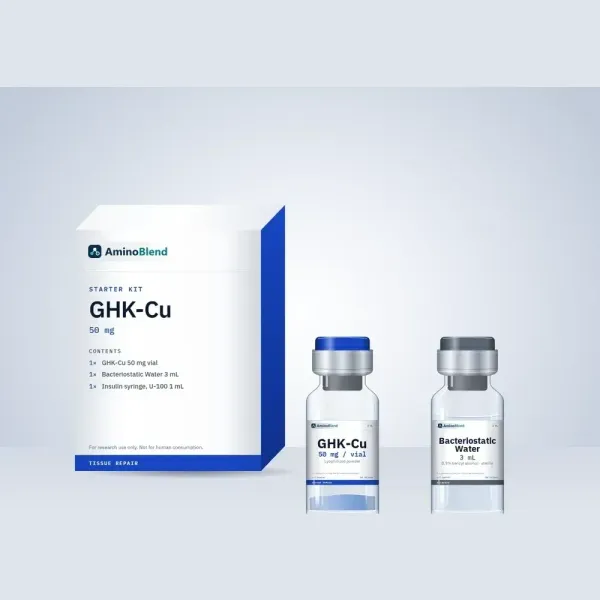
The GHK-Cu Starter Kit at $59 is the right carton when the copper peptide is the only compound in your design. The bundle earns its place when the comparison needs all three, since it costs $21 less than assembling the same contents.
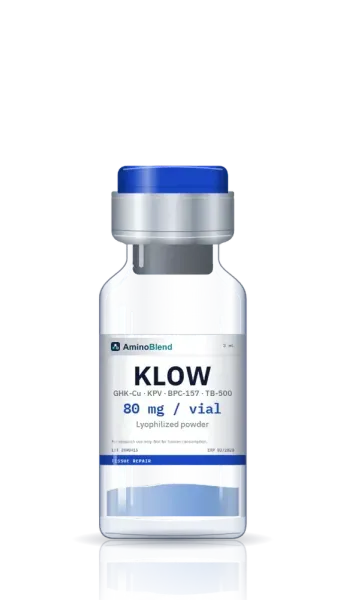
Labs that want the compounds in a single vial at a fixed ratio can look at the KLOW blend instead. The GLOW vs KLOW guide explains the trade-off between pre-mixed blends and separate vials.
The carton holds GHK-Cu, KPV and BPC-157 in separate vials, so each compound can be measured alone or combined.
Three peptide vials, 10 mL of bacteriostatic water and three U-100 syringes, $21 less than buying the parts.
Labs study them in fibroblast cultures, inflammation models and rodent repair studies, strictly in the laboratory.
If GHK-Cu is the only compound you need, the $59 GHK-Cu Starter Kit is the smaller and cheaper carton.
Keep sealed vials at -20 °C until use. Reconstituted solutions are stored at 2 to 8 °C, with one syringe per vial.
Every peptide lot is confirmed by mass spectrometry and measured by HPLC, with each certificate open in the COA library.
Add the $179 bundle to your cart from this page and check out. It ships from Australian stock, and bundles paid before 3pm on a business day are dispatched the same afternoon. The three peptide vials, 10 mL of bacteriostatic water and three syringes all come in the one carton.
Order it online from AminoBlend, which delivers to every Australian state and territory from local stock. No retail store puts these three research peptides in one box, and AminoBlend has no shopfront, so labs everywhere order from this page and receive the same tested lots.
Yes, each of the three peptides has its own lot certificate. Mass spectrometry confirms identity and HPLC measures purity for GHK-Cu, KPV and BPC-157 separately. Open each report in the COA library using the lot number printed on the matching vial label.
Order the Radiance Bundle when your study needs GHK-Cu, KPV and BPC-157 together, because the carton costs $21 less than its parts. Choose the $59 GHK-Cu Starter Kit if the copper peptide is the only compound in your design, since the bundle saving no longer applies.
Separate vials let a study measure each compound alone, combine them in any ratio or leave one out. A pre-mixed blend fixes the ratio in one vial, which suits some designs but removes that flexibility. Labs that want a fixed mix can compare the KLOW and GLOW blends instead.
It is a carton of three research peptides with diluent and syringes, used to compare copper peptide, melanocortin fragment and gastric pentadecapeptide activity in cell and animal tissue models. AminoBlend sells it as research material to adults aged 18 and over, not for human or veterinary use.
Kit
Kit

80 mg vial