
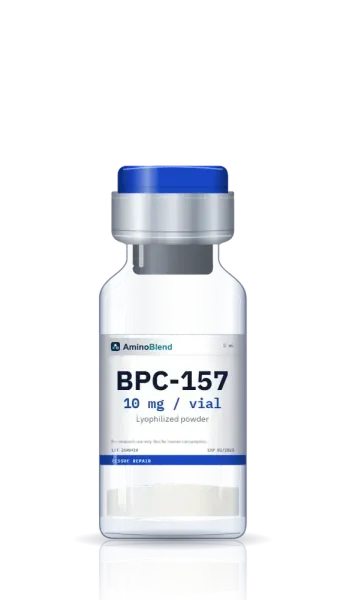
BPC-157
From $69
Research use only. AminoBlend supplies research compounds for laboratory and in-vitro use, not for human or animal consumption. By continuing you confirm you are 18 or older and buying for research.
GLOW vs KLOW comes down to one ingredient. The GLOW stack peptide is a 70 mg vial of GHK-Cu, BPC-157 and TB-500, and the KLOW stack is the same three peptides plus 10 mg of KPV, for 80 mg in total. Which one fits depends on whether your protocol includes KPV, and whether you want a fixed pre-mixed ratio at all.
Both names are used loosely across the market, and ratios differ between suppliers. These are the exact contents of the AminoBlend vials, confirmed on the certificate for each lot:
| Component | GLOW (70 mg) | KLOW (80 mg) | Main research area |
|---|---|---|---|
| GHK-Cu | 50 mg | 50 mg | Collagen synthesis, skin remodelling, copper delivery |
| BPC-157 | 10 mg | 10 mg | Tendon, gut and soft tissue repair models |
| TB-500 | 10 mg | 10 mg | Cell migration, angiogenesis, wound models |
| KPV | None | 10 mg | Inflammation, especially intestinal models |
| Total fill | 70 mg | 80 mg | |
| Cake colour | Blue | Blue | From the GHK-Cu copper |
GHK-Cu is the dominant component in both: about 71% of GLOW by mass and about 63% of KLOW. Both are really GHK-Cu vials with repair peptides added.
The glow stack, also written glow stack.peptides or GLOW blend peptide in searches, is a pre-mixed, freeze-dried combination of GHK-Cu, BPC-157 and TB-500. The name points at GHK-Cu and its long history in skin research. The two repair peptides are included because they are the most studied compounds in soft tissue repair models, so the blend puts a skin-remodelling peptide and two tissue-repair peptides in one solution.
KLOW is GLOW with a K for KPV. The KLOW blend holds the same 50 mg GHK-Cu, 10 mg BPC-157 and 10 mg TB-500, plus 10 mg of KPV, in an 80 mg vial. KPV is the tripeptide lysine-proline-valine, the final three amino acids of alpha-melanocyte-stimulating hormone (alpha-MSH). Research interest in it centres on inflammation.
So what are the KLOW peptide benefits in research terms? The blend adds an anti-inflammatory line of study to the repair and remodelling lines already in GLOW. Whether combining them produces anything beyond the sum of the parts has not been tested: we are not aware of any published study of either pre-mixed blend.
Maquart and colleagues (FEBS Letters, 1988) reported that GHK-Cu stimulated collagen synthesis in fibroblast cultures by about 80% at its peak concentration. Small topical trials reported improved skin density and wrinkle depth over 8 to 12 weeks. See our GHK-Cu explainer for the full background.
BPC-157 is a 15 amino acid sequence from a protein found in human gastric juice. Most of its literature comes from rodent models of tendon, ligament, muscle and gut injury, much of it from one research group in Zagreb. Controlled human data are sparse.
TB-500 is a synthetic fragment of thymosin beta-4, a protein that binds actin and is involved in cell migration. The frequently cited wound study (Malinda et al., Journal of Investigative Dermatology, 1999) used full-length thymosin beta-4 in rats and reported re-epithelialisation 42% above saline controls at day 4 and up to 61% at day 7. The fragment and the full protein are not interchangeable, a point often lost in marketing.
Dalmasso and colleagues (Gastroenterology, 2008) reported that KPV is taken up into intestinal cells by the PepT1 transporter and, at nanomolar concentrations, reduced NF-kappaB inflammatory signalling in cultured cells, while KPV given in drinking water reduced colitis severity in two mouse models.
This is the decision that matters more than GLOW vs KLOW. A blend saves vials, reconstitutions and paperwork: one vial, one lot, one certificate. But the ratio is fixed at 50:10:10 (plus 10 for KPV), you cannot measure any one component's effect in isolation, and you cannot change the proportion once it is mixed.
Whichever you pick, compare the label and the certificate, not just the name, because other suppliers sell different ratios under both. For concentration maths, the GHK-Cu calculator and the BPC-157 and TB-500 calculator work per component. Browse the full tissue repair peptide range for the individual compounds.
The decision list above maps straight onto the shop. Buy GLOW, the 70 mg vial at $129, for protocols built on GHK-Cu, BPC-157 and TB-500 alone; it is the lower outlay of the two blends. Buy KLOW, the 80 mg vial at $139, when KPV belongs in the design as well. KLOW costs $10 more per vial yet works out slightly cheaper per milligram, about $1.74 against $1.84 for GLOW, because that $10 adds 10 mg of KPV. If you need controls for each compound, buy single vials of KPV 10 mg and GHK-Cu next to the blend. Both blends are held in Australian stock and sold online with an independent certificate matched to the lot. Shop the peptide blends range to see every premixed option before you order.
GLOW, KLOW and every component are sold by AminoBlend for laboratory research use only, not for human or veterinary use.
KLOW contains everything in GLOW plus KPV. The AminoBlend GLOW vial holds 50 mg GHK-Cu, 10 mg BPC-157 and 10 mg TB-500 (70 mg total). KLOW adds 10 mg KPV, an anti-inflammatory tripeptide from alpha-MSH, for 80 mg total. Every other component and amount is the same.
KLOW is a pre-mixed research blend of four peptides in one freeze-dried vial: GHK-Cu, BPC-157, TB-500 and KPV. The AminoBlend version is 80 mg, with 50 mg of GHK-Cu and 10 mg of each other component. The name is usually read as GLOW with a K added for KPV.
The glow stack combines GHK-Cu, BPC-157 and TB-500. In the AminoBlend GLOW vial the amounts are 50 mg, 10 mg and 10 mg, for 70 mg in total. The powder is blue because GHK-Cu, which carries copper, makes up about 71% of the blend. Ratios vary between suppliers, so check the certificate.
No published study has tested the KLOW blend itself. Its rationale comes from each component's own research: GHK-Cu in collagen synthesis, BPC-157 and TB-500 in rodent tissue repair models, and KPV in reducing inflammatory signalling in mouse colitis models. Any combined effect remains untested.
AminoBlend sells both online from Australian stock: GLOW as a 70 mg vial at $129 and KLOW as an 80 mg vial at $139. Third-party identity and purity results for every batch are posted in our COA library, keyed to the vial's lot number. Neither blend is for use in people or animals; both are sold as laboratory research material.
10 mg vial
