
Spray Research Kit
Kit
$179
Research use only. AminoBlend supplies research compounds for laboratory and in-vitro use, not for human or animal consumption. By continuing you confirm you are 18 or older and buying for research.
In stock, ready to ship from Australia
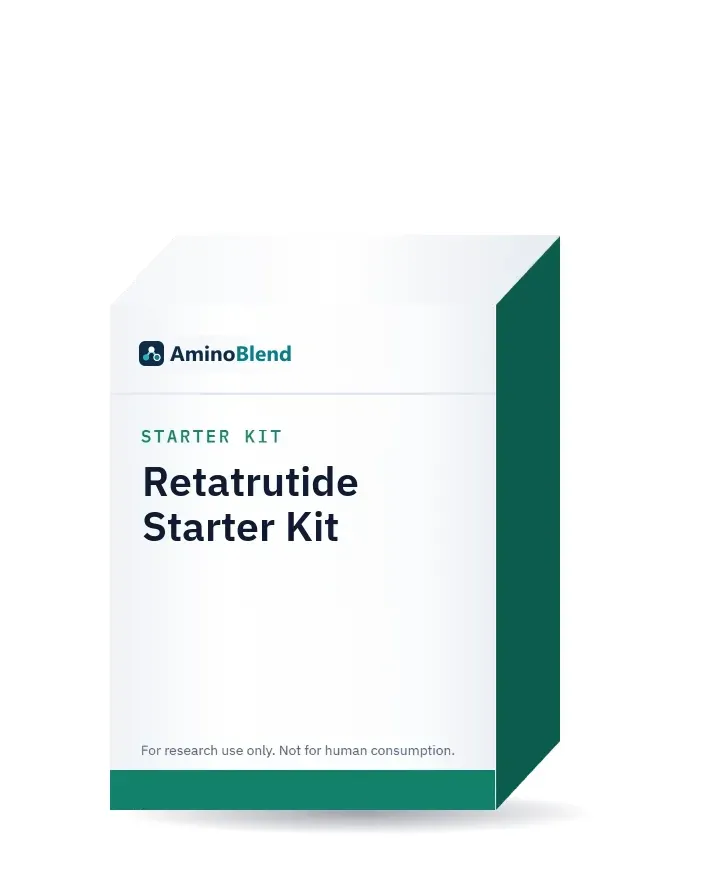
Order the Retatrutide Starter Kit online in Australia with a 10 mg ($134), 20 mg ($214) or 30 mg ($294) retatrutide vial, packed in one carton with a 3 mL bacteriostatic water vial and one U-100 1 mL insulin syringe. Retatrutide, development code LY3437943, is a 39-residue synthetic peptide that binds the GIP, GLP-1 and glucagon receptors and carries a C20 fatty diacid that tethers it to albumin. Its identity data is public, namely C221H342N46O68, 4731.3 g/mol and CAS 2381089-83-2. The vial in each carton comes from a lot confirmed by mass spectrometry and measured for purity by HPLC, and that certificate can be read before checkout. Shop with the retatrutide calculator open to turn the supplied water into a concentration. Labs comparing dual and triple agonists can add tirzepatide to the same order. With the diluent already boxed, nothing more is needed for the first reconstitution, and the sealed peptide vial keeps at -20 °C. A research reagent for adults 18 and over, from our metabolic peptides range.
For laboratory research use only. Not for human or veterinary use. Not TGA approved. See our research use policy.
| Name | Retatrutide Starter Kit |
|---|---|
| Sizes and prices | With 10 mg vial at $134, with 20 mg vial at $214, with 30 mg vial at $294 |
| Peptide | Retatrutide (LY3437943), a triple agonist at the GIP, GLP-1 and glucagon receptors |
| Length | 39 amino acids |
| Molecular formula | C221H342N46O68 |
| Molar mass | 4731.3 g/mol |
| CAS number | 2381089-83-2 |
| Form | Peptide as lyophilised powder in a sealed glass vial, water as a clear liquid in a stoppered vial |
| Testing | Retatrutide lot confirmed by mass spectrometry and measured by HPLC, with a certificate per lot |
| Contents | One retatrutide vial of the chosen fill, one 3 mL bacteriostatic water vial (0.9% benzyl alcohol) and one sterile U-100 1 mL insulin syringe, with no alcohol swabs |
| Storage | Sealed peptide vial at -20 °C, dry and dark, and in solution at 2 to 8 °C. Water and syringe at room temperature until opened |
| Availability | In stock |
| Use | Laboratory in vitro research only |
Buy the carton when your lab has no diluent on hand yet. The vial, water and syringe are the same items sold separately, priced $7 lower together, and the peptide is drawn from the same lots as our single vials.
The retatrutide starter kit is a single carton holding everything a lab needs to turn dry peptide into a measured solution for the first time: the peptide vial, a preserved diluent, and a graduated syringe to move one into the other. The peptide is the same material sold on the retatrutide vial page, where the compound itself is explained, so this section covers the two supporting items and why they were chosen.
Start with the water. Bacteriostatic water is sterile water carrying a small dose of benzyl alcohol. The name is literal. The alcohol holds back bacterial growth rather than sterilising anything, which is why a stoppered vial of it can be punctured several times over a few weeks without the contents spoiling. Plain sterile water lacks that protection, so a vial of it is opened once and thrown out, while saline adds sodium chloride that a peptide stock does not need. For a solution that will be returned to repeatedly over several weeks, the preserved option is the sensible match, and our comparison of bacteriostatic and sterile water weighs the two in detail.
The syringe is a 1 mL insulin type with a U-100 scale, meaning the barrel is marked so that 100 units fill exactly 1 mL. One unit is therefore 0.01 mL, or 10 microlitres, which makes it a handy small-volume measuring tool at the bench. Those marks measure volume only. They say nothing about how much retatrutide a given volume carries, because that depends entirely on how much water went into the vial. Mixed to 5 mg in each mL, the 20-unit mark holds 1 mg of peptide. Mixed twice as strong, that same mark holds 2 mg.
That is the mistake we see most often with first kits: treating the unit marks as a fixed amount of compound. Write the concentration on the vial label the moment it is mixed and convert every volume through it. The second point matters for cell work. At the dilutions used in most culture media the benzyl alcohol is a minor component, yet sensitive lines can still respond to it, so build a vehicle control from the same water. When the whole vial will be used within a day or two, plain sterile water removes the question altogether.
Retatrutide was designed by Eli Lilly, the US group behind tirzepatide, and its structure appeared in the literature in the early 2020s. It folds activity at three gut and pancreatic hormone receptors into one molecule, letting a laboratory ask a precise question about what changes when GIP, GLP-1 and glucagon signalling switch on together rather than one or two at a time.
The carton takes care of the practical side. First orders often stall because diluent or syringes were forgotten, and here both arrive in the same white and green box. The contents are research reagents with no tie to any medicine, and retatrutide is not a registered medicine anywhere. Shop other combined cartons under kits and bundles.
Each white and green carton holds three separate items. The first is a labelled glass vial of lyophilised retatrutide at 10, 20 or 30 mg, depending on the option you pick. The second is a 3 mL vial of clear bacteriostatic water preserved with 0.9% benzyl alcohol, and the third is a sterile 1 mL U-100 insulin syringe in its own wrap. Only the first item is the research compound. The water is a standard multi-draw diluent, and the syringe is the same U-100 type that Australian chemists also sell, as our overview of insulin syringes in Australia explains.
The peptide is the part with a regulatory story. Retatrutide has no entry on the ARTG as of October 2026, so no Australian pharmacy or clinic can supply a kit built around it. On 14 September 2026 the TGA published test results on a product sold as retatrutide in an unmarked vial: it held no retatrutide at all, only undeclared semaglutide at roughly eight times the level found in registered semaglutide products.
An unmarked vial cannot be traced, and a purity test alone would not have caught the swap, because semaglutide sits near 4114 g/mol while retatrutide sits near 4731 g/mol. Every peptide vial packed into our kits carries a printed lot code, and that lot has a mass spectrometry identity result on file. AminoBlend holds the reta kit in Australian stock in all three fills, available to order online for laboratory research by adults 18 and over. It is not for human or veterinary use, and the lot certificate archive is open before you check out.
The water vial and syringe are identical in every carton, and only the peptide fill changes. The price per milligram falls as the fill grows, from $13.40 with the 10 mg vial to $10.70 with 20 mg and $9.80 with 30 mg.
Bought one by one, the vial, water and syringe come to $141, $221 or $301, so each carton saves $7. Order several cartons together for a longer series and we pack them from one retatrutide lot wherever stock allows, giving a single certificate for the whole run. Sale is restricted to adults aged 18 and over.
Like tirzepatide, retatrutide rests on a GIP-like backbone. Aminoisobutyric acid and alpha-methylated residues guard the positions DPP-4 would otherwise cleave, the C-terminus is amidated, and a lysine carries a linker to a C20 fatty diacid. That lipid chain binds reversibly to albumin, and the half-life reported in the literature is around six days.
On the certificate, look for a measured mass matching 4731.3 g/mol and the HPLC purity reported for the lot. The water and syringe are sterile supplies printed with lot and expiry rather than analysed items. Reports are filed in the COA library under the lot number on the peptide label.
No pharmacy or clinic sells a retatrutide kit, because the peptide is investigational. AminoBlend trades online only, with no counter or pickup point, and ships to every state and territory from Australian stock. Cartons paid for before 3pm on a business day are dispatched the same day, and delivery information sets out transit times.
Let the peptide vial reach room temperature, swab both stoppers, draw the water with the supplied syringe and run it slowly down the inside of the glass, then swirl until clear. Worked through for the 20 mg fill, 2 mL of water yields 10 mg per mL, and the retatrutide reconstitution calculator covers any other volume.
Before mixing, keep the peptide vial frozen at -20 °C, dry and dark, although the powder tolerates a short spell at room temperature in transit. Once in solution it belongs at 2 to 8 °C, preferably in aliquots so the same preparation is never refrozen. The water vial is discarded 28 days after its first puncture.
The carton also goes by retatrutide kit or reta kit, and the peptide inside appears as retatrutide, LY3437943 or simply reta. Each of these refers to the same 39-residue chain with CAS 2381089-83-2.
Receptor names carry their own vocabulary. GLP-1 is glucagon-like peptide-1, GIP began as gastric inhibitory peptide and was later renamed glucose-dependent insulinotropic polypeptide with no change in sequence, and GCGR is the glucagon receptor. Papers group retatrutide with the triple agonists, or tri-agonists, while tirzepatide is classed as a dual agonist.
If your bench already holds bacteriostatic water and U-100 syringes, the standalone retatrutide vial at $129, $209 or $289 is the leaner order. The carton is the better buy for a first purchase, or whenever you want the diluent and syringe guaranteed to arrive with the peptide. Labs that prefer no mixing at all can look at the retatrutide pen at $149.
For a receptor comparison, add tirzepatide, the dual GIP and GLP-1 agonist, at $59 for 2 mg. Both peptides are 39 residues long with a C20 chain, so ordering the pair isolates what the glucagon receptor contributes. The retatrutide vs tirzepatide guide sets the two side by side.
The carton pairs a retatrutide vial, a 39-residue GIP, GLP-1 and glucagon receptor agonist, with the water and syringe needed to reconstitute it.
Choose the 10 mg kit at $134, the 20 mg kit at $214 or the 30 mg kit at $294. Each holds 3 mL of bacteriostatic water and one syringe.
Retatrutide is used in receptor pharmacology on cells and in rodent metabolic models, compared with single and dual agonists. Laboratory use only.
Labs already holding water and syringes save by buying the vial alone. The kit is the simpler first order and costs $7 less than its parts.
Keep the sealed peptide at -20 °C. Once reconstituted, store it at 2 to 8 °C in aliquots and avoid refreezing.
The retatrutide lot is confirmed by mass spectrometry and measured by HPLC, with the report open in the COA library.
Choose the carton with a 10 mg, 20 mg or 30 mg vial, priced at $134, $214 or $294, and add it to the cart. Stock is held in Australia, and kits paid for before 3pm on a business day are dispatched the same day. The water and syringe are already inside, so no separate diluent is needed.
Order it online from AminoBlend, which ships to every state and territory from Australian stock. Pharmacies and clinics do not sell retatrutide kits because the peptide is investigational, and AminoBlend has no shopfront, so every lab orders from this page and receives the same tested lots.
Order the 20 mg carton for most first purchases, because 2 mL of the supplied water gives a round 10 mg per mL. The 10 mg carton suits a pilot run, and the 30 mg carton offers the lowest cost per milligram, at $9.80, for established protocols with a steady pace.
Yes, the retatrutide vial comes from a lot with its own certificate. Mass spectrometry confirms the 4731.3 g/mol mass and HPLC measures purity, and the report is filed in the COA library under the lot number on the vial. The water and syringe are sterile supplies printed with lot and expiry.
Choose retatrutide when your study needs the glucagon receptor activated alongside GIP and GLP-1, and tirzepatide when you want the dual agonist alone. Both are 39-residue peptides with a C20 fatty chain, so ordering the two together isolates the contribution of the glucagon pathway in one comparison.
It is a ready-to-reconstitute carton of retatrutide for in vitro receptor work, holding the peptide, the bacteriostatic water and a U-100 syringe. AminoBlend sells it strictly as research material to adults aged 18 and over. Retatrutide is not a registered medicine and is not for human or veterinary use.
Kit
Bundle
Kit
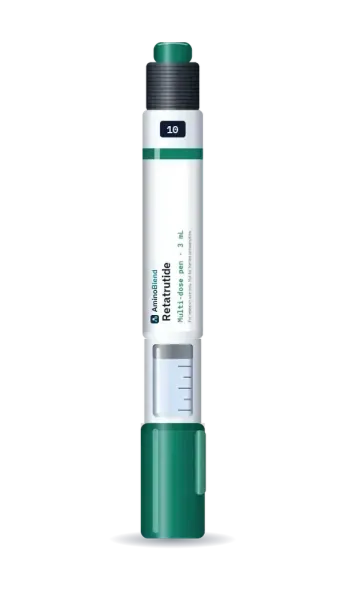
10 mg pen, 3 mL