
BPC-157
From $69
Research use only. AminoBlend supplies research compounds for laboratory and in-vitro use, not for human or animal consumption. By continuing you confirm you are 18 or older and buying for research.
In stock, ready to ship from Australia
Size: 10 mg vial
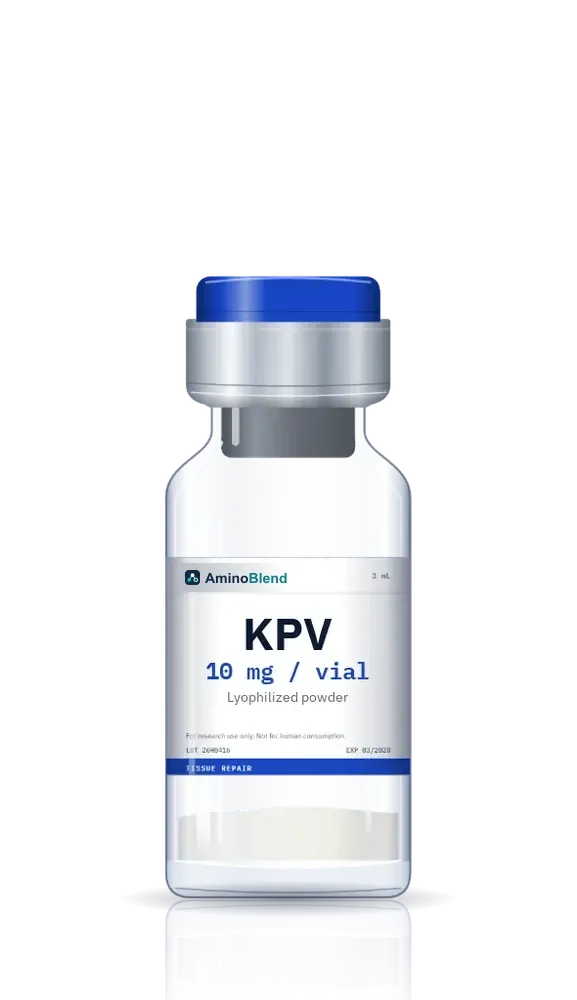
Buy KPV peptide online in Australia as a 10 mg lyophilised vial for $59, shipped from local stock with the lot certificate already published. It is the tripeptide lysine-proline-valine taken from the C-terminal end of alpha-MSH, and with only three residues its identity is easy to pin down, C16H30N4O4, 342.4 g/mol and CAS 67727-97-3. KPV carries none of the His-Phe-Arg-Trp core that switches on melanocortin receptors, which is why researchers order it for epithelial inflammation signalling rather than pigmentation work. Every lot is confirmed by mass spectrometry and measured by HPLC before release. Order with the peptide calculator to convert any diluent volume into mg per mL. A frequent companion in the same cart is BPC-157, studied in neighbouring gut lining models through quite different pathways. The vial is supplied as dry powder without diluent, so add bacteriostatic water to the order. Keep the sealed KPV vial frozen at -20 °C, dry and dark. Sold as a laboratory reagent to adults aged 18 and over.
For laboratory research use only. Not for human or veterinary use. Not TGA approved. See our research use policy.
| Name | KPV (lysyl-prolyl-valine) |
|---|---|
| Sizes and prices (AUD) | 10 mg lyophilised vial at $59 |
| Sequence or structure | Lys-Pro-Val, alpha-MSH residues 11 to 13 |
| Length | 3 amino acids |
| Molecular formula | C16H30N4O4 |
| Molar mass | 342.4 g/mol |
| CAS number | 67727-97-3 |
| Form | White lyophilised powder in a sealed 3 mL glass vial |
| Testing | Identity checked by mass spectrometry and purity measured by HPLC, with the lot certificate published online |
| Contents | A single 10 mg vial of KPV per unit, supplied dry, with bacteriostatic water ordered on its own |
| Storage | Sealed vial at -20 °C, protected from light and humidity, then 2 to 8 °C in solution |
| Availability | In stock |
| Use | Strictly in vitro laboratory research |
Order KPV for work on inflammatory signalling in epithelial cells, with three residues, a simple synthesis and an identity anyone can confirm on the certificate. At 342 g/mol, one 10 mg vial holds about 29 micromoles, a long run of experiments for a small outlay.
KPV is a tripeptide made of lysine, proline and valine, the final three amino acids of alpha-MSH (alpha-melanocyte-stimulating hormone), studied because it keeps much of that hormone's anti-inflammatory activity without its role in pigmentation. Alpha-MSH itself is 13 residues long and is cut from a larger precursor, pro-opiomelanocortin (POMC), which cells in the pituitary, skin and immune system all process. In the native hormone the valine end is amidated. The research tripeptide we supply is the free acid form, which is the version used in most cell papers.
Most peptides in this catalogue act by binding a receptor on the cell surface. KPV seems to work from inside the cell instead. Alpha-MSH signals through melanocortin receptors, yet in a 2008 Gastroenterology paper, Guillaume Dalmasso, Didier Merlin and colleagues found that KPV raised no cAMP in Caco-2 intestinal cells that carry two of those receptors, MC3R and MC5R. What mattered was PepT1, a transporter that normally pulls dietary di- and tripeptides into the small intestine lining and becomes more abundant in an inflamed colon. Once carried inside, KPV at 10 nanomolar cut NF-kappa B activation and the phosphorylation of three MAP kinases (ERK1/2, JNK and p38), and the cells released less IL-8, a chemokine that calls neutrophils to a site of inflammation. Flooding the transporter with a competing dipeptide, glycyl-leucine, abolished the effect.
Keratinocytes express their own melanocortin machinery and inflammatory cascades, which makes them the second home for this compound and the basis of most KPV peptide anti-inflammatory skin studies. Every finding so far is preclinical, and what we sell is a reagent to reproduce and extend it. Other inflammation probes are listed in our immune signalling peptide range.
The point we would stress to any lab: check whether your cell line expresses PepT1 before you design around KPV. A line with little or no transporter may show a weak or absent response that says more about uptake than about the peptide, so a quick PepT1 expression check, and a Gly-Leu competition arm, will save a confusing first experiment.
The anti-inflammatory activity of this alpha-MSH tail was first reported in 1989 by Hiltz and Lipton in the United States, who found that the 11 to 13 fragment reduced swelling in a mouse ear inflammation model. More than three decades later the tripeptide is still a research tool. What arrives from us is a 3 mL glass vial containing 10 mg of fine white powder, nothing more, and the same molecule is also one of the four components of the KLOW blend, for labs that run the full combination.
The honest answer is narrower than most listings admit. As of October 2026 KPV has no approved therapeutic use here, and we could not confirm a dedicated, named entry for it in the Poisons Standard, unlike BPC-157 or TB-500. That gap does not make it a consumer product. The TGA's April 2026 advisory on unapproved peptide products, and its guidance that "research only" wording does not change the law when goods are supplied for people, apply to any peptide offered for use in humans. Athletes face a separate rule, since WADA's S0 category catches pharmacological substances with no current government approval for human therapeutic use.
So KPV peptide Australia listings are research supply, full stop. AminoBlend keeps the 10 mg vial in Australian stock as a laboratory reagent, available to order online by adults 18 and over, and never for human or veterinary use. If you plan to buy KPV in Australia for a combined protocol, set it against the KLOW 80 mg blend first, and check the lot in our certificate archive before ordering.
KPV comes in one size, the 10 mg vial at $59, or $5.90 per mg, among the lowest per-milligram prices in our recovery peptides range. Because the molecule is so light, that milligram goes much further in molar terms than the same mass of a long peptide.
Shop several units in one order and they stay on a single lot wherever stock allows, removing one variable between two series of experiments. KPV is sold only to adults aged 18 or over, who confirm their age and laboratory purpose when they check out.
A swapped or missing residue in a three amino acid chain leaves a powder that looks exactly the same, so the mass line is what counts. The certificate should show a measured mass near 342.4 g/mol and an HPLC chromatogram with one main peak, its purity value printed beside it. All three residues are in the L configuration, with a free N-terminal amine and a free C-terminal acid.
Order after reviewing that data, which is filed under its lot code in the COA library, then match it to the label on arrival.
Short peptides also make purity easier to interpret. With so few residues there are only a handful of plausible impurities, such as a deletion dipeptide or a racemised valine, and these separate cleanly from the main peak on a reversed-phase column. That makes KPV one of the simplest compounds in our catalogue to document in a methods section, and a sensible first purchase for a lab setting up its own identity checks on incoming reagents. It also answers which is the best KPV peptide to stock, since the one you can verify line by line is the one worth keeping.
Work on KPV peptide for skin models uses keratinocyte cultures and topical inflammation studies in rodents, where cytokine release and NF-kappa B activity are the usual readouts. Gut research leans on Caco-2 monolayers and colitis models instead. Both lines treat the tripeptide as a probe of inflammatory signalling, not as a finished product, and every result so far comes from cells and animals. Any KPV peptide skin benefits described to date are laboratory readouts, such as lower cytokine release in cultured keratinocytes and reduced inflammation scores in rodent skin, and our peptides for skin research guide places them beside other skin model compounds.
Hunting for a KPV stockist in your city, or for research peptides on the Gold Coast, is unnecessary. Our online store supplies research groups across Australia from a single local stock, and anything ordered ahead of the 3pm cut-off on a working day is sent out that day under tracking. Delivery details by state are on the delivery information page.
Buy bacteriostatic water in the same cart, as KPV is hydrophilic and dissolves without fuss. Bring the vial to room temperature, add the diluent against the glass and turn it gently. With 2 mL in the 10 mg vial you have 5 mg/mL, and the reconstitution calculator covers every other volume.
The powder keeps at -20 °C, dry and in the dark. Once dissolved, keep it at 2 to 8 °C, divided into aliquots so the stock solution is not warmed and chilled repeatedly.
The same tripeptide is written KPV, Lys-Pro-Val, H-Lys-Pro-Val-OH, lysyl-prolyl-valine or alpha-MSH (11-13). Some papers describe it as the C-terminal tripeptide of alpha-MSH. Every label refers to the chain with CAS 67727-97-3 and formula C16H30N4O4.
Related terms come from its biology, including POMC, melanocortin, PepT1 (SLC15A1), NF-kappa B and IL-8. KPV should not be confused with melanotan analogues, which keep the receptor-activating core that KPV lacks.
Both turn up in intestinal models, which is why labs compare them before buying. BPC-157, fifteen residues long and drawn from a gastric protein, is studied for angiogenesis, nitric oxide and tissue repair in rodents, while KPV is a hormone-derived tripeptide used to probe inflammatory signalling inside epithelial cells. If the question concerns barrier cells and cytokines, order KPV, and if it concerns blood supply and healing tissue, BPC-157 fits better.
Shop the KLOW blend when a protocol is already fixed at that blend's ratio, since KPV is one of its four components. For studying the tripeptide alone, the single vial is the right purchase.
KPV is a tiny peptide of three amino acids, the tail end of the hormone alpha-MSH. It is made by chemical synthesis and dried to a stable powder.
Order one sealed glass vial holding 10 mg of powder. The liquid to dissolve it is not included and is ordered from our lab supplies.
Teams add it to cultured intestinal or skin cells, or study it in mouse colitis models, to see how inflammatory signals switch on and off. This is basic research only.
BPC-157 is also studied in the gut, but it is five times longer and derives from a stomach protein. KPV comes from a hormone and probes other mechanisms.
The powder goes in the freezer and the dissolved solution in the fridge, to be used within weeks. The online calculator prevents concentration errors.
HPLC and mass spectrometry are run on each lot, and the report can be opened by the lot number printed on the vial.
Order the 10 mg vial by putting it in your cart for $59 and completing checkout on this page. Stock is held locally, and any order placed before 3pm on a business day leaves the same afternoon with tracking. The vial contains powder only, so add bacteriostatic water if you need it, and confirm you are 18 or older.
You can buy it right here, online, from anywhere in Australia, with no shop or local reseller to visit. Every lab receives vials from the same Australian stock, with each lot certificate already published, and tracked delivery reaches metropolitan and regional addresses.
Published reports are preclinical. In mouse colitis models and in intestinal and keratinocyte cell lines, KPV has reduced markers of inflammatory signalling such as NF-kappa B activity and cytokine release. None of this establishes any effect in people, and the vial is sold strictly as a reagent for repeating and extending that laboratory work.
Yes. Every lot is tested by an independent laboratory, where mass spectrometry confirms a mass close to 342.4 g/mol and HPLC measures purity. For a sequence only three residues long, that mass result is the real proof of identity. Open the report in our COA library using the lot code on your vial.
Buy the single KPV vial at $59 when KPV is the compound you want to measure or adjust. KLOW, at $139, makes sense only when your protocol already uses KPV with GHK-Cu, BPC-157 and TB-500 at the blend ratio, because blended peptides cannot be separated again.
It is a minimal, easily verified tool for studying anti-inflammatory signalling inherited from alpha-MSH, without activating the pigmentation receptors. Labs use it in intestinal and keratinocyte cell lines and in rodent colitis models. Every vial is sold for bench and in vitro research, never for human or veterinary use.
10 mg vial
10 mg vial
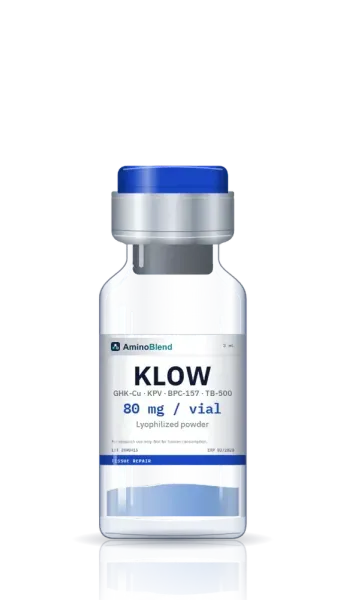
80 mg vial