MOTS-C
From $69
Research use only. AminoBlend supplies research compounds for laboratory and in-vitro use, not for human or animal consumption. By continuing you confirm you are 18 or older and buying for research.
In stock, ready to ship from Australia
Size: 10 mg vial
Buy Pinealon online in Australia as a 10 mg lyophilised vial of Pinealon peptide for $50, shipped from local stock. Pinealon is the tripeptide Glu-Asp-Arg, written EDR, one of the shortest sequences in the bioregulator series that Vladimir Khavinson's group built in St Petersburg, and it appears mainly in neuronal culture studies of oxidative stress. Check its identity against two fixed markers, the formula C15H26N6O8 and a molar mass of 418.4 g/mol. Mass spectrometry confirms each batch and HPLC measures its purity, with the lot certificate available to view before you pay. Plan your diluent volume with the reconstitution calculator. Order Epitalon in the same parcel for a second bioregulator from the same school. Pinealon arrives as a dry cake without any solvent, so add bacteriostatic water to the cart and store the unopened vial frozen at -20 °C. This reagent is sold for laboratory research to adults 18 and over only.
For laboratory research use only. Not for human or veterinary use. Not TGA approved. See our research use policy.
| Name | Pinealon (EDR) |
|---|---|
| Sizes and prices (AUD) | 10 mg vial at $50 |
| Sequence or structure | Glu-Asp-Arg (H-Glu-Asp-Arg-OH), linear tripeptide |
| Length | 3 amino acids |
| Molecular formula | C15H26N6O8 |
| Molar mass | 418.4 g/mol |
| Form | Freeze-dried powder, sealed glass vial |
| Testing | Mass spectrometry for identity, HPLC for purity, one certificate per lot |
| Contents | One 10 mg vial of Pinealon per unit, no diluent included (bacteriostatic water sold separately) |
| Storage | Unopened at -20 °C, away from light and moisture. Reconstituted at 2 to 8 °C |
| Availability | In stock |
| Use | Laboratory in vitro research only |
Buy Pinealon when a neuronal culture study calls for the smallest member of the bioregulator family. The 10 mg vial is in stock in Australia, every batch is certified, and one fill stretches across a long run of plates.
Pinealon is a synthetic three-amino-acid peptide that researchers use to ask whether something far smaller than a hormone or growth factor can still change how nerve cells behave. Unlike most neuroactive peptides, it has no identified receptor. That single fact shapes how the Pinealon peptide is studied and how its results should be read.
Conventional signalling peptides dock onto a receptor on the cell membrane and trigger a cascade inside. The group that designed EDR proposes a different route: the tripeptide is small enough to cross into the cell, where it may bind histone proteins (the spools DNA wraps around) or RNA. In a 2021 review in Molecules, the authors linked that binding to shifts in MAPK/ERK signalling, a pathway neurons rely on for survival and plasticity, and to changes in genes for apoptosis, antioxidant enzymes and transcription factors. Treat this as a working model put forward by the developers, not as something independent labs have pinned down.
The more interesting recent data concern dendritic spines, the tiny protrusions on a neuron where most excitatory synapses sit. Mature, stable spines have a bulbous head and are nicknamed mushroom spines, and they are lost early in rodent models of Alzheimer's disease. A 2017 report from the same school found that EDR at 200 ng/mL raised mushroom spine numbers by 71 per cent in mouse hippocampal cultures exposed to amyloid synaptotoxicity. A 2021 paper in Pharmaceuticals then described EDR, alongside the related tripeptide KED, preventing spine loss in 5xFAD-M transgenic mice, and the review mentions similar culture results in a Huntington's model.
Where does that leave a lab? With a cheap, fully defined, highly soluble molecule and a body of work that comes almost entirely from one research school. That is a reason to include it in a study, not a reason to assume the published effect sizes will repeat.
Our advice for anyone running EDR on neurons: have a custom synthesis house make a scrambled control from the same three residues (DER or RDE, for example) and run it on the same plates. With no receptor to block, a scrambled sequence is the cleanest way to show that any spine count or viability change depends on the order of the amino acids rather than on extra glutamate, aspartate and arginine in the medium. Glutamate in particular is an excitatory neurotransmitter, so skipping that control in a neuronal assay leaves an obvious objection unanswered.
Pinealon comes from the same St Petersburg programme that produced Epitalon. Where Epitalon was modelled on a pineal extract, Pinealon is a minimal three-residue design, with glutamic acid and aspartic acid, both negatively charged, followed by a positively charged arginine. That charge pattern makes the molecule highly water soluble and simple to analyse.
Order it for neuronal work. Published studies place it mostly in cerebellar granule cell cultures exposed to oxidative stress, with readouts such as reactive oxygen species, cell viability and caspase-3 activity, plus rodent studies in the offspring of mothers given experimental hyperhomocysteinaemia. The question it lets a lab pose is narrow and testable, namely whether a three-residue peptide changes how neurons cope with oxidative load. Its very small size also makes it an inexpensive tool for testing whether bioregulator effects depend on chain length. Shop it in our nootropic peptides range or among the longevity peptides, where it is listed as a reagent and not a medicine.
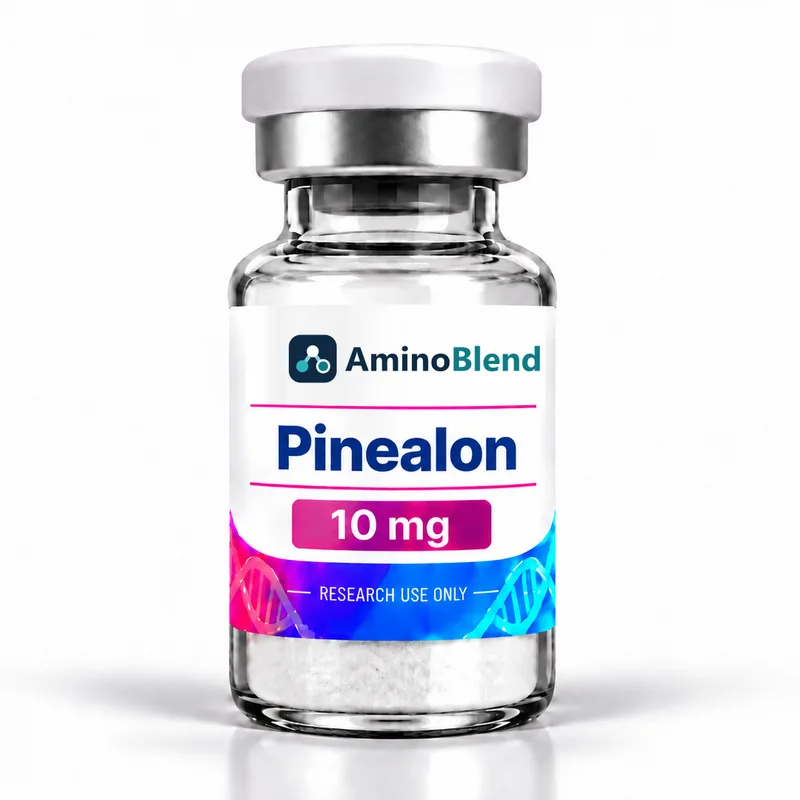
Open the carton and you find one 10 mg glass vial with a white cap, the powder sitting as a pale, compact cake at the base. The 10 mg on the label is the figure to plan concentrations around, and the lot certificate states the purity behind it. The tripeptide is a product of Khavinson's St Petersburg Institute of Bioregulation and Gerontology, and its best known English-language report appeared in Rejuvenation Research in 2011, describing lower reactive oxygen species and less necrotic cell death in cerebellar granule cells, neutrophils and PC12 cells under oxidative challenge.
Is Pinealon legal in Australia? It does not appear in the Poisons Standard as of October 2026 (we searched the October 2026 instrument for it by name), so it has no schedule entry of its own. That is a long way from being a medicine. Any peptide supplied for a therapeutic purpose has to be entered on the Australian Register of Therapeutic Goods first, and the TGA has flagged unapproved peptide products for compliance action. In practice, Pinealon Australia sourcing therefore runs through laboratory reagent suppliers rather than any medical channel.
Buy Pinealon peptide from AminoBlend and you are buying a research reagent held in Australian stock, sold to adults aged 18 and over for in vitro and laboratory work only, not for human or veterinary use. For a neuronal panel that also covers sleep and pineal questions, DSIP in vial or spray format sits naturally beside it, and the peptide storage guide covers keeping a small tripeptide stable between experiments.
Pinealon is sold in one size, a 10 mg vial at $50, which comes to $5.00 per milligram however many vials you take. A single format keeps the paperwork light, with one vial type, one specification and one certificate per batch.
Working concentrations in published neuronal cultures are low, so one 10 mg vial usually covers method set-up, a concentration-response series and several replicate plates. If a project will compare Pinealon with other bioregulators, adding those vials to the same order keeps delivery, storage start date and paperwork aligned across the whole panel.
Buy all the vials you expect to need for a replicated series at once, so they leave from the same lot wherever stock allows and share a certificate. That removes a mid-study batch change, the variable most worth eliminating in small-peptide work. Pinealon is sold only to adults 18 and over, and the age declaration is part of checkout.
No verified CAS number is listed for Pinealon in our records, so identity rests on the formula C15H26N6O8 and the 418.4 g/mol mass. The certificate should show a measured mass consistent with that value and an HPLC trace with one dominant peak, with the purity result stated for that lot.
Because EDR is short and strongly charged, it elutes early on reverse-phase HPLC, and a related tripeptide could look much the same on a chromatogram alone. Mass data is what separates it from neighbouring sequences. Look up any lot in the certificate library using the number on your label.
There is no Pinealon counter to walk into. AminoBlend trades online only and ships to every Australian address from stock kept here, and an order paid before 3pm on a business day is packed and dispatched that afternoon, as set out on our delivery page. A lab ordering research peptides in Brisbane gets the same cold-packed vial as one in a country town.
To prepare the vial, bring it to room temperature, add diluent slowly against the glass and swirl until the solution is clear. Adding 2.5 mL of bacteriostatic water to the 10 mg vial gives 4 mg/mL, and the peptide calculator works out any other volume in seconds.
Keep the sealed vial at -20 °C, dry and out of the light. The solution belongs in the fridge at 2 to 8 °C, ideally split into aliquots so the bulk is never warmed and chilled over and over. Label each tube with the lot number, concentration and preparation date, and any later result can be traced straight back to its certificate.
In papers and supplier catalogues Pinealon appears as EDR, Glu-Asp-Arg or H-Glu-Asp-Arg-OH, and in full as L-glutamyl-L-aspartyl-L-arginine. Russian-language sources group it with the synthetic peptide bioregulators, sometimes called cytogens, a class defined by chains of two to four residues. Every one of these names refers to the same 418.4 g/mol tripeptide. In a peptide catalogue the three letters EDR always mean this chain and nothing else, so the code alone is enough to match a paper's reagent to our vial.
Choose Pinealon for neuronal endpoints such as oxidative stress, viability and apoptosis markers in brain-derived cells. Choose Epitalon, the four-residue AEDG peptide, for telomerase and pineal ageing models, where most of the bioregulator literature sits. Both contain a Glu-Asp pair, the acidic core shared by several Khavinson peptides, which makes them a natural pair for comparison on the same cell line.
Shop Cartalax as well when building a wider bioregulator panel, since this AED tripeptide linked to cartilage research lets three related sequences run under identical conditions.
Pinealon is Glu-Asp-Arg, a three-residue bioregulator from Vladimir Khavinson's research programme, highly soluble thanks to its charged side chains.
One sealed 10 mg vial of powder for $50. It ships without solvent, so bacteriostatic water goes in the same order.
Used in cerebellar granule cell cultures and rodent models that track reactive oxygen species, viability and caspase-3, strictly as a bench reagent.
Epitalon is the four-residue AEDG peptide studied in telomerase work. Pinealon is shorter and aimed at neuronal endpoints.
Sealed vial at -20 °C. After reconstitution, 2 to 8 °C in small aliquots, with no repeated freeze and thaw.
Each batch is confirmed by mass spectrometry and measured by HPLC, and the certificate matches the lot on the label.
Add the 10 mg vial to your cart from this page and check out, at $50 per vial. It ships from Australian stock, and orders paid before 3pm on a business day go out the same day. The vial contains dry powder only, so order bacteriostatic water with it unless you already have a suitable diluent.
You can buy it online from any Australian city or regional town. AminoBlend has no retail shop or collection point, and every order is filled from the same local stock and shipped with order tracking to your address. That means each buyer receives material from a certified lot, wherever the laboratory is based.
It does. Each lot is analysed by mass spectrometry to confirm the 418.4 g/mol mass and by HPLC to measure purity, and the resulting certificate is posted in the COA library. Match the lot number on your vial to the document before you start a series, and keep a copy with your plate records.
Pinealon fits neuronal experiments on oxidative stress, viability and apoptosis. Epitalon fits telomerase and cell ageing models in dividing cells. The two share a Glu-Asp core, so many labs order one vial of each to compare bioregulator sequences on the same cell system within a single parcel.
Pinealon is a synthetic tripeptide, Glu-Asp-Arg, used as a reagent in neuronal culture and rodent research. It lets a lab test whether a very short peptide changes cellular responses to oxidative stress. It is supplied for in vitro research only and is never intended for people or animals.
Pinealon is not named in the Poisons Standard as of October 2026, so it has no schedule of its own. It is also not an approved medicine, and the TGA does not allow unapproved peptides to be supplied for therapeutic purposes. AminoBlend sells it only as a laboratory research reagent to adults 18 and over, not for human or veterinary use.