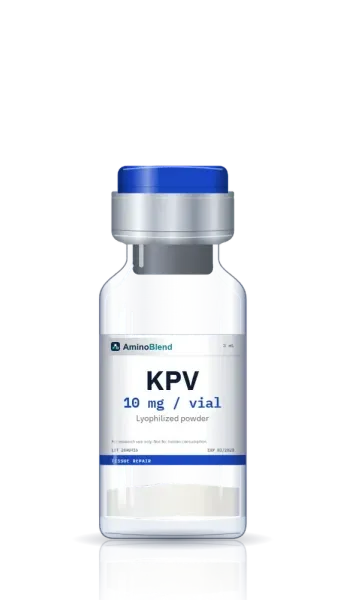
KPV
10 mg vial
$59
Research use only. AminoBlend supplies research compounds for laboratory and in-vitro use, not for human or animal consumption. By continuing you confirm you are 18 or older and buying for research.
In stock, ready to ship from Australia
Size: 10 mg vial
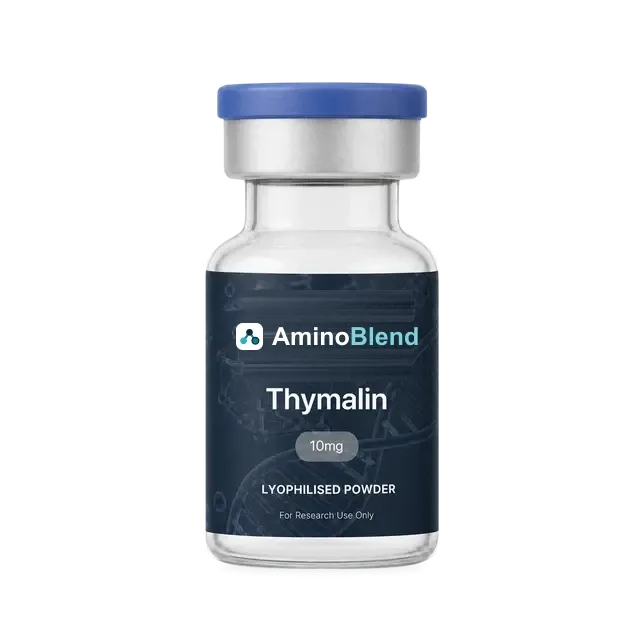
Buy Thymalin peptide online in Australia as a 10 mg lyophilised vial for $119.99, sent from Australian stock. Also written timalin, this thymic bioregulator was first prepared in the 1970s by Vladimir Khavinson and Vyacheslav Morozov at the Kirov Military Medical Academy in Leningrad, and it is defined as a complex of short polypeptides rather than one sequence. That origin puts lot control at the centre of every order. Each Thymalin lot is tested for identity by mass spectrometry and for purity by HPLC, and its certificate can be read before checkout. Shop Thymosin Alpha-1 in the same order to set a single defined thymic chain beside it. The vial contains dry powder only, so include bacteriostatic water, and let the peptide calculator convert the added volume into a concentration. Store the sealed vial frozen at -20 °C and out of the light. Thymalin is a laboratory research reagent sold to adults aged 18 and over.
For laboratory research use only. Not for human or veterinary use. Not TGA approved. See our research use policy.
| Name | Thymalin (timalin, thymic bioregulator) |
|---|---|
| Sizes and prices (AUD) | 10 mg vial, $119.99 |
| Sequence or structure | Complex of low molecular weight thymic polypeptides, with the dipeptide Glu-Trp (thymogen) as its best-known active fragment |
| Form | Lyophilised powder in a stoppered glass vial with a flip-off cap |
| Testing | Identity by mass spectrometry and purity by HPLC, with a certificate published for each lot |
| Contents | One vial of 10 mg Thymalin, bacteriostatic water sold separately |
| Storage | -20 °C sealed and shielded from light, then 2 to 8 °C after reconstitution |
| Availability | In stock |
| Use | Laboratory in vitro research only |
Order Thymalin for studies that follow the bioregulator line of thymus research, with every 10 mg vial traceable to a tested lot. It is the oldest compound in our immune range and the one where lot records count most.
Thymalin is a mixture of small peptides extracted from calf thymus, the gland in the chest where immature white blood cells are trained to become T cells. It is not one molecule with a single sequence. That makes Thymalin peptide different from nearly every other vial we stock, and it changes how the research on it has to be read.
Precursor cells leave the bone marrow, travel to the thymus and mature there into T cells that can tell the body's own proteins from foreign ones. Thymic epithelial cells support that process partly through small signalling molecules, and from the 1960s onward several labs set out to isolate them. That search produced a family of thymic preparations with confusingly similar names, and the bioregulator group in Leningrad contributed its own extract to it.
A 2021 review by Khavinson, Linkova, Chalisova and Ivko in Biology Bulletin Reviews describes Thymalin as a polypeptide complex holding a large number of peptides. Three short ones have been characterised. The dipeptide Glu-Trp (EW) was separated from the extract by reversed-phase HPLC before it was made synthetically. A 2020 analysis by Zhurkovich and co-workers, using mass spectrometry with HPLC, added Lys-Glu (KE, known in Russian papers as vilon) and the tripeptide Glu-Asp-Pro (EDP, called crystagen).
The best known cell result is a 2020 study in human haematopoietic stem cells, also from the Khavinson group. The authors reported that Thymalin cut expression of CD44 and CD117, markers of early and intermediate stages, by two to three times, while CD28, a marker carried by mature T cells, rose 6.8-fold. They read that as the extract pushing precursors along the T cell maturation path, a single in vitro result still waiting for outside replication.
One mistake we see often: confusing Thymalin with thymulin. Thymulin is a separate, defined nonapeptide secreted by thymic epithelium that needs a bound zinc ion to be active, and it has its own literature going back to work in Paris in the 1970s. Search results, papers and even product listings mix the two up. If a protocol cites thymulin, the reference compound is a nine-residue zinc complex, not this calf-derived mixture, and the results will not transfer. For a defined synthetic chain with a mainstream immunology record, the closer match is thymosin alpha 1.
Thymalin started as an extract of calf thymus, prepared in Leningrad when Soviet researchers were searching for short peptides that might regulate the tissues they came from. The same group later isolated smaller active fragments, above all thymogen, the dipeptide Glu-Trp, and the programme went on to yield pineal and vascular bioregulators too.
The research question it serves concerns the ageing thymus. After adolescence the gland involutes and its output of new T cells declines, and published Thymalin studies measure helper to suppressor T cell ratios, lymphocyte maturation markers and cytokine signalling in aged animal models. Much of that literature appears in Russian-language journals, so it is best read as an exploratory line of work, and older study designs need careful handling before results sit beside modern immunology papers. Shop it as a research reagent, not a medicine, within our immune peptides range.
Each Thymalin unit is a single 10 mg glass vial of lyophilised powder, sealed under a flip-off cap and supplied dry. What sets it apart from almost everything else in our catalogue is its history as a registered drug. A 2013 paper by Khavinson and colleagues records that the thymus preparation was registered by order of the USSR Ministry of Health on 10 November 1982, and describes it as the first medicine in the peptide bioregulator class. Its development traces to the Kirov Military Medical Academy in Leningrad, where Khavinson and Vyacheslav Morozov worked with thymus-derived peptides through the 1970s, years before the St Petersburg institute existed.
That Soviet registration has never carried over to Australia. Thymalin is not named in the Poisons Standard as of October 2026; we checked the October 2026 instrument, where the only thymic peptide listed is thymosin beta 4, a different molecule placed in Schedule 4. No schedule therefore applies to Thymalin by name, but the TGA still requires any peptide supplied for a therapeutic purpose to be on the Australian Register of Therapeutic Goods, and it has made unapproved peptide products a compliance priority. For Thymalin Australia enquiries, that means the realistic source is a laboratory reagent supplier.
Buy Thymalin Australia stock from AminoBlend and the vial comes from inventory held here, sold as a research reagent to adults 18 and over for laboratory work, not for human or veterinary use. If your study needs a fully synthetic thymic chain instead, compare it with the 28 residue Thymosin Alpha-1 vials, and the published lot certificates let you check either compound before ordering.
Thymalin comes in one fill, a 10 mg vial at $119.99, or about twelve dollars per milligram. A single vial covers a defined block of work such as a lymphocyte culture series or a panel of immune assays, and its size fits the 28 day window that begins at reconstitution. Most panels run for a few weeks, so one or two vials usually cover a pilot, with a bigger order once the method is settled.
Because the material is a polypeptide complex rather than a single chain, holding a study on one lot matters more here than with most peptides. Buy every vial a project needs at the start so they share a certificate, and keep the lot code in your notes. Purchase is limited to adults aged 18 and over, who confirm their age before payment.
Two products sold under the same name are not automatically equivalent, which is why the certificate carries more weight than the label. The report for each lot lists the mass spectrometry profile used to confirm identity, the HPLC purity result and the analysis date, and a lot that fails specification never reaches sale.
Look up the lot in the COA library before you buy and compare it with any earlier lot your lab has used. The guide on how to read a COA explains the chromatogram and the key figures.
With no single sequence to match, the mass spectrometry profile acts as a fingerprint for the lot instead of one target number. Labs that use Thymalin across several years often file each certificate with their raw data so a later lot can be compared peak by peak.
Thymalin is sold online only, with no shop or collection point, and orders are packed from Australian stock for every state and territory. Orders placed before 3pm on a business day are dispatched that same day.
To reconstitute, let the vial warm to room temperature, run bacteriostatic water slowly down the side of the glass and swirl until clear. As a worked example, 4 mL in the 10 mg vial gives 2.5 mg/mL, and the reconstitution calculator handles other volumes.
Keep the unopened vial at -20 °C, dry and away from light. Once mixed, store the solution at 2 to 8 °C, divide it into aliquots for separate runs and use it up within 28 days. Shelf life is covered further in the peptide storage guide.
The compound appears as Thymalin, thymaline, timalin and Timalinum, and it is grouped with the cytomedins, the peptide bioregulators developed by the Khavinson school. Its short fragment thymogen is also known in later literature as oglufanide.
Immune vocabulary linked to it includes thymic involution, T helper and T suppressor cells, the CD4 to CD8 ratio and immunosenescence. These are research terms and do not name alternative products.
Choose Thymalin when your study follows the bioregulator programme and you want the material its published work used as a reference point. Choose Thymosin Alpha-1 when you need a single 28 residue sequence with a fixed mass, which is easier to set against mainstream immunology papers.
Ageing projects often add Epitalon, the pineal tetrapeptide from the same research school, listed in the longevity peptides range. Shop the thymic reagents in one parcel so a lab can run them side by side under identical conditions, each with its own lot certificate.
Thymalin is a preparation of short thymic polypeptides, developed in 1970s Leningrad and studied as a regulator of thymus function.
The sealed 10 mg vial is priced at $119.99 and holds dry powder alone. Bacteriostatic water is a separate purchase.
Studies examine T cell balance and lymphocyte maturation in aged animal models and cultured cells. It remains a laboratory reagent with no approved use.
Thymosin Alpha-1 is one defined sequence, while Thymalin is a polypeptide complex with a more specialised body of literature.
Freeze the unopened vial at -20 °C in the dark. After mixing, refrigerate the solution and finish it within 28 days.
Every lot passes through mass spectrometry and HPLC, and its certificate is posted in the COA library under the lot code on the label.
Add the 10 mg vial to your cart on this page and complete checkout. It costs $119.99, ships from stock held in Australia and leaves the same day when ordered before 3pm on a business day. Diluent is not included, so order bacteriostatic water with it if your lab has none on hand.
Online from AminoBlend, wherever your laboratory sits. The store has no retail outlet or pickup desk, and parcels travel by tracked delivery to all Australian states and territories. Buying direct means the lot certificate is visible before payment, which matters for a polypeptide complex like this one.
Yes, each lot is analysed by mass spectrometry for identity and by HPLC for purity before it goes on sale, and the report appears in the COA library under the lot code on the label. Keep that code with your records so later lots can be compared with the one you used.
Thymosin Alpha-1 suits work needing one defined 28 amino acid chain that lines up with the wider immunology literature. Thymalin suits studies following the Russian bioregulator research on thymic involution. They answer different questions, and both can be ordered together, each with its own certificate.
Thymalin is defined as a thymic polypeptide complex rather than a single sequence, so small differences between lots are more likely than with a short synthetic peptide. Ordering every vial for a project at once keeps the work under a single certificate and removes one source of variation from your results.
It is a reference material for research on the thymus and immune ageing, applied in cell culture and animal studies of T cell ratios, lymphocyte maturation and cytokine signalling. It is sold strictly for in vitro laboratory research, never for human or veterinary use, and only to adults aged 18 and over.