
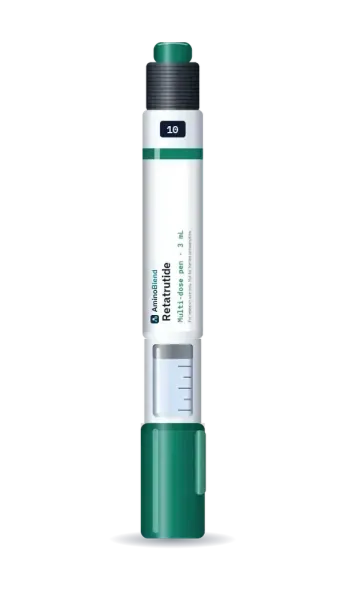
Retatrutide Pen
10 mg pen, 3 mL
$149
Research use only. AminoBlend supplies research compounds for laboratory and in-vitro use, not for human or animal consumption. By continuing you confirm you are 18 or older and buying for research.
In stock, ready to ship from Australia
Size: 500 mg vial
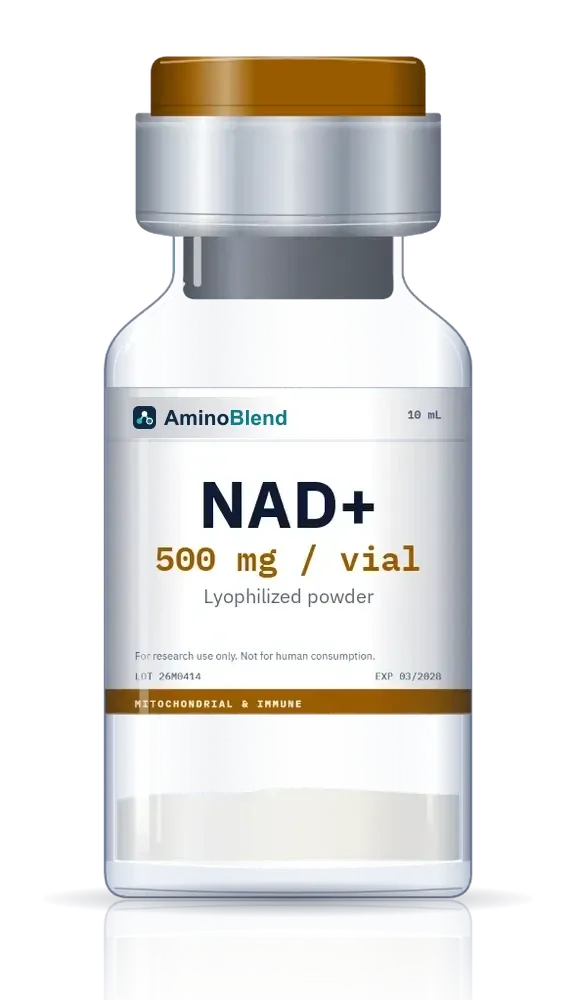
Buy NAD+ Australia-wide from our online store as a 500 mg lyophilised vial for $79, shipped from local stock. NAD+ is a coenzyme rather than a peptide, the oxidised form of nicotinamide adenine dinucleotide (C21H27N7O14P2, 663.4 g/mol, CAS 53-84-9), and this vial holds the coenzyme itself rather than a precursor such as NMN or NR. Shop the NAD+ 500mg fill in a 10 mL glass vial, sized so the large cake has room to dissolve. Every lot is confirmed by mass spectrometry and measured for purity by HPLC, with the certificate viewable before you pay. Order 5-Amino-1MQ in the same cart to study the enzyme that drains the nicotinamide pool. The vial ships without diluent, so include bacteriostatic water, and the peptide calculator gives the concentration for any volume. Store the unopened NAD+ vial at -20 °C, dry and away from light. For adults 18 and over only, as a reagent for in vitro laboratory work.
For laboratory research use only. Not for human or veterinary use. Not TGA approved. See our research use policy.
| Name | NAD+ (nicotinamide adenine dinucleotide, oxidised form) |
|---|---|
| Sizes and prices | 500 mg vial, $79 AUD |
| Sequence or structure | Dinucleotide of nicotinamide riboside and adenosine joined by a pyrophosphate bridge, a coenzyme and not a peptide |
| Molecular formula | C21H27N7O14P2 |
| Molar mass | 663.4 g/mol |
| CAS number | 53-84-9 |
| Form | Lyophilised powder in a sealed 10 mL glass vial |
| Testing | Mass spectrometry for identity and HPLC for purity, with a published certificate per lot |
| Contents | One 10 mL vial holding 500 mg of NAD+, bacteriostatic water sold separately |
| Storage | Sealed vial at -20 °C, dry and away from light, and solution at 2 to 8 °C |
| Availability | In stock |
| Use | In vitro laboratory research only |
Order NAD+ in a large 500 mg fill for enzyme assays and cell media work that consume plenty of coenzyme. The vial is in stock, tested lot by lot and documented before sale.
NAD+ is a small molecule that cells use to shuttle electrons from the food they break down to the machinery that makes energy, and it also serves as raw material for a group of enzymes that repair DNA and adjust gene activity. Despite being sold as an NAD+ peptide in some catalogues, it is a nucleotide-based coenzyme with no amino acids in it at all.
The chemistry is worth understanding before any assay is designed. When NAD+ takes up electrons it accepts them as a hydride, two electrons and a proton together, at carbon 4 of its nicotinamide ring, becoming NADH; a second proton goes into solution. The reaction is reversible, which is exactly the point, because the same molecule can be charged and discharged many thousands of times. Cells also keep the two forms at deliberately different ratios in different compartments: measurements of free coenzyme put the cytosol near 700 oxidised molecules for every reduced one, while mitochondria sit nearer 10 to 1. Those two ratios set which direction a given dehydrogenase will push its reaction, which is why a cell-free assay has to be given a defined ratio rather than a defined amount.
Redox cycling does not consume NAD+, but a second group of enzymes does. Sirtuins, PARPs and CD38 cut the molecule apart to do their work, taking the ADP-ribose portion and releasing nicotinamide, which the salvage pathway then has to rebuild into fresh coenzyme. The destruction is what makes the pool turn over quickly and what connects DNA damage, in which PARP activity climbs sharply, to a measurable fall in cellular NAD+. Suppressing that drain from the other direction is the logic behind the NNMT inhibitor sold as 5-Amino-1MQ.
The one thing we would tell any lab buying this vial: the coenzyme crosses the plasma membrane poorly. Add NAD+ to culture medium and much of it is broken down by ectoenzymes on the cell surface, then taken up as smaller fragments, so an experiment framed as raising intracellular NAD+ may really be testing those breakdown products and the receptors they hit. For cell work, include a nicotinamide riboside arm to separate the two routes, or use permeabilised cells or isolated mitochondria when the intracellular pool is genuinely the subject. In cell-free enzyme kinetics none of this applies, and the coenzyme behaves as cleanly as any reagent on the bench.
NAD+ sits at the centre of cellular energy metabolism. It accepts electrons in glycolysis and the citric acid cycle, becoming NADH, which then feeds the mitochondrial electron transport chain. Sirtuins, PARPs and CD38 also consume it as a substrate, linking its levels to gene regulation, DNA repair and cell signalling.
Shop this vial for a defined amount of the oxidised coenzyme itself, with nothing blended in. Data gathered with precursors such as NMN, NR or nicotinamide does not transfer directly, since cells must first convert those into NAD+. This is a research reagent, not a supplement or medicine, and the longevity peptides range lists compounds often ordered beside it.
Expect a noticeably bigger vial than the rest of our metabolic range. The NAD+ 500mg fill sits in a 10 mL glass vial under a flip-off cap, and the contents are a white to off-white solid of the oxidised coenzyme alone, with no precursor, peptide or filler mixed through it. The solid is hygroscopic, meaning it draws moisture from the air, which is why the vial stays sealed and frozen until the day you dissolve it.
Unlike most products on this site, NAD+ was not invented by anyone. Arthur Harden and William John Young first detected it in 1906 as a heat-stable factor, which they called cozymase, that yeast extracts needed in order to ferment sugar. Harden shared the 1929 Nobel Prize in Chemistry with Hans von Euler-Chelpin for their work on fermentation and its enzymes, and the coenzyme's role in carrying electrons was worked out in the decades that followed. More than a century on, it remains one of the most widely used biochemical reagents in enzyme kinetics and cell metabolism research.
Because it is a natural metabolite rather than a designed drug, NAD+ has a long life as a catalogue chemical, and laboratories have bought it from reagent suppliers for decades. The vial on this page belongs in that category. It is not a registered medicine, not a listed supplement and has not been evaluated by the TGA. AminoBlend holds the 500 mg vial in Australian stock, available to order online by adults 18 and over, for in vitro research only and never for human or veterinary use. Labs that buy NAD+ in Australia for mitochondrial studies often add the cardiolipin-binding peptide SS-31 as a second arm.
Buy the one size we carry, 500 mg, which is roughly 750 micromoles of coenzyme. Enzyme assays and media supplementation often call for millimolar concentrations, so a single vial supports several stock solutions from one lot. At $79 it costs about 16 cents per milligram, so even assays that need high millimolar concentrations stay affordable across a full series of plates.
One vial is usually enough for a first order, because the reconstituted solution should be used within a few weeks. Order a second vial from the same lot wherever stock allows only when a follow-up experiment is already planned, so both runs share one certificate. NAD+ buyers must be 18 or older.
The 10 mL vial is deliberate. A 500 mg cake needs room for enough diluent to dissolve fully, and the larger glass lets you make a concentrated stock in the vial itself rather than transferring powder, which keeps handling losses and contamination risk low.
The molecule joins two nucleotides through a pyrophosphate bridge. One carries nicotinamide, the reactive end that accepts electrons, and the other carries adenine. The oxidised form, NAD+, does not absorb at 340 nm while the reduced form NADH does, which is the basis of many enzyme assays and a quick way to confirm which form you hold. A spectrophotometer reading of a fresh stock at 260 nm and 340 nm will show whether any of the coenzyme has been reduced during handling.
The certificate should show a measured mass consistent with 663.4 g/mol, the CAS number 53-84-9 and the HPLC purity for your lot. Reports are published in the COA library under the code printed on each vial.
Our store has no counter to visit. Orders are placed online and shipped from Australian stock to every state and territory, from labs buying research peptides in Sydney to Kalgoorlie. Pay before 3pm on a business day for same-day dispatch, then follow the parcel on the order tracking page.
The large fill dissolves readily. Let the vial reach room temperature, add bacteriostatic water down the inside of the glass and swirl until clear. Five mL in the 500 mg vial gives 100 mg/mL, about 150 mM, a convenient stock for diluting into assay buffer.
Freeze the unopened NAD+ vial at -20 °C, dry and dark. NAD+ in solution is less stable than the dry powder, particularly at alkaline pH, so store the stock at 2 to 8 °C in small aliquots, protect it from light and use it within 28 days.
Catalogues write it as NAD+, NAD, beta-NAD, nicotinamide adenine dinucleotide or by its older name, diphosphopyridine nucleotide (DPN). Some shops call it an NAD peptide and advertise the best NAD+ peptide on the market, though the molecule contains no amino acids, and CAS 53-84-9 identifies the oxidised form.
Related but different compounds include NADH, the reduced form, NADP+, the phosphorylated cousin used in biosynthesis, NMN, nicotinamide mononucleotide, and NR, nicotinamide riboside. Each is a separate molecule with its own identifiers, so check the CAS number on any label before assuming two products are interchangeable.
Both bear on the same pool, from opposite ends. NAD+ supplies the coenzyme directly, while 5-Amino-1MQ blocks NNMT, the enzyme that methylates nicotinamide and removes it from the salvage route that rebuilds NAD+. Order NAD+ when an assay needs the cofactor in the medium, 5-Amino-1MQ when the question is about protecting recycling, and both to compare the two in one design.
The GHK-Cu peptide vs NAD+ question comes up because both are listed in longevity ranges, yet they are very different reagents. GHK-Cu is a copper-binding tripeptide studied in cell culture for gene expression and matrix work, while NAD+ is a redox coenzyme. Labs planning NAD copper peptides work, with NAD+ and GHK-Cu side by side, usually run them as separate arms rather than mixing them in a single solution.
NAD peptide benefits for skin are a laboratory topic only, studied as NAD+ levels and sirtuin activity in cultured fibroblasts and keratinocytes, and our peptides for skin guide covers that bench literature. The NAD vs collagen peptides comparison sets a redox coenzyme against hydrolysed protein fragments, so any NAD collagen peptides design in skin cell culture runs them as separate arms with their own controls.
For signalling rather than supply, MOTS-c acts through AMPK, the cell's energy sensor, and SS-31 targets the inner mitochondrial membrane. Either pairs well with an NAD+ Australia order built around mitochondrial work.
The oxidised form of nicotinamide adenine dinucleotide, central to redox reactions and consumed by sirtuins, PARPs and CD38.
One 10 mL vial holding 500 mg of powder for $79, with bacteriostatic water sold separately.
Enzyme assays, redox chemistry and cell media work that need the coenzyme itself, strictly in vitro.
Supplies the cofactor directly, while 5-Amino-1MQ protects the route that recycles it inside cells.
Sealed vial frozen and dark, and the solution refrigerated in aliquots and used within 28 days.
Mass spectrometry and HPLC on each NAD+ lot, with the certificate published in the COA library.
Add the 500 mg vial to your cart from this page for $79. It ships from Australian stock, and payment received before 3pm on a business day means dispatch that afternoon. The lot certificate is viewable first, and bacteriostatic water for mixing is a separate item you can add to the same cart.
Buy it from our online store, which delivers to every Australian state and territory from a single local stock. There is no shopfront, so the vial, its lot certificate and the dispatch cut-off are identical for every buyer, wherever the lab happens to be.
It is not a peptide at all. NAD+ is a dinucleotide coenzyme of 663.4 g/mol with no amino acids, sold beside peptides and sometimes labelled that way. For enzyme assays what matters is the oxidised form, a confirmed mass and the HPLC result, all shown on the lot certificate before you order.
Yes. Every lot is tested by mass spectrometry for identity and by HPLC for purity before release. The certificate is filed in our COA library under the lot code on the vial label, so it can be checked before ordering and kept with your study records.
Choose NAD+ when your assay needs the coenzyme itself in solution. Choose 5-Amino-1MQ when you want to block NNMT and protect the salvage route that rebuilds NAD+ inside cells. Ordering both lets one design compare supplying the cofactor with sparing it, using matched delivery dates.
Yes, both can go in the same cart, and many labs run them as separate arms of one design. GHK-Cu is a copper-binding tripeptide, while NAD+ is a redox coenzyme, so they are dissolved and stored apart rather than combined in a single solution. Each arrives with its own lot certificate.
10 mg pen, 3 mL
2 mg vial
