MOTS-C
From $69
Research use only. AminoBlend supplies research compounds for laboratory and in-vitro use, not for human or animal consumption. By continuing you confirm you are 18 or older and buying for research.
In stock, ready to ship from Australia
Size: 20 mg vial
Buy Cartalax online in Australia as a 20 mg vial of Cartalax peptide for $69, the cartilage-linked member of the short bioregulator family. It is the tripeptide Ala-Glu-Asp, or AED, developed within Vladimir Khavinson's St Petersburg programme and studied in chondrocyte and skin fibroblast cultures that follow cell ageing and extracellular matrix genes. Check the identity data before ordering, the formula C12H19N3O8 and a molar mass of 333.3 g/mol. Every lot passes mass spectrometry for identity and HPLC for purity, and its certificate is open to view before checkout. Use the peptide calculator to set the concentration you want from the volume of diluent. The sequence matches the first three residues of Epitalon, so ordering a vial of each makes a neat structural comparison. The powder ships without solvent, so add bacteriostatic water and keep the sealed vial at -20 °C. Cartalax is a research reagent sold to adults 18 and over only.
For laboratory research use only. Not for human or veterinary use. Not TGA approved. See our research use policy.
| Name | Cartalax (AED) |
|---|---|
| Sizes and prices (AUD) | 20 mg vial at $69 |
| Sequence or structure | Ala-Glu-Asp, linear tripeptide (H-Ala-Glu-Asp-OH) |
| Length | 3 amino acids |
| Molecular formula | C12H19N3O8 |
| Molar mass | 333.3 g/mol |
| Form | Lyophilised white powder in a sealed glass vial |
| Testing | Mass confirmed by mass spectrometry, purity measured by HPLC, certificate issued for each lot |
| Contents | One 20 mg vial of Cartalax per unit, shipped dry, with diluent as a separate purchase |
| Storage | Sealed at -20 °C in the dark. Dissolved at 2 to 8 °C in aliquots |
| Availability | In stock |
| Use | Laboratory in vitro research only |
Order Cartalax for connective tissue and cell ageing studies in a generous 20 mg fill, twice the size of most bioregulator vials. It is in stock in Australia, each batch is certified, and one vial carries a long culture series.
Cartalax is a synthetic peptide made of just three amino acids that is studied for its effect on ageing connective tissue cells, the cells that build and maintain cartilage, skin and other structural tissue. In the papers it is usually written by its one-letter code, AED.
The St Petersburg school that produced Cartalax works from one central claim: that a tissue's own short peptide fragments help keep its genes running in a youthful pattern, and that a synthetic copy can restore some of that pattern in older cells. Each sequence in the family was matched to an organ. AED was assigned to cartilage and the wider group of connective tissues. No receptor has been found for it. The developers propose that the tripeptide reaches the nucleus and interacts with chromatin, a model that remains unproven outside their own laboratories.
The clearest published dataset is in skin fibroblasts rather than cartilage. A 2016 paper in the Bulletin of Experimental Biology and Medicine (Lin'kova and colleagues) aged fibroblast cultures through repeated passages and then compared four short peptides, AED among them, using confocal microscopy. Four markers were tracked:
All four peptides lowered MMP-9 and raised Ki-67 and CD98hc, while AED and the four-residue AEDG also damped caspase-dependent apoptosis. A follow-up in the same journal in 2020 compared AED with the dipeptide KE in replicatively aged skin fibroblasts. Chondrocyte work exists too, though much of it appears in Russian-language sources that are harder to check.
The practical point we would stress: every effect above was reported in old cultures, not young ones. A lab testing AED should run matched early-passage and late-passage cells from the same donor line side by side. If the peptide shifts Ki-67 or MMP-9 only in the late-passage plates, that is consistent with the published picture. If it shifts both equally, something other than an ageing-specific effect is at work, and you have learned that cheaply from a single vial.
Cartalax belongs to the family of short peptides developed at Vladimir Khavinson's institute in St Petersburg, where each tiny sequence was paired with a tissue of interest. Cartalax, as its name hints, is the one assigned to cartilage. Its three residues, alanine, glutamic acid and aspartic acid, make it one of the lightest compounds we sell.
Order it knowing where the literature stands. Most published work comes from Khavinson's group and collaborators and sits in cell culture, with chondrocytes from older donors or heavily passaged cultures, skin fibroblasts carrying senescence markers, and expression of matrix genes such as collagens. The proposed mechanism, that short peptides act on chromatin to switch tissue-specific genes, is still a hypothesis with limited independent replication, and that open status is what makes it worth testing with defined material. Shop it in our longevity peptides and recovery peptides ranges, where it is listed as a research reagent rather than a medicine. That dual listing reflects how labs use it, since connective tissue ageing panels can test it against longer repair peptides without changing their culture system.
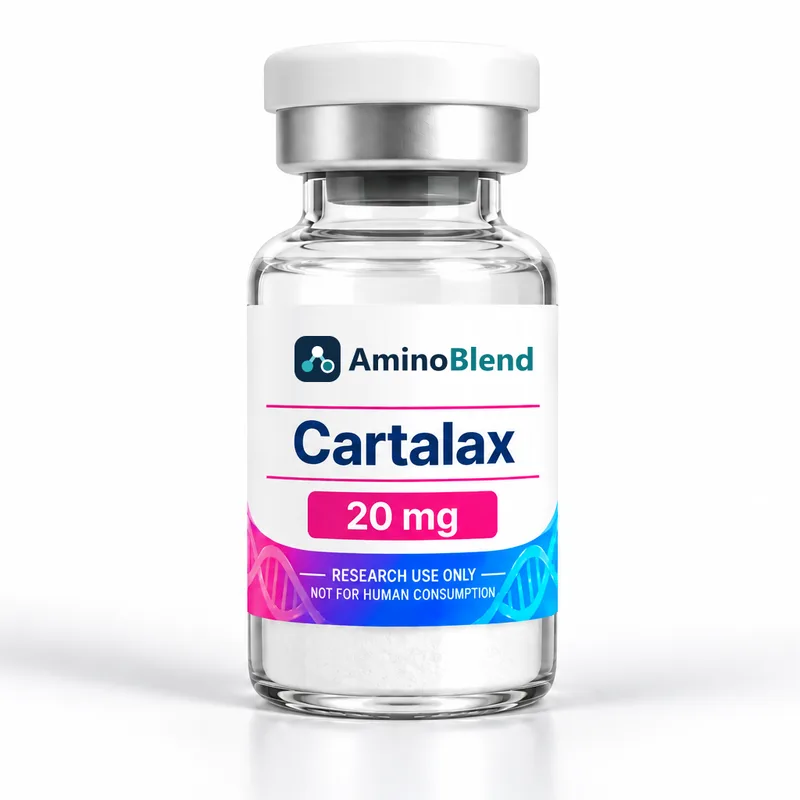
A Cartalax order brings one glass vial with a white cap and a pink and blue label, holding 20 mg of AED as a dry white cake. That fill is double the 10 mg common to Pinealon and other bioregulator vials, which suits labs that keep a concentrated master stock. Only the peptide's sequence links it to Russia: the AED chain was described within Vladimir Khavinson's short peptide programme at the St Petersburg Institute of Bioregulation and Gerontology, a body he founded in 1992 after years running the bioregulator laboratory at the Kirov Military Medical Academy. Most of what has been published about the tripeptide still comes from that group and its collaborators, so the evidence base is narrow and almost entirely in cultured cells.
Is Cartalax legal in Australia? The compound is not listed by name in the Poisons Standard as of October 2026, and our check of the October 2026 instrument found no entry for AED or Ala-Glu-Asp, so no schedule applies to it as a named substance. An unscheduled peptide is still not a therapeutic good. Supplying any peptide for therapeutic use requires inclusion on the Australian Register of Therapeutic Goods, and the TGA has said unapproved peptide products are a compliance focus. That framework explains why Cartalax Australia buyers find it through reagent catalogues rather than through medical supply chains.
Cartalax for sale at AminoBlend is held in Australian stock and supplied only as a research reagent for laboratory use. Orders are accepted from adults 18 and over, and the vial is not for human or veterinary use under any circumstances. Labs planning a wider connective tissue comparison can read the terms of supply on our research use policy page before ordering.
Cartalax comes in one size, a 20 mg vial at $69, or about $3.45 per milligram. At roughly 333 g/mol, that vial holds around 60 micromoles of AED, enough for many plates of chondrocyte or fibroblast culture before a second vial is needed. The larger fill also suits labs that prefer a concentrated master stock, since the extra powder lets you prepare one strong solution and dilute working aliquots from it without opening another vial.
Buy every vial up front when a study will run for months, so they ship from the same lot wherever stock allows under one certificate and no batch change interrupts the series. Cartalax is sold strictly to adults aged 18 and over.
AED carries two acidic side chains and a free C-terminal acid, which makes it very polar and easy to dissolve. Its small size is also its analytical weak point, because a tripeptide of similar composition could resemble it on HPLC alone, so mass confirmation is what fixes identity. If you run your own LC-MS check on arrival, the singly protonated ion should appear close to 334 on the mass-to-charge scale.
Shop with the certificate open and check that the measured mass agrees with 333.3 g/mol, that the chromatogram shows one main peak, and that the reported purity applies to your lot number. Certificates are kept in the COA library, indexed by the lot printed on each label, and our guide on how to read a COA walks through every line of one.
Cartalax is not sold over any counter. AminoBlend is an online store that ships across Australia from local stock, and payment received before 3pm on a business day means dispatch that same day. See delivery information for transit times by region, including for labs buying research peptides in Perth.
Warm the sealed vial to room temperature, add diluent slowly down the side of the glass and swirl gently until clear. With 4 mL of bacteriostatic water the 20 mg vial gives 5 mg/mL, and 2 mL gives a stronger 10 mg/mL stock, while the peptide calculator covers every other volume.
Unopened, the vial stays at -20 °C away from moisture and light. Once in solution, keep it at 2 to 8 °C and split it into single-use portions so the stock is not cycled between temperatures. Write the date and concentration on every tube, because months later that note is what ties an aliquot to its certificate.
Cartalax is also written as AED, Ala-Glu-Asp, H-Ala-Glu-Asp-OH or L-alanyl-L-glutamyl-L-aspartic acid. Russian literature places it among the peptide bioregulators, sometimes described as cytogens, and links it to cartilage and connective tissue. All of these names describe the same 333.3 g/mol tripeptide with the formula C12H19N3O8. Some catalogues print it simply as AED peptide or as a cartilage bioregulator, with no change in the molecule supplied.
Epitalon reads Ala-Glu-Asp-Gly, so Cartalax is the same chain minus its final glycine. Despite that near identity, the two are studied in different cells, Epitalon in telomerase and pineal ageing models and Cartalax in chondrocytes and fibroblasts. Order Cartalax for matrix and cartilage endpoints, Epitalon for telomerase questions, and both when you want to know whether one extra residue changes the result. Because the two differ only at the C-terminus, any gap between their readouts points directly at that glycine.
Shop BPC-157 as a contrast when comparing tissue-repair tools. It is a 15-residue gastric peptide fragment with a broad soft tissue literature, unrelated to Cartalax in structure and proposed mechanism.
Cartalax is Ala-Glu-Asp, a short bioregulator from the St Petersburg programme, associated with cartilage and connective tissue cells.
A sealed vial of freeze-dried powder, double the usual bioregulator fill. Diluent is not included, so add bacteriostatic water.
Studied in cultured chondrocytes and skin fibroblasts for senescence markers and matrix gene expression, inside the lab only.
Epitalon is AEDG and Cartalax is AED, so the pair lets a study test the effect of a single glycine.
Store the closed vial at -20 °C. Refrigerate the solution at 2 to 8 °C in portions you thaw once.
Identity by mass spectrometry, purity by HPLC, and a published certificate that matches the lot on the label.
Add the 20 mg vial to your cart here and complete checkout, at $69 per vial. The vial ships from stock held in Australia, and payment before 3pm on a business day means same-day dispatch. Because Cartalax is supplied as dry powder, include bacteriostatic water in the order if you need a diluent.
Order it online from anywhere in Australia. AminoBlend does not run a physical shop or a pickup point, so every lab, in a capital city or a regional centre, buys from this page and receives a tracked parcel from the same local inventory and the same certified lot.
Yes. Each lot is checked by mass spectrometry for its 333.3 g/mol mass and by HPLC for purity, and its certificate is published in our COA library. The lot number on your vial matches the certificate, so the paperwork lines up with the material you hold.
Pick Cartalax for chondrocyte, fibroblast and matrix gene studies, and Epitalon for telomerase or pineal ageing models. Since Cartalax is Epitalon without the final glycine, buying both gives a clean structural comparison in one parcel. Both ship dry from Australian stock and need a diluent.
Cartalax is a defined synthetic tripeptide, Ala-Glu-Asp, used as a reagent in connective tissue cell culture. It lets researchers test whether a very short peptide shifts ageing markers or matrix gene expression in cartilage cells. It is sold for in vitro research only, never for human or veterinary use.
Yes, as a laboratory reagent. Cartalax is not named in the Poisons Standard as of October 2026, but it is not an approved medicine and cannot be supplied for therapeutic use in Australia. AminoBlend holds the 20 mg vial in Australian stock and sells it to adults 18 and over strictly for in vitro research, not for human or veterinary use.