
Retatrutide Pen
10 mg pen, 3 mL
$149
Research use only. AminoBlend supplies research compounds for laboratory and in-vitro use, not for human or animal consumption. By continuing you confirm you are 18 or older and buying for research.
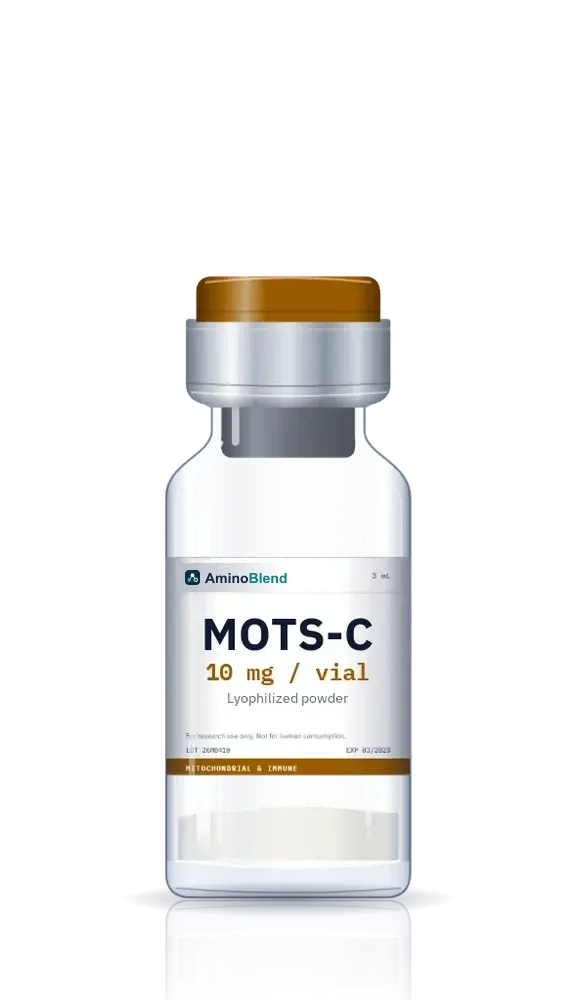
In stock, ready to ship from Australia
Buy MOTS-c Australia-wide from local stock in 10 mg ($69), 20 mg ($119) and 40 mg ($189) lyophilised vials. The chain is 16 amino acids long, MRWQEMGYIFYPRKLR, and it is encoded in mitochondrial DNA, inside a short open reading frame of the 12S rRNA gene, rather than in the nucleus. Identity markers for each lot are C101H152N28O22S2, 2174.6 g/mol and CAS 1627580-64-6. Shop with confidence in the lot, which is confirmed by mass spectrometry and measured by HPLC, with its certificate of analysis open before checkout. The MOTS-c calculator turns any water volume into a working concentration. Order SS-31 in the same cart for a fuller mitochondrial study. Vials ship as powder without diluent, so include bacteriostatic water, and keep sealed vials at -20 °C, dry and dark. Every vial is a research reagent, sold only to adults 18 and over for in vitro laboratory work and never for human or veterinary use.
For laboratory research use only. Not for human or veterinary use. Not TGA approved. See our research use policy.
| Name | MOTS-c, a mitochondrial-derived peptide |
|---|---|
| Sizes and prices | 10 mg vial $69 AUD, 20 mg vial $119 AUD, 40 mg vial $189 AUD |
| Sequence or structure | MRWQEMGYIFYPRKLR in one-letter code, a free acid chain encoded in the mitochondrial 12S rRNA gene |
| Length | 16 amino acids |
| Molecular formula | C101H152N28O22S2 |
| Molar mass | 2174.6 g/mol |
| CAS number | 1627580-64-6 |
| Form | Freeze-dried MOTS-c powder in a sealed glass vial |
| Testing | Mass spectrometry confirms identity and HPLC measures purity, with a certificate for each lot |
| Contents | One vial of lyophilised MOTS-c at 10, 20 or 40 mg, bacteriostatic water sold separately |
| Storage | Sealed at -20 °C, dry and protected from light, and 2 to 8 °C after reconstitution |
| Availability | In stock |
| Use | In vitro laboratory research only |
Shop MOTS-c for work on signalling between mitochondria and the nucleus, in the size that matches how fast your lab will use it. All three fills share one specification and one release test.
MOTS-c is a small peptide that mitochondria build themselves and send out as a signal, telling the rest of the cell how its energy supply is faring. That one line covers the reason the compound exists in catalogues: it is a messenger from an organelle that was assumed to have nothing to say.
A little background makes the oddity clear. Human cells keep nearly all their genes in the nucleus, but mitochondria hold their own small circular genome of about 16,500 base pairs, a leftover from the bacterial ancestor they descend from. Textbooks credited that genome with 37 genes, 13 of them proteins, all of which stay inside the organelle. The MOTS-c reading frame hides inside one of the others, the stretch coding 12S ribosomal RNA, overlapping a sequence whose job was supposed to be structural. Reading it out requires the mitochondrial genetic code, which differs from the nuclear one, so the peptide was overlooked by the standard gene-finding tools of the day.
Genetics gives the most striking evidence that the peptide matters. Zempo and colleagues, writing in Aging in 2021, examined a mitochondrial DNA variant found in East Asian populations, m.1382A to C, which changes residue 14 of the peptide from lysine to glutamine. In a large Japanese cohort the variant tracked with type 2 diabetes prevalence in men, and only in those reporting the least physical activity. The altered peptide also performed worse than the usual form in their mouse and cell experiments. A single base change in mitochondrial DNA, altering one residue in a 16-residue peptide, with a measurable association in a population: that is a stronger argument for biological relevance than any supplementation study.
For labs, our advice is to treat the variant as the experiment rather than an aside. Ordering the standard sequence and a K14Q version synthesised to match gives a built-in specificity control, and any response seen with both points away from the mechanism under test. Dig into the published cell and rodent findings in our review of what MOTS-c research has measured before settling on endpoints, because the effects reported are mostly indirect and need a readout chosen with care.
Almost every peptide in our catalogue is coded by nuclear genes, and MOTS-c is the exception. Its sequence sits in the small circular genome inside mitochondria, which places it among the mitochondrial-derived peptides alongside humanin. A University of Southern California team led by Changhan Lee first described it in Cell Metabolism in 2015, reporting that it acted mainly in skeletal muscle by switching on AMPK, the cell's energy sensor. Our guide to MOTS-c benefits in published cell and rodent work follows that record forward.
Order it to explore a specific question. How does a signal written in mitochondrial DNA reach and influence nuclear gene expression? This vial is a research reagent for studying that in cells, with no link to any approved medicine, and the mitochondrial peptides category lists the compounds usually ordered with it.
All three fills arrive the same way: a sealed glass vial holding a white freeze-dried cake of the 16-residue peptide, with no second compound added. The 10 mg and 40 mg vials wear amber flip-off caps, which makes them easy to tell apart from green-capped vials such as tirzepatide on a shared freezer shelf. The 20 mg fill sits between them for labs that find 10 mg too small and 40 mg too much to use in time.
MOTS-c began as a discovery rather than a drug design. The 2015 Cell Metabolism report came from a search of the mitochondrial genome for short open reading frames that might encode signalling peptides, and the 12S rRNA region turned one up. As of October 2026 no product containing MOTS-c is registered on the ARTG and no regulator we know of has approved it as a medicine, so the vial on this page is a laboratory reagent with no prescription equivalent.
Sport is where this peptide now has a formal status. WADA's 2025 Prohibited List named MOTS-c as an example of an AMP-activated protein kinase activator within the metabolic modulators class, S4, which is banned in and out of competition. Sport Integrity Australia applies the same list here, so MOTS-c is a prohibited substance for any athlete subject to the code.
For research groups, MOTS-c for sale in Australia means reagent supply. AminoBlend holds the 10, 20 and 40 mg vials in Australian stock, available to order online by adults 18 and over, for in vitro use only and never for human or veterinary use. Labs that buy MOTS-c in Australia as part of an ageing biology programme will find related compounds in the longevity peptides range.
Buy the 10 mg vial at $69, or $6.90 per milligram, for first orders, pilot runs and short concentration-response series, since it is the easiest to finish within 28 days of mixing. The 20 mg vial at $119, or $5.95 per milligram, covers two or three short experiments. The 40 mg vial at $189, about $4.73 per milligram, suits a settled method that will use the whole solution in time.
Order more than one vial together and request a single lot wherever stock allows, so one certificate documents the entire series. Checkout is limited to adults 18 and over.
Size choice comes down to the 28 day window more than to price. A 40 mg vial that is only half used before the solution expires costs more per useful milligram than two 10 mg vials opened a month apart, so match the fill to the pace of your experiments rather than to the lowest sticker figure.
The sequence carries two methionines, which makes it worth protecting from oxidation, and a cluster of basic arginine and lysine residues near the C-terminus. Published work links that basic tail to its movement into the nucleus under metabolic stress, reported by the same group in 2018. A 2021 Nature Communications study then tied its levels to exercise, with work in aged mice, and that is the thread most current cell models follow.
The best MOTS c peptide for bench work is one whose certificate you can check. Look for a measured mass close to 2174.6 g/mol, the sequence MRWQEMGYIFYPRKLR and the HPLC purity for your lot, all published in the COA library under the lot code printed on the vial.
We have no storefront. The business runs online and ships from Australian stock to every state, so each MOTS-c Australia order, whether bound for a lab buying peptides in Adelaide, Cairns or a farm postcode, comes from the same shelf. A cleared payment before 3pm on a business day means same-day dispatch, as the delivery information page explains.
Order bacteriostatic water with the vial, because it holds only the dry peptide. Bring it to room temperature, add the water slowly against the glass and swirl rather than shake. Two mL in the 10 mg vial gives 5 mg/mL, and the MOTS-c reconstitution calculator covers the 20 and 40 mg fills or any other volume.
Hold unopened MOTS-c vials frozen at -20 °C. After mixing, hold the solution at 2 to 8 °C, away from light, in aliquots so no portion is thawed more than once, and limit air exposure because of the methionines.
Labels and papers write it as MOTS-c, MOTS-C, MOTS C or MOT-C, an acronym built from the open reading frame it comes from, a short coding stretch inside the mitochondrial 12S rRNA gene, type c. It belongs to the mitochondrial-derived peptides, sometimes abbreviated MDPs, and is identified by CAS 1627580-64-6.
Related vocabulary includes AMPK (AMP-activated protein kinase), the folate cycle and AICAR, an intermediate the 2015 paper linked to its action. None of these are separate products, as they describe the pathway the peptide is studied in.
The best peptide to stack with MOTS c depends on the level of mitochondrial biology you want to probe. MOTS-c is a signalling peptide that acts through AMPK and gene expression, while SS-31 is a synthetic tetrapeptide that binds cardiolipin in the inner mitochondrial membrane. Choose MOTS-c for signalling questions, SS-31 for membrane and bioenergetics questions, and separate vials of both to keep their contributions apart.
Buy NAD+ when the coenzyme at the centre of energy metabolism belongs in the design, or SLU-PP-332, a small molecule that switches on estrogen-related receptors, for a non-peptide route into the same mitochondrial programmes.
A 16 amino acid chain encoded in the mitochondrial genome rather than the nucleus, first described in 2015.
$69, $119 or $189 per vial, with the largest fill cheapest per milligram. Diluent is sold separately.
AMPK signalling, mitochondria to nucleus communication and metabolic stress, as published in cell and rodent models.
A signalling peptide beside a membrane-binding one, covering two levels of mitochondrial biology.
Sealed vials frozen at -20 °C, and the solution refrigerated in aliquots that are thawed a single time.
Identity by mass spectrometry and purity by HPLC on every lot, with the certificate showing the sequence in the COA library.
Choose the 10 mg, 20 mg or 40 mg vial on this page, priced at $69, $119 and $189, and add it to your cart. Paid orders before 3pm on a business day are dispatched that day from Australian stock. Add bacteriostatic water as well, since the vial holds dry powder.
Our online store is the place to buy it, wherever you are in Australia. There is no retail outlet, so every buyer receives vials from the same local stock with a published lot certificate, and tracking follows the parcel from our dispatch bench to your address.
Look for a vial whose lot has been confirmed by mass spectrometry and measured by HPLC, with a certificate showing the measured mass and sequence. Ours are published in the COA library under the lot code on each vial, so you can review the report before you order and file it afterwards.
Pick MOTS-c when your question concerns AMPK signalling or communication between mitochondria and the nucleus. Pick SS-31 when the focus is the inner mitochondrial membrane and cardiolipin. Many labs order both as separate vials so the effect of each one can be told apart in the data.
Buy 10 mg for a first order or pilot work, since it is simplest to use within 28 days of mixing. The 20 mg vial suits two or three short runs. The 40 mg vial gives the lowest cost per milligram for a settled method that will use all of it in time.
It is a tool for studying how a mitochondria-encoded peptide influences cellular energy sensing and nuclear gene expression. Published work in cells and mice links it to AMPK and metabolic stress responses. Our vials are supplied for bench experiments only, never for people or animals.
10 mg pen, 3 mL
2 mg vial
