Bacteriostatic Water
From $9
Research use only. AminoBlend supplies research compounds for laboratory and in-vitro use, not for human or animal consumption. By continuing you confirm you are 18 or older and buying for research.
In stock, ready to ship from Australia
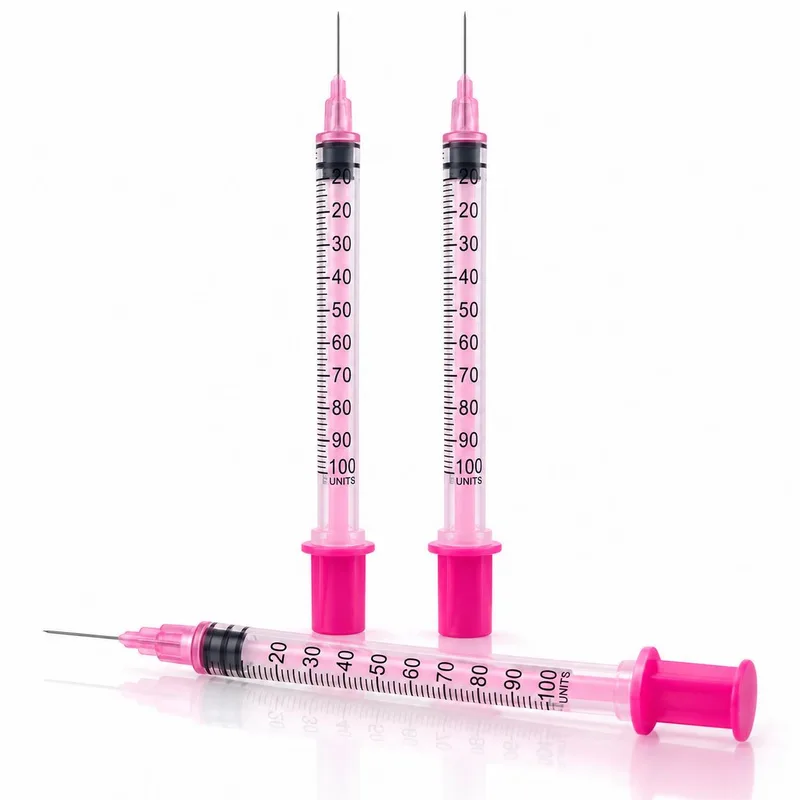
Shop the best syringes for peptides online in Australia, U-100 insulin syringes sold as a 30 pack of 1 mL 29G barrels for $20 or as $3 singles in 1 mL 29G 12.7 mm, 1 mL 31G 6 mm, 0.5 mL 31G 6 mm and 0.3 mL 31G 6 mm. Every barrel uses the U-100 scale, where 100 units fill 1 mL and 10 units equal 0.1 mL, so the markings read directly against the unit figures from the peptide calculator. Each syringe is sterile, individually wrapped and fitted with a fixed needle under an orange cap. As consumables they are not lot-tested by HPLC the way our peptides are, but the vials you draw from carry their own certificates in the COA library. Order bacteriostatic water with the pack so a new peptide vial can be prepared on arrival. Keep unopened syringes dry at room temperature out of direct sun, use each one once and dispose of it in a sharps container. Laboratory consumables for adults aged 18 and over.
For laboratory research use only. Not for human or veterinary use. Not TGA approved. See our research use policy.
| Name | U-100 insulin syringes |
|---|---|
| Sizes and prices | 30 pack of 1 mL 29G at $20, or singles at $3 each in 1 mL 29G 12.7 mm, 1 mL 31G 6 mm, 0.5 mL 31G 6 mm and 0.3 mL 31G 6 mm |
| Scale | U-100, where 100 units equal 1 mL and 10 units equal 0.1 mL |
| Full scale by barrel | 100 units (1 mL), 50 units (0.5 mL), 30 units (0.3 mL) |
| Needle | Fixed needle, 29G 12.7 mm or 31G 6 mm, under an orange needle cap |
| Form | Sterile, individually wrapped, single use |
| Contents | Thirty 1 mL syringes in the pack, or one syringe of the chosen size |
| Storage | Dry, at room temperature, away from direct sunlight, in the sealed wrapper until use |
| Availability | In stock |
| Use | Measuring diluent and solution for laboratory research peptides only |
Order the barrel that matches the volumes you measure most. The pack covers diluent transfers and routine draws, and the small singles make low volumes easier to read.
An insulin syringe is a small disposable syringe with a very fine needle bonded permanently into the tip and a barrel printed in units instead of millilitres. The design was built around one hormone's standard strength, but the same features make it the usual measuring tool for small volumes of reconstituted peptide solution on a lab bench.
There are three parts. The barrel is clear medical-grade polypropylene. The plunger rod carries a rubber or elastomer stopper that seals against the barrel wall. The needle is a stainless steel cannula glued into the barrel nose, and both the needle and the inside of the barrel are coated with a thin film of silicone oil so the needle slides through a stopper and the plunger moves smoothly.
The key engineering feature is the absence of a hub. On a conventional syringe with a detachable needle, liquid stays trapped in the hub and needle base after the plunger bottoms out. That leftover, the dead space, can reach about 80 microlitres on high dead space designs. Fixed-needle insulin syringes leave only a few microlitres behind. When the whole measurement may be 20 or 30 microlitres, that difference decides whether the volume dispensed matches the volume read off the scale.
That is also the clearest answer to what syringe is best for peptides when the job is measuring small amounts: a fixed-needle, unit-marked barrel. A tuberculin syringe looks similar and also holds 1 mL, but it is graduated in millilitres, usually to two decimal places, and often takes a detachable needle with the extra dead space that brings. It suits a millilitre-based method, not a calculator that reports units. The other common look-alike, a general-purpose 3 mL or 5 mL Luer syringe, is fine for moving bulk diluent but far too coarse to read fractions of a tenth of a millilitre.
Our firm advice, whichever size you buy: draw and dispense in one movement, and never use the syringe as a storage container. The silicone lubricant can shed microscopic droplets into the liquid over time, and formulation labs treat those droplets as a known trigger for protein aggregation and a source of false counts in particle assays. Peptide solution left sitting in a barrel for hours also has more plastic surface to adsorb to. If your choice of the best insulin syringe for peptides comes down to price, that rule matters more than the brand on the wrapper, and our full guide to buying insulin syringes in Australia covers gauge and needle length.
Insulin syringes are small, fine-needled syringes graduated in units rather than millilitres. They became the standard bench tool for reconstituted peptides because reconstitution calculators report results in U-100 units, so the reading on the barrel and the figure on the screen agree without conversion.
Every option we sell uses that U-100 scale, which means 1 unit is always 0.01 mL whichever barrel you pick. Shop them in our lab supplies range alongside the diluents they are used with, so one cart holds the peptide, the water and the means to measure it.
Every syringe we sell is a sterile, single-use plastic barrel with U-100 unit markings and a needle fixed permanently to the tip under an orange cap. The 30 pack holds thirty 1 mL 29G barrels with pink plungers. The four single options are one syringe each: the 1 mL with a 29G 12.7 mm needle, and the 1 mL, 0.5 mL and 0.3 mL barrels with a 31G 6 mm needle. All of them read in units, where 100 units fill 1 mL, so swapping barrel sizes never changes the scale, only how finely each millilitre is divided.
In Australia, insulin syringes are regulated as medical devices rather than as medicines, and the Australian Register of Therapeutic Goods lists insulin syringes from several sponsors in that category. They are not a scheduled poison or a prescription item. Retail pharmacies sell them over the counter, usually in boxes of 100, and the National Diabetes Services Scheme supplies them at no cost to registered people with diabetes who use insulin. That subsidy has nothing to do with laboratory buying, and our guide to insulin syringe sources in Australia compares the routes side by side.
For a lab, a box of 100 in one gauge is often more than a project needs, which is why many teams buy insulin syringes online with their diluents instead. AminoBlend keeps every size in Australian stock as a laboratory consumable for measuring diluent and reconstituted research solutions, sold to adults 18 and over and not for human or veterinary use. Insulin syringes for sale here come as a pack or as single barrels, so a bench can match the syringe to the volume it measures, and bac water vials with an optional syringe keep the measuring tool and the diluent in one order.
Two numbers settle the choice. The best syringe size for peptides follows the volume you measure most, and the best gauge syringe for peptides follows the vial you draw from. A higher gauge means a thinner needle, so 31G passes a stopper with less force and is less likely to core it, while 29G moves liquid faster.
So what is the best syringe for peptides on a typical bench? Start with the 30 pack and add a few 0.3 mL singles if your method involves very small volumes. In short, the best size insulin syringe for peptides is the smallest barrel that still holds your largest single measurement. Sale of these consumables is limited to adults aged 18 and over.
Each syringe is sealed and sterile until its wrapper is opened, and it is made for one draw. A needle that has passed through a stopper once is duller and can core the rubber or carry contamination, so it should never return to a vial. Check that the wrapper is intact before use and discard any syringe whose seal is broken.
The costliest mistake is mixing scales. U-40 syringes look similar but mark 40 units per mL, so a reading taken against a U-100 calculation would be out by a factor of 2.5. Every barrel we stock is U-100, which is why the best insulin syringe for peptides on a calculator-led bench is always a U-100 one. The peptides you draw are the lot-tested items, with mass spectrometry and HPLC reports explained in our guide on how to read a COA.
Pharmacy stock of barrel sizes, needle lengths and scales varies from one counter to the next. Buying the syringes in the same cart as the vials and water keeps everything on one U-100 scale, which makes AminoBlend the best place to buy syringes for peptides in a single parcel. We are an online store with no shopfront, shipping to all states and territories from Australian stock, and orders paid before 3pm on a business day leave that day, with timing on the delivery information page.
For a worked example, adding 2 mL of water to a 10 mg vial takes two full draws of a 1 mL barrel and gives 5 mg per mL, and the peptide calculator converts any other combination into units on the barrel. Our reconstitution guide covers the full aseptic method.
Store unopened syringes dry at room temperature, out of direct sunlight, and keep them in their wrappers until the moment of use. Used syringes go straight into an approved sharps container.
Catalogues list the same item as insulin syringes, U-100 syringes, unit syringes, 1 cc or 1 mL syringes, half-cc or 0.5 mL syringes and 0.3 cc syringes. The cc and mL figures are the same measure, and 29G or 31G describe the needle gauge, sometimes written as 29 gauge or 31 gauge.
Fixed-needle syringes like these are also called low dead space syringes, because no detachable hub sits between barrel and needle to hold liquid. Tuberculin syringes are a different product, graduated in millilitres rather than units.
If you need just one syringe for a single reconstitution, the best syringe to use for peptides is the 1 mL 29G that comes with our bacteriostatic water options for $3 extra. Once a study involves more than a handful of draws, the 30 pack is cheaper and keeps spares on the bench, which is usually the answer when labs ask what syringes are best for peptides over a long series. Order the best peptide syringes for your method in the same cart as the vials.
Labs preparing IGF-1 LR3 in acetic acid 0.6% usually need one full 1 mL draw for the acid, so a 1 mL barrel suits that step. For a first peptide order with everything in one box, the GHK-Cu Starter Kit already includes a syringe and water.
Small sterile syringes graduated in units, where 100 units fill 1 mL. The markings match the units shown by peptide calculators.
The 30 pack of 1 mL 29G syringes costs $20. Singles in 1 mL, 0.5 mL and 0.3 mL cost $3 each.
The 1 mL barrel suits diluent transfers and most draws, while the 0.5 mL and 0.3 mL barrels read small volumes more clearly.
One syringe can be added to any bacteriostatic water vial for $3. The pack is cheaper once you need more than six or seven.
Store syringes in their wrappers at room temperature, out of direct sun. Use each one once and discard it into a sharps container.
Every syringe is sealed sterile and uses the U-100 scale, so readings never need converting from U-40.
Choose the 30 pack of 1 mL 29G syringes at $20 or a $3 single in the barrel and needle you need, then add it to the cart with your peptides and diluent. Stock ships from Australia, and orders paid before 3pm on a business day are dispatched the same day.
The best choice is a sterile U-100 insulin syringe with a fixed needle, because its unit markings match reconstitution calculators and there is no hub to trap liquid. Buy the 1 mL 29G 30 pack for routine work, then add 0.3 mL or 0.5 mL singles if your method measures small volumes.
Pick the 1 mL barrel for adding diluent and for most draws, and the 0.5 mL or 0.3 mL barrels when you measure small volumes and want wider spacing between graduations. A 31G 6 mm needle suits short vials, while the 29G 12.7 mm needle reaches into taller bottles.
No, syringes are sterile consumables, so they are not analysed by HPLC or mass spectrometry the way peptides are. Each one is individually wrapped and sterile until opened. The peptides you prepare with them carry lot certificates that you can open in the COA library.
Choose the water vial with one syringe for $3 extra if you only need a single reconstitution. Choose the 30 pack at $20 once a study involves more than six or seven draws, since each syringe is used once and the pack works out at about $0.67 per syringe.
They measure diluent and reconstituted peptide solution in units that match reconstitution calculators, where 100 units equal 1 mL. AminoBlend sells them as laboratory consumables for research use only, to adults aged 18 and over, and not for use on people or animals.