
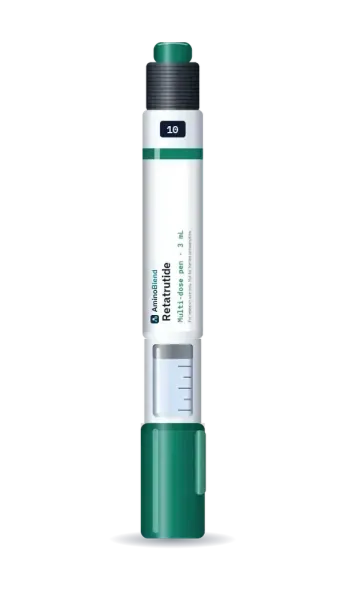
Retatrutide Pen
10 mg pen, 3 mL
$149
Research use only. AminoBlend supplies research compounds for laboratory and in-vitro use, not for human or animal consumption. By continuing you confirm you are 18 or older and buying for research.
In stock, ready to ship from Australia
Size: 50 mg vial
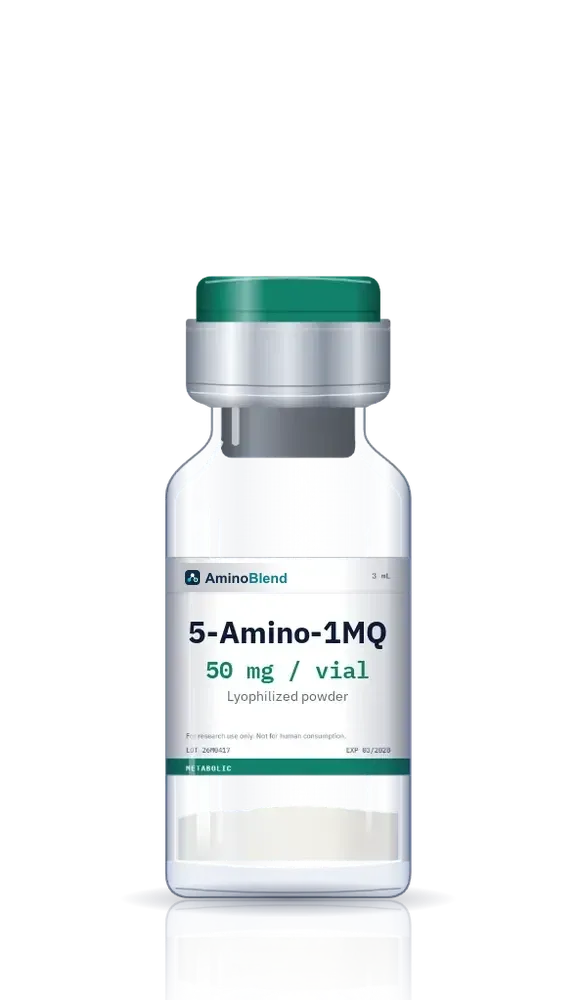
Buy 5 Amino 1MQ Australia-wide from local stock as a 50 mg research vial for $79. This is a small molecule rather than a peptide, 5-amino-1-methylquinolinium, a quinolinium cation (C10H11N2+, about 159 g/mol) supplied as a salt that labs use to inhibit nicotinamide N-methyltransferase (NNMT) inside intact cells. Shop with the lot report available, since every lot is confirmed by mass spectrometry and checked for purity by HPLC, and the certificate of analysis is viewable before checkout. Order NAD+ in the same cart to connect NNMT inhibition with the cofactor it spares. The vial ships as dry solid without solvent, so add bacteriostatic water and prepare only the stock solution the next few weeks of work need. Keep the sealed vial dry, dark and cold, at -20 °C for long holding. It sits in our metabolic peptides range and is supplied as a laboratory reagent to adults 18 and over for in vitro research only.
For laboratory research use only. Not for human or veterinary use. Not TGA approved. See our research use policy.
| Name | 5-Amino-1MQ (5-amino-1-methylquinolinium) |
|---|---|
| Sizes and prices | 50 mg vial, $79 AUD |
| Sequence or structure | Methylquinolinium cation with an amino group at position 5, supplied as a salt, a small molecule with no amino acids or peptide bonds |
| Molecular formula | C10H11N2+ (cation) |
| Molar mass | About 159 g/mol for the cation, with the salt form stated on the certificate |
| Form | Dry solid in a sealed glass vial |
| Testing | Mass spectrometry for identity and HPLC for purity, documented on a certificate per lot |
| Contents | One vial holding 50 mg of 5-Amino-1MQ, solvent not included |
| Storage | Sealed vial dry and dark at -20 °C for long holding, stock solution at 2 to 8 °C |
| Availability | In stock |
| Use | In vitro laboratory research only |
Order 5-Amino-1MQ for work on NNMT, the methyl pool and NAD+ salvage. One 50 mg fill goes a long way at micromolar working concentrations, and each lot is traced from test to label.
5-Amino-1MQ is a small laboratory compound that blocks NNMT, an enzyme that uses up nicotinamide inside cells, and it is studied to see how fat and muscle cells behave when that enzyme is switched off. Searchers often call it the 5 amino 1MQ peptide, but it is a single ring-based molecule rather than a chain of amino acids, and that distinction shapes how it behaves in an experiment.
To see why anyone would want to block NNMT, follow the nicotinamide. Every time a cell spends NAD+ on signalling enzymes such as sirtuins or PARPs, nicotinamide is left over. Most of it goes back through the salvage pathway, where the enzyme NAMPT turns it into NMN and then into fresh NAD+. NNMT competes for the same pool. It tags nicotinamide with a methyl group taken from SAM, the cell's main methyl donor, and the methylated product cannot be recycled. So an active NNMT drains two pools at once: the nicotinamide that would have rebuilt NAD+, and the SAM that supplies methyl groups for DNA and histone marks.
The target came first. In 2014 a team led by Barbara Kahn at Beth Israel Deaconess and Harvard published a Nature paper showing that NNMT expression rises in the white fat and liver of obese and diabetic mice, and that knocking the gene down in those tissues protected mice from diet-induced obesity by raising energy expenditure. Adipose SAM and NAD+ both went up when NNMT was suppressed. That result gave medicinal chemists a reason to look for a drug-like inhibitor, and the Galveston methylquinolinium series followed. In the 2018 obese-mouse study, treated animals lost body weight and white fat over 11 days with no change in food intake, and their fat cells were smaller, a pattern the authors read as increased fat use rather than reduced eating.
Our practical advice is to check NNMT before buying anything else. Expression varies enormously between cell types and even between undifferentiated and differentiated cultures of the same line, and an inhibitor added to cells with little NNMT will produce a flat result that says nothing about the compound. Confirm expression by western blot or qPCR first. Then measure 1-methylnicotinamide, the enzyme's direct product, by LC-MS as your engagement marker. NAD+ levels drift with culture density and medium, so they make a weak primary readout on their own.
Shop it beside research peptides because it comes in the same style of vial, but chemically 5-Amino-1MQ is a compact aromatic cation with no amino acids at all. Its small size and permanent positive charge still let it cross cell membranes, which is the property that first drew researchers to the methylquinolinium series. A group at the University of Texas Medical Branch published the key work in Biochemical Pharmacology in 2018, describing membrane-permeable NNMT inhibitors in diet-induced obese mice.
The lab question is direct. What happens to a cell's methyl balance and NAD+ recycling when NNMT is blocked? Reports of 5 amino 1MQ benefits in that literature are preclinical observations in cells and mice, and the vial is a reagent for that work, with no published human trials and no connection to any medicine.
What is 5-Amino-1MQ in physical terms? A single vial with a green flip-off cap and a white label, holding 50 mg of dry solid salt. There is no liquid, no peptide and no carrier blended in. Because the counter-ion makes up part of the weighed mass, the certificate for each lot names the salt form, and that figure, not the bare cation, is the one to use when converting milligrams into a molar stock.
The compound comes from academic medicinal chemistry rather than a drug company pipeline. Researchers at the University of Texas Medical Branch in Galveston explored a series of methylquinolinium compounds as NNMT inhibitors, and 5-amino-1-methylquinolinium was the analogue they carried forward into cell and mouse studies. It has not been approved as a medicine by any regulator we could find, and as of October 2026 we found no product containing it on the Australian Register of Therapeutic Goods. That means there is no prescription version, no pharmacy supply and no TGA evaluation behind it.
With no medicine to buy, the only source is a chemical supplier selling it as a laboratory reagent, which is how research groups obtain it. AminoBlend keeps the 50 mg vial in Australian stock, available to order online by adults 18 and over, and supplies it strictly for in vitro work, never for human or veterinary use. Labs that buy 5-Amino-1MQ in Australia often add a second small molecule from the same metabolic group, such as the ERR agonist SLU-PP-332, so that an enzyme inhibitor and a nuclear receptor agonist can be compared on one plate.
Buy the single size that covers nearly every buyer. NNMT inhibitor studies in culture run at micromolar concentrations, and a molecule of about 159 g/mol packs a large number of micromoles into 50 mg. At $79 the vial costs $1.58 per milligram, and one fill usually outlasts a full programme of cell work.
Order the vials you need for multi-site studies or a long screen in one checkout from one lot wherever stock allows, so every arm traces back to a single certificate. Sales are open to adults 18 and over only.
Because the compound is a stable small molecule, the dry vial keeps well, which makes it practical to hold one sealed reserve vial from the same lot for replication work later in the year.
The structure is a quinoline ring methylated on its nitrogen, which gives the permanent positive charge, with an amino group at position 5 that sets its fit in the NNMT active site. It is supplied as a salt, so the weighed mass includes a counter-ion as well as the active cation.
When reading the certificate, look for the cation mass near 159 on the mass spectrum, the stated salt form and the HPLC purity for your lot. All reports sit in the COA library under the lot code on the label, ready to download before or after purchase. A lot that misses its specification is withheld from sale rather than discounted.
AminoBlend sells online only, dispatching from stock kept in Australia to any address in the country, from inner-city labs buying peptides in Newcastle to regional campuses. Pay before 3pm on a business day and the vial goes out that day, and the delivery information page covers the services.
Buy a solvent separately, as none is supplied. Many labs dissolve the compound in bacteriostatic water, letting the vial reach room temperature first, then adding the liquid and swirling until clear. Five mL in the 50 mg vial gives 10 mg/mL, and the general concentration calculator handles other volumes. Before converting to molarity, use the full salt mass from the certificate rather than the cation alone, or every working dilution will be off.
Keep the sealed vial dry and dark at -20 °C for long holding. Once dissolved, store the stock at 2 to 8 °C, protected from light, and use it within 28 days, leaving whatever you do not need yet as dry solid.
The compound is written 5-amino-1MQ, 5-amino 1MQ, 5amino1MQ and 5 amino 1 MQ, and spelled out as 5-amino-1-methylquinolinium or 5-amino-1-methylquinolin-1-ium. Salt forms add a suffix such as iodide. Some shops list it as 5 amino 1MQ peptide, although it has no peptide bonds.
The enzyme it targets is nicotinamide N-methyltransferase, abbreviated NNMT. That enzyme moves a methyl group from S-adenosylmethionine (SAM) onto nicotinamide, producing 1-methylnicotinamide (1-MNA) and S-adenosylhomocysteine (SAH). NNMT is expressed at high levels in liver and adipose tissue, which is where most of the preclinical 5-Amino-1MQ work has been done.
They work at two ends of one pathway. 5-Amino-1MQ blocks the enzyme that diverts nicotinamide away from recycling, while NAD+ is the coenzyme itself, added directly. Order 5-Amino-1MQ to study what happens when the salvage route is protected, NAD+ when you need the cofactor in the medium, and both to compare the two approaches in one design.
For a receptor-level angle on the same metabolic programmes, SLU-PP-332 is another small molecule, an agonist of the estrogen-related receptors, while AOD-9604 offers a peptide route into fat cell metabolism. Either one sits well beside this NNMT inhibitor in a single order.
A methylquinolinium cation of about 159 g/mol that blocks nicotinamide N-methyltransferase inside intact cells. Not a peptide.
One sealed 50 mg vial for $79, about $1.58 per milligram, with solvent sold separately.
NAD+ salvage, methyl balance and adipocyte metabolism, published in cell and rodent models and sold for in vitro use.
Protects the recycling route rather than supplying the coenzyme, so shop both to compare the two.
Sealed vial dry and dark in the freezer, stock solution in the fridge and used within 28 days.
Mass spectrometry and HPLC on each lot, with the salt form and results on its published certificate.
Add the 50 mg vial to your cart from this page for $79. It ships from Australian stock, and payments cleared before 3pm on a business day go out the same afternoon with tracking. The lot certificate can be read first, and a solvent such as bacteriostatic water is ordered as a separate item.
Buy it through our online store from anywhere in Australia. Because we run no walk-in counter, every order is filled from the same local stock and each vial carries its published lot certificate, whether the parcel is heading to a capital city or a regional town.
No. It is 5-amino-1-methylquinolinium, a small aromatic cation of about 159 g/mol supplied as a salt, with no amino acids or peptide bonds. It is stocked beside research peptides because it comes in the same vial format and is handled in a similar way at the bench.
Yes. Every lot goes through mass spectrometry for identity and HPLC for purity, and the certificate also states the salt form. It is published in our COA library under the lot code on the vial, so you can review it before you order and keep it on file.
Choose 5-Amino-1MQ to study what happens when NNMT is blocked and nicotinamide is spared for recycling. Choose NAD+ when your assay needs the coenzyme itself. Ordering both lets one design compare protecting the salvage route with supplying the end product directly.
Usually a full programme. Culture studies with NNMT inhibitors run at micromolar concentrations, and a cation of about 159 g/mol yields many micromoles per milligram. Dissolve only what the coming weeks need, keep the rest dry and frozen, and the vial covers repeated series from one lot.
10 mg pen, 3 mL
2 mg vial
