
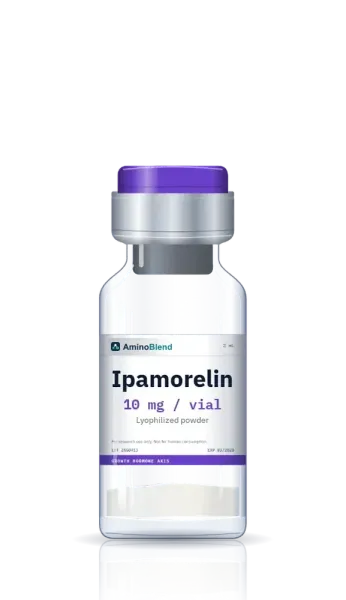
Ipamorelin
10 mg vial
$59
Research use only. AminoBlend supplies research compounds for laboratory and in-vitro use, not for human or animal consumption. By continuing you confirm you are 18 or older and buying for research.
In stock, ready to ship from Australia
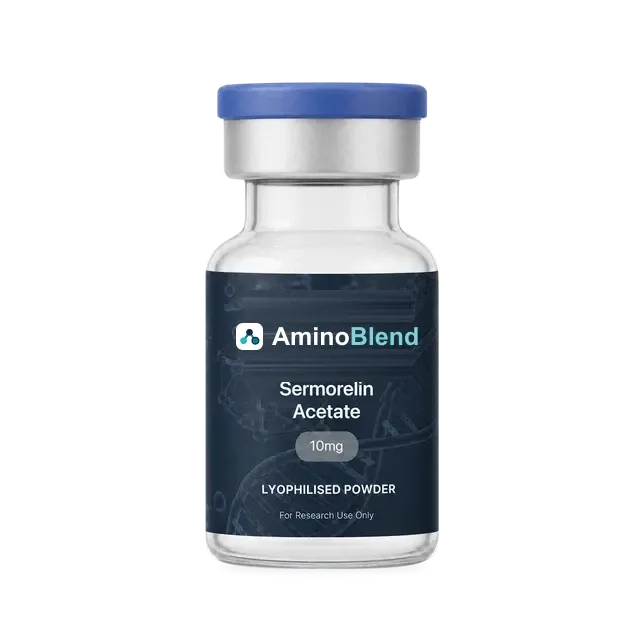
Size: 10 mg vial
Buy sermorelin acetate online from sermorelin Australia stock as a 10 mg lyophilised vial for $89, dispatched from local shelves. Sermorelin is GHRH (1-29) amide, the first 29 residues of human growth hormone releasing hormone with no substitutions, and it activates the GHRH receptor on pituitary somatotrophs just as the native sequence does. Its identity references are C149H246N44O42S, 3357.9 g/mol and CAS 86168-78-7. Order with the lot report already checked, since each batch is analysed by mass spectrometry for identity and by HPLC for purity, and the certificate can be read in the COA library before you pay. The peptide calculator turns your diluent volume into a concentration. Shop CJC-1295 No DAC in the same cart to compare the native fragment with its stabilised relative. The vial contains powder only, with no diluent, so include bacteriostatic water. Hold the sealed sermorelin vial at -20 °C away from light. A reagent for in vitro laboratory research, available to buyers aged 18 and over.
For laboratory research use only. Not for human or veterinary use. Not TGA approved. See our research use policy.
| Name | Sermorelin acetate |
|---|---|
| Sizes and prices (AUD) | 10 mg vial, $89 |
| Sequence or structure | YADAIFTNSYRKVLGQLSARKLLQDIMSR-NH2, human GHRH (1-29) amide |
| Length | 29 amino acids |
| Molecular formula | C149H246N44O42S (peptide) |
| Molar mass | 3357.9 g/mol (free base) |
| CAS number | 86168-78-7 |
| Form | Lyophilised acetate salt in a sealed glass vial |
| Testing | Mass spectrometry identity, HPLC purity, certificate attached to each lot |
| Contents | One vial with 10 mg sermorelin acetate, shipped without diluent (bacteriostatic water sold separately) |
| Storage | Sealed at -20 °C, shielded from light and humidity, and in solution at 2 to 8 °C for a short period |
| Availability | In stock |
| Use | Laboratory in vitro research only |
Order sermorelin when the study needs the GHRH receptor activated by the unmodified sequence. The 10 mg vial is held in Australia with HPLC data for every lot, and the sections below cover identity checks, mixing and the choice against stabilised analogues.
Sermorelin is a copy of the first 29 amino acids of the brain's own growth hormone releasing signal, made synthetically and left exactly as nature wrote them. It is the smallest piece of GHRH that still works at full strength, which makes the sermorelin peptide the plainest available way to switch on the GHRH receptor in a pituitary model.
The story behind sermorelin is stranger than most. Physiologists had suspected for decades that the hypothalamus sent a releasing factor for growth hormone, but the quantities in brain tissue were far too small to purify. The breakthrough came from the pancreas. Rare pancreatic tumours in a few patients with acromegaly were secreting a hormone that made their pituitaries overproduce growth hormone. In 1982 two groups at the Salk Institute, one under Roger Guillemin and one under Wylie Vale and Jean Rivier, sequenced it from that tumour tissue, and it proved identical to the hypothalamic hormone. Truncation studies soon showed that the front 29 residues, with an amide at the end, matched the activity of all 44.
Most of the information sits at the amino end. The first few residues, tyrosine, alanine and aspartic acid, are needed for receptor activation, while the remainder forms a helix that holds the peptide in the binding site. That is also why the molecule is fragile: the activating end is exactly where DPP-4 cuts. Once bound, the receptor raises cyclic AMP in the somatotroph, and growth hormone is released in a brief pulse that follows the timing of the stimulus.
Human research on the fragment is older than most peptide literature. In a small 1992 clinical study, Corpas and colleagues gave GHRH 1-29 to older men for two weeks; at the higher of two doses, 24-hour growth hormone and IGF-1 rose to levels no longer different from those of young men. That paper is still cited as evidence that the ageing pituitary keeps a reserve which the right signal can call on.
Our view on what sermorelin acetate is for in a modern lab: it is the control every newer analogue implicitly measures itself against. Claims for Mod GRF, tesamorelin or the DAC conjugate are all claims of improvement over the native fragment, and the most convincing demonstration is to run the original in the same plate. The guide comparing the GHRH analogue family places all four side by side.
GHRH was isolated in 1982 as a 44 amino acid hormone, and structure work soon showed that the amidated 1-29 segment carried most of its activity. That synthetic fragment became sermorelin, which was registered in the United States as Geref and used to probe pituitary growth hormone reserve before it left the market. Its activity is brief, with a half-life of roughly 10 to 20 minutes, which is precisely what makes it useful as a baseline. Today it is a common laboratory reagent.
Buy sermorelin to give a lab the unmodified reference for the GHRH pathway, a way to characterise the receptor, measure pituitary secretory capacity in ageing models, or benchmark newer analogues against the original. It is sold here as a research reagent, not a medicine, within our GH peptide category.
The vial holds 10 mg of sermorelin acetate as a lyophilised white powder, the acetate being the counter-ion left from purification rather than a second ingredient. Unlike most compounds in our growth hormone range, this one has been a finished medicine. Serono sold it in the United States as Geref, approved in 1997 for idiopathic growth hormone deficiency in children with growth failure, alongside a diagnostic version for testing pituitary reserve. EMD Serono told the FDA in 2008 that it was discontinuing the product, approvals were withdrawn in June 2009, and the FDA later found the withdrawal was not for reasons of safety or effectiveness.
Is sermorelin legal in Australia? It is a prescription-only substance with no product behind it. Sermorelin has its own Schedule 4 entry in the June 2026 Poisons Standard, still current in October 2026, and Appendix D, clause 5, which bars possession without authority, extends to growth hormone releasing hormones "including those separately specified in Schedule 4", wording that brings sermorelin in as well. Neither sermorelin nor Geref brings up a document in the TGA's product information search, and we found no current ARTG registration, so a prescriber here has no registered sermorelin product to write for.
On the sporting side, WADA's 2026 list names sermorelin as a GHRH analogue in class S2, alongside CJC-1295 and tesamorelin, and Sport Integrity Australia applies that prohibition at all times.
That gap between a known molecule and an empty pharmacy shelf is why sermorelin Australia supply comes from research suppliers. Our 10 mg vial is one such reagent: in stock in Australia, available to customers 18 or older, and intended for in vitro study rather than any use in humans or animals. Labs studying the full 44 residue hormone can compare it with the tesamorelin vials in three sizes.
Order sermorelin in one fill, a 10 mg vial at $89, or $8.90 per mg. That sits a little above the stabilised CJC-1295 No DAC vial per milligram and below tesamorelin at the same fill, which is $99. Ten milligrams is the common research size for GHRH (1-29) peptides, and with a fragile native sequence, labs often mix only part of their stock at a time and keep the remaining vials sealed.
All sermorelin vials in one order come from a single lot wherever stock allows, so there is one certificate to file for the whole series. Purchases require the buyer to confirm they are 18 or older and to accept the research use terms.
Sermorelin keeps residues 1 to 29 of human GHRH without a single substitution, from the opening tyrosine to the amidated arginine. The sulphur in methionine 27 accounts for the S in its formula and is also its weak point, since that residue can oxidise. The acetate counter-ion does not change the active chain, and the identity data refer to the peptide itself.
Because sermorelin and Mod GRF (1-29) share a backbone, mass is the decisive check. A result near 3357.9 g/mol identifies sermorelin, while one near 3367.9 g/mol would point to the stabilised analogue. Look up your lot in the certificate archive and compare it with the guide to COA interpretation.
Sermorelin is not kept at any counter or pickup point. The online store is the only way to buy, it serves labs from Perth to Hobart, and every order leaves from one domestic stock. Buyers of research peptides in Perth receive the very same lots as labs in the east. Payment cleared before 3pm on a business day means same-day dispatch, and timeframes appear on the delivery information page.
Two weaknesses shape handling. DPP-4 cuts the Ala2-Asp3 bond within minutes, and Met27 can oxidise. Reconstitute only when needed, running bacteriostatic water down the glass without agitation. Adding 2.5 mL to the 10 mg vial gives 4 mg/mL, and the concentration calculator works out any other volume.
Store the powder at -20 °C in the dark until use. The solution goes to 2 to 8 °C, and since the native sequence is less stable than its analogues, aliquoting it and finishing it well within 28 days is good practice. Label every aliquot with the lot number and mixing date so results trace back to the right certificate.
Sermorelin acetate is also listed as GRF (1-29) NH2, GHRH (1-29) amide, somatorelin fragment 1-29 or by its former US brand name, Geref. Some older papers call the parent hormone somatocrinin or growth hormone releasing factor, which is where the GRF abbreviation comes from.
Its receptor is GHRHR, a Gs-coupled receptor that raises cAMP inside somatotrophs. Downstream, the growth hormone it releases drives hepatic IGF-1, the marker most GH axis studies record.
CJC-1295 No DAC, the Mod GRF (1-29) analogue, uses the same 29 residue frame with four substitutions that resist DPP-4, giving a half-life near 30 minutes against the 10 to 20 minutes reported for sermorelin. It costs $79 for 10 mg. Order sermorelin when the native sequence is the point of the study, and the stabilised version when a longer window matters more than fidelity to the natural hormone.
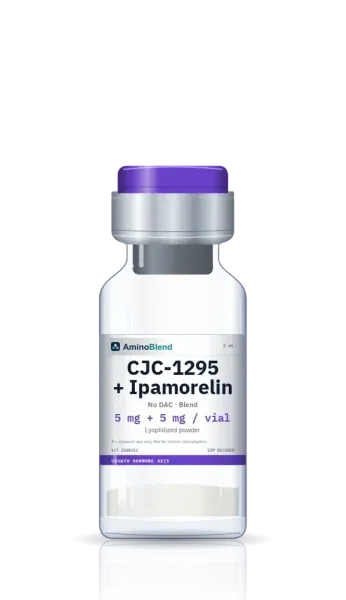
Ipamorelin works on a different receptor altogether, the ghrelin receptor GHS-R1a, and sells as a 10 mg vial for $59. A sermorelin ipamorelin CJC 1295 design covers both pituitary inputs with a native and a stabilised GHRH arm. Tesamorelin takes a third GHRH route, keeping all 44 residues behind an N-terminal cap, and sermorelin remains the least expensive way to keep an unmodified control in that comparison.
Sermorelin is the first 29 residues of human GHRH with a C-terminal amide and no substitutions. It acts on the same receptor as the full hormone.
A sealed 10 mg vial of sermorelin acetate costs $89 and ships from Australian stock. No diluent comes with it, so add bacteriostatic water.
Used in the lab to characterise the GHRH receptor and pituitary growth hormone reserve, and as the baseline for newer analogues. Research use only.
CJC-1295 No DAC has four protective substitutions and lasts about 30 minutes. Sermorelin is the native sequence and acts for 10 to 20 minutes.
Keep the powder at -20 °C. The native chain is fragile in solution, so reconstitute only when needed and hold aliquots at 2 to 8 °C.
Mass spectrometry separates sermorelin from Mod GRF, and HPLC measures purity. Each lot certificate is published in the COA library.
Add the 10 mg sermorelin acetate vial to your cart on this page and complete checkout. The price is $89 and stock is held in Australia, so when payment clears before 3pm on a business day the vial ships the same day. Include bacteriostatic water in the order, since the vial holds powder only.
Choose a supplier that ships from local stock and shows the lot certificate before checkout. AminoBlend sells sermorelin online only, with no shop or pickup point, and sends vials from the same tested lots to every state and territory, whether the lab is in Perth, Brisbane or a regional centre.
Documentation, more than any label. There is no sermorelin peptide best brand in a regulatory sense, so judge a supplier by whether each lot has a mass result near 3357.9 g/mol, an HPLC purity figure and a certificate you can match to the vial. Every AminoBlend lot is published in the COA library.
Sermorelin is the native GHRH (1-29) fragment and acts on the GHRH receptor for 10 to 20 minutes. Ipamorelin is a five residue agonist of the ghrelin receptor GHS-R1a, sold as a 10 mg vial for $59. They reach the pituitary by separate routes, so many labs order both to compare the two inputs.
The native sequence has no protective substitutions, so DPP-4 cleaves it quickly and methionine 27 can oxidise. Keep the powder frozen at -20 °C, reconstitute only when the work is ready, avoid shaking and store the solution at 2 to 8 °C in aliquots for a short period.
Sermorelin is a research reagent used to activate the GHRH receptor with the unmodified sequence, to study pituitary growth hormone release and to benchmark stabilised analogues. It is not a medicine, holds no TGA approval and is sold for in vitro and laboratory research only, to adults aged 18 and over.
10 mg vial
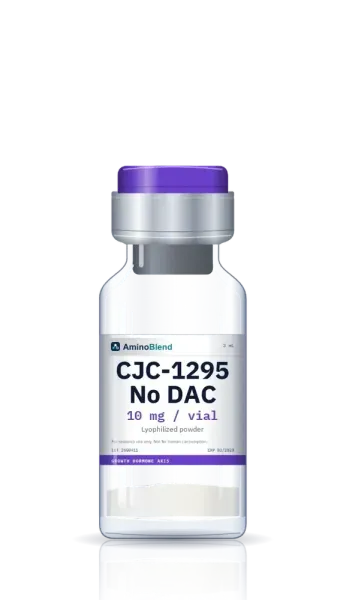
10 mg vial
5 mg vial
10 mg vial