
Ipamorelin
10 mg vial
$59
Research use only. AminoBlend supplies research compounds for laboratory and in-vitro use, not for human or animal consumption. By continuing you confirm you are 18 or older and buying for research.
In stock, ready to ship from Australia
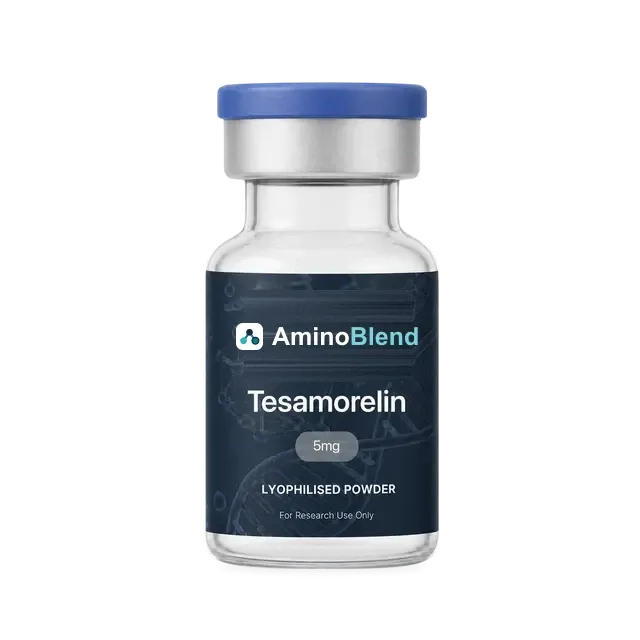
Buy tesamorelin Australia stock online in 5 mg, 10 mg and 20 mg lyophilised vials at $89.99, $99 and $179, packed and shipped from local shelves. Developed as TH9507, tesamorelin keeps all 44 amino acids of human growth hormone releasing hormone and adds a trans-3-hexenoyl group to the N-terminal tyrosine, which shields it from DPP-4 cleavage while it binds the pituitary GHRH receptor. Its identity data are C221H366N72O67S, 5135.9 g/mol and CAS 218949-48-5. Order with the paperwork in hand, because each lot is confirmed by mass spectrometry and measured by HPLC, and its certificate of analysis opens in the COA library before checkout. The tesamorelin calculator converts the diluent you add into a working concentration. Shop sermorelin in the same order to compare the full chain with the native 29 residue fragment. Vials ship as powder without diluent, so add bacteriostatic water. Store sealed vials at -20 °C away from light. Supplied as a laboratory reagent for in vitro work and sold only to buyers aged 18 and over.
For laboratory research use only. Not for human or veterinary use. Not TGA approved. See our research use policy.
| Name | Tesamorelin |
|---|---|
| Sizes and prices (AUD) | 5 mg vial $89.99, 10 mg vial $99, 20 mg vial $179 |
| Sequence or structure | Human GHRH (1-44) amide with a trans-3-hexenoyl group on Tyr1 |
| Length | 44 amino acids |
| Molecular formula | C221H366N72O67S |
| Molar mass | 5135.9 g/mol |
| CAS number | 218949-48-5 |
| Form | Lyophilised powder in a sealed glass vial with rubber stopper and flip-off cap |
| Testing | Mass spectrometry for identity, HPLC for purity, certificate for every lot |
| Contents | One vial of 5 mg, 10 mg or 20 mg tesamorelin, no diluent supplied (bacteriostatic water sold separately) |
| Storage | Sealed vial at -20 °C, kept dark and dry, and reconstituted solution at 2 to 8 °C |
| Availability | In stock |
| Use | Laboratory in vitro research only |
Order tesamorelin when the work needs the complete GHRH sequence rather than a truncated fragment. Three fills are held in Australian stock, every lot is documented by HPLC, and the size guide below matches the vial to your study.
Tesamorelin is a man-made copy of GHRH, the 44-amino-acid hormone that switches on growth hormone output, with one small fatty cap added at the front so enzymes cannot dismantle it straight away. The pituitary answers it by letting out growth hormone in its usual rhythm. Of all the GHRH analogues on the market, it is the one with a finished phase 3 programme behind it.
Native GHRH is cut between its second and third residues, alanine and aspartic acid, by the enzyme DPP-4, and the shortened chain is close to inactive. Tesamorelin answers that with a trans-3-hexenoyl group, a six-carbon acyl chain with one double bond, fixed to the opening tyrosine. The cap leaves the receptor-binding surface untouched, so the molecule still fits the somatotroph receptor for GHRH and still triggers the cyclic AMP signal that releases stored growth hormone.
What makes this route interesting to researchers is the feedback loop it keeps. Growth hormone given directly overrides the system. A GHRH agonist works upstream, so somatostatin and IGF-1 can still rein the pituitary in, and the output stays pulsatile rather than flat.
The best known data set is a 2007 New England Journal of Medicine trial by Falutz and colleagues. It randomised 412 adults with HIV and abdominal fat accumulation, 275 to tesamorelin and 137 to placebo, for 26 weeks, and measured visceral fat by CT scan at the level of the abdomen. Visceral fat area fell by 27.8 square centimetres in the active group and rose by 5.1 square centimetres with placebo, and the authors also reported better lipid profiles. Later work by Stanley and colleagues extended the question to liver fat in the same population. Every one of those studies sits within an HIV context, and nothing in them describes the compound outside it.
Our practical view: because it is the only GHRH analogue with large controlled trials behind it, tesamorelin makes the most defensible reference agonist when results need to sit beside the clinical literature. Plan by moles, not milligrams. At 5135.9 g/mol it is about 1.5 times heavier than sermorelin, so an equimolar comparison needs roughly half as much mass again. Labs asking for the best peptide to pair with tesamorelin will find the ghrelin receptor partner already combined in the tesamorelin and ipamorelin vial.
Theratechnologies in Montreal built tesamorelin by keeping the whole 44 residue human hormone and attaching a single hexenoyl cap to its first amino acid. Native GHRH is cut by DPP-4 within minutes, and the cap slows that cleavage while leaving receptor binding intact. The compound was approved in the United States in 2010 as Egrifta for a narrow indication, and the trial literature behind that decision is one reason tesamorelin is so well represented in published GH axis work.
For a lab, the question it answers is what the complete hormone does at the GHRH receptor when it survives long enough to be measured. Buy it here as a research reagent with no therapeutic standing and no TGA approval, listed among our growth hormone peptides. Every tesamorelin peptide Australia order is drawn from the same tested stock, whichever fill you choose.
Whichever fill you pick, 5 mg, 10 mg or 20 mg, the vial holds the same lyophilised white powder and nothing else, ready for a diluent of your choosing. Theratechnologies took the compound, then coded TH9507, through phase 3 trials in the 2000s, and the US Food and Drug Administration approved it on 10 November 2010 as Egrifta, for reducing excess abdominal fat in adults with HIV-associated lipodystrophy. Two reformulations followed in the United States, Egrifta SV and then Egrifta WR, cleared in March 2025, while the European filing was withdrawn in 2012 before a decision.
Australia never received a tesamorelin medicine. A search of the TGA's product information repository returns no tesamorelin or Egrifta document as of October 2026, we found no ARTG registration for it, and no pharmacy product is available to order on prescription. The Poisons Standard does not list tesamorelin by name, but it does not need to: the June 2026 instrument places growth hormone releasing hormones as a class in Schedule 4 and in Appendix D, clause 5, and a GHRH (1-44) analogue sits squarely inside that class. That leaves research suppliers as the only realistic source of tesamorelin Australia laboratories can buy.
WADA names tesamorelin beside sermorelin and CJC-1295 in the GHRH analogue group of class S2 on its 2026 Prohibited List, a ban Sport Integrity Australia applies at all times.
All three sizes of tesamorelin for sale here sit in AminoBlend's Australian stock as laboratory reagents, with checkout open only to adults and use confined to in vitro research, not humans or animals. Groups that want a shorter GHRH comparator alongside it often choose CJC-1295 No DAC in its 10 mg vial.
The tesamorelin buy decision comes down to fill size, because all three vials contain the same peptide made to one specification. The 5 mg vial at $89.99 ($18.00 per mg) suits a pilot or a handling check. The 10 mg vial at $99 ($9.90 per mg) is the standard research fill and the usual first order, since doubling the material adds little to the bill. The 20 mg vial at $179 ($8.95 per mg) is the value pick once a protocol is settled and the full fill can be used inside the 28 days after mixing.
Order several vials of one size in a single checkout and they stay on the same lot wherever stock allows and the same certificate. Labs unsure which fill to take usually start with 10 mg and step up once the method holds. Checkout is restricted to adults aged 18 and over.
The sequence reads YADAIFTNSYRKVLGQLSARKLLQDIMSRQQGESNQERGARARL-NH2, with the trans-3-hexenoyl group on Tyr1. With 44 residues, synthesis leaves more room for deletion and truncated sequences than a short peptide does, and those near-miss products can sit close to the main HPLC peak. That is why the mass result matters as much as the purity figure.
Confirm that the certificate reports a mass consistent with 5135.9 g/mol and an HPLC result for the lot printed on your vial. Reports sit in the COA library by lot number, and the guide to reading a COA explains how the two results fit together.
AminoBlend is an online store with no walk-in counter, so every order ships from one domestic stock to all states and territories. Payment received before 3pm on a business day means the vial is dispatched that afternoon, and you can follow it on track order. Labs needing research peptides in Hobart are supplied from that one stock too.
Reconstitute by bringing the vial to room temperature, adding bacteriostatic water slowly against the glass and swirling rather than shaking. As an example, 2 mL in the 10 mg vial gives 5 mg/mL. The tesamorelin calculator covers the 5 mg and 20 mg fills and any other volume.
Sealed vials keep best at -20 °C in their carton. Mixed solution goes to 2 to 8 °C and should be finished inside 28 days, and aliquots spare the stock from repeated handling. The storage guide explains the difference between powder and solution stability.
Tesamorelin appears as TH9507 in development papers, as tesamorelin acetate when supplied as the acetate salt, and under the brand name Egrifta in regulatory records. Chemically it is described as N-(trans-3-hexenoyl)-GHRH (1-44) amide, or more loosely as a stabilised human GRF analogue.
Its target is the GHRH receptor, GHRHR, on pituitary somatotrophs. Papers on the downstream axis use GH for growth hormone and IGF-1 for insulin-like growth factor 1, the liver-derived marker most studies measure. Whatever name a protocol uses, the identity check stays the same, a 44 residue chain with a mass near 5135.9 g/mol.
Sermorelin is the native GHRH (1-29) amide with no protection, a 10 mg vial for $89, and its activity lasts only minutes. Tesamorelin keeps the 15 extra residues and adds the cap, so it is longer and more resistant to enzymatic breakdown. Sermorelin suits work that needs the unmodified fragment as a control, while tesamorelin suits work on the complete hormone. Both arrive as powder and mix the same way.
Shop the tesamorelin and ipamorelin blend instead if you also want a ghrelin receptor signal in the same vial, carried at 13 mg plus 3 mg.
Tesamorelin is all 44 residues of human GHRH with a hexenoyl cap on the first amino acid. The cap slows enzymatic cleavage without changing receptor binding.
Sealed vials of lyophilised powder at $89.99, $99 and $179 from Australian stock. Diluent is sold separately, so add bacteriostatic water to the cart.
Studied for GHRH receptor activation, pulsatile growth hormone release and the IGF-1 axis. Supplied strictly for in vitro and laboratory work.
Sermorelin is the bare 29 residue fragment and acts for minutes. Tesamorelin is longer, capped and more resistant to breakdown.
Keep sealed vials at -20 °C. Once mixed, store the solution at 2 to 8 °C, divide it into aliquots and use it within 28 days.
Mass spectrometry and HPLC are run on every lot, and the certificate can be checked in the COA library before ordering.
Choose 5 mg, 10 mg or 20 mg on this page, add the vial to your cart and check out. Prices are $89.99, $99 and $179, and stock sits in a local warehouse, so any order paid by 3pm on a business day goes out the same day. Add bacteriostatic water, because the vial contains powder only.
Look for a supplier that publishes the lot certificate before you pay and ships from local stock. The best tesamorelin peptide for research is one whose mass and purity you can check against the vial label. AminoBlend sells online only, with no physical shop, and delivers the same tested lots to every state and territory.
Yes. Each lot is confirmed by mass spectrometry against the expected 5135.9 g/mol and measured by HPLC for purity. The certificate carries the lot number on your vial and can be viewed in the COA library at any time, including before you buy.
Choose tesamorelin when the study concerns the complete 44 residue GHRH sequence in a form that resists rapid breakdown. Choose sermorelin, a 10 mg vial at $89, when you need the unmodified 29 residue fragment as a control or to replicate older work. Some labs order both for a direct comparison.
The 10 mg vial at $99 suits most first orders and costs $9.90 per mg. Take 5 mg for a low-outlay pilot, or 20 mg at $8.95 per mg for a settled, longer series. Pick the size your lab will use within 28 days of mixing, since solution does not keep as well as powder.
Among the best peptides to stack with tesamorelin for comparison work are ipamorelin, which adds a ghrelin receptor signal, and sermorelin or CJC-1295 No DAC as shorter GHRH controls. The tesamorelin and ipamorelin blend already combines the first pair at 13 mg to 3 mg. All are sold for laboratory research only.
10 mg vial
10 mg vial
5 mg vial
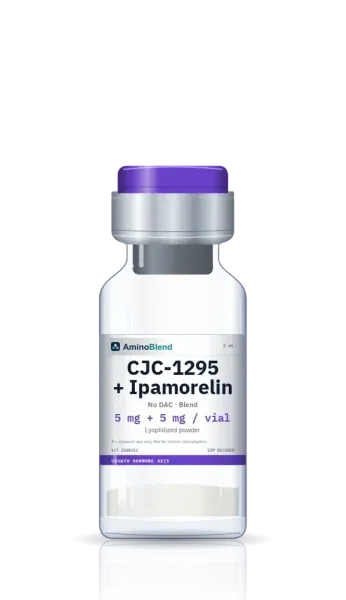
10 mg vial