
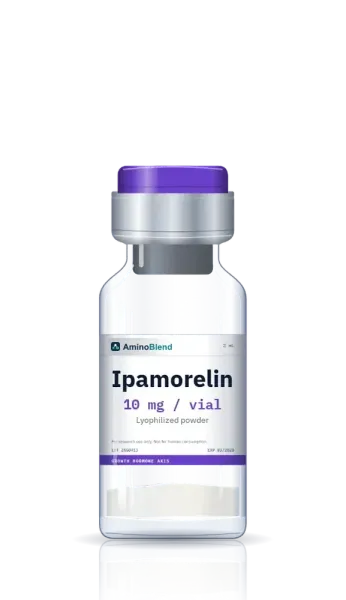
Ipamorelin
10 mg vial
$59
Research use only. AminoBlend supplies research compounds for laboratory and in-vitro use, not for human or animal consumption. By continuing you confirm you are 18 or older and buying for research.
In stock, ready to ship from Australia
Size: 10 mg vial
Buy CJC 1295 No DAC online in Australia as a 10 mg lyophilised vial of Mod GRF (1-29) for $79, held in local stock and shipped with its lot certificate already published. This 29-residue GHRH analogue keeps the active core of growth hormone releasing hormone with four substitutions, D-alanine at 2, glutamine at 8, alanine at 15 and leucine at 27, that slow enzyme breakdown. It carries no drug affinity complex, so its reported half-life stays near 30 minutes. Identity markers are C152H252N44O42 and 3367.9 g/mol, and mass spectrometry also separates it from the DAC version, which reads near 3647. Every lot is HPLC tested before release. Order with the CJC-1295 and ipamorelin calculator open to plan concentrations. Add ipamorelin to the same order for ghrelin and GHRH synergy work. The vial ships as powder with no diluent included, so order bacteriostatic water with it. Freeze the unopened vial at -20 °C in its carton. The product is a laboratory reagent and is only sold to customers who are 18 or older.
For laboratory research use only. Not for human or veterinary use. Not TGA approved. See our research use policy.
| Name | CJC-1295 No DAC (Modified GRF 1-29) |
|---|---|
| Sizes and prices (AUD) | 10 mg lyophilised vial at $79 |
| Sequence or structure | GHRH (1-29) amide with D-Ala2, Gln8, Ala15 and Leu27 substitutions, no DAC |
| Length | 29 amino acids |
| Molecular formula | C152H252N44O42 |
| Molar mass | 3367.9 g/mol |
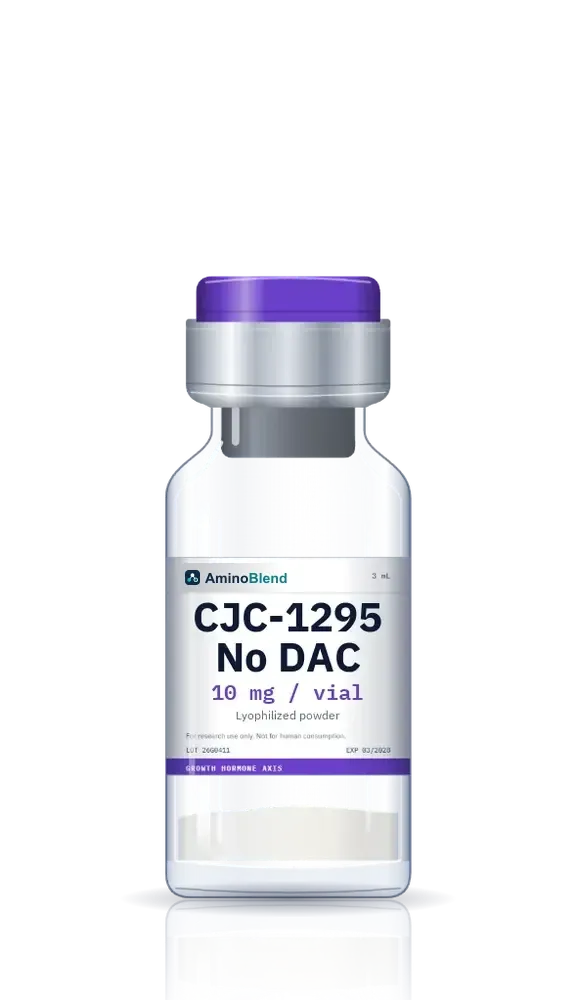
| Form | White lyophilised cake in a sealed 3 mL glass vial with a purple cap and No DAC printed on the label |
| Testing | Mass spectrometry for identity, which distinguishes No DAC from DAC, and HPLC for purity, with a certificate per lot |
| Contents | One 10 mg vial of CJC-1295 No DAC per unit without solvent, bacteriostatic water a separate purchase |
| Storage | Sealed at -20 °C in the dark, then 2 to 8 °C once in solution |
| Availability | In stock |
| Use | Limited to in vitro laboratory research |
Order the short-acting member of the CJC-1295 family, the stabilised GHRH core without the arm that binds it to albumin. It is the analogue to choose for brief, repeatable growth hormone pulses, and the 10 mg vial carries twice the fill of our DAC version.
CJC-1295 No DAC is a lab-built version of the active front section of growth hormone releasing hormone, rebuilt with four amino acid swaps so it lasts long enough to study. Researchers also call it Mod GRF 1-29. It switches on the GHRH receptor, the same switch the hypothalamus uses to tell the pituitary when to release growth hormone.
Every substitution repairs a specific weak point in the natural sequence, and knowing which one does what helps when reading a certificate or an older paper.
In the body, neurons in the arcuate nucleus release GHRH into the small portal vessels that feed the anterior pituitary. There it binds a class B G protein coupled receptor on somatotroph cells. The receptor couples to Gs, cyclic AMP climbs, and protein kinase A drives both the release of stored growth hormone and the transcription of new hormone. Somatostatin pushes the other way through Gi, which is why the pulse pattern of growth hormone reflects a running contest between the two signals. The importance of this receptor shows up clearly in the little mouse, a dwarf strain whose phenotype traces to a single amino acid change in the GHRH receptor.
Here is the honest gap in the literature. Very little published work tests the CJC 1295 no DAC molecule by itself. Most clinical data on the CJC name come from the albumin-bound conjugate, and most of the short-acting human data come from sermorelin, the unmodified fragment. Mod GRF sits between the two, and a design that relies on it should say so plainly in its methods.
Our practical tip: in pituitary cell work, measure cyclic AMP as well as secreted growth hormone. The cAMP signal appears within minutes, gives a cleaner concentration curve, and with forskolin as a positive control it tells you whether a weak result is the receptor or the cells. How it differs from the long-acting sibling is laid out in the complete DAC and No DAC comparison.
Human GHRH, isolated in 1982, has 44 amino acids, but its first 29 residues are enough to activate the receptor, and that fragment, GRF 1-29, became sermorelin. It is cleaved within minutes by dipeptidyl peptidase-4. Modified GRF (1-29) fixes that weakness with four substitutions, and the CJC name came from ConjuChem, the Canadian company that later attached a drug affinity complex to make the long-acting version.
Buy the 29-residue amidated chain here without that complex. It is a research reagent, not a registered medicine, and is sold only for laboratory work. Labs choose it over native sermorelin when they need the same receptor target with enough stability to survive a full sampling window in culture medium or plasma. Related analogues and secretagogues are grouped in our growth hormone peptides range.
Each unit is a single vial of 10 mg Mod GRF (1-29) dried to a white cake, with No DAC printed on the label so it cannot be confused with the 5 mg albumin-binding sibling. Nothing is premixed and no second peptide shares the glass. The tetrasubstituted chain is essentially ConjuChem's CJC-1295 minus the extra C-terminal lysine that carries the albumin-reactive maleimide group. It was never developed into a medicine in its own right, so the name CJC-1295 No DAC is a market label borrowed from the conjugated molecule.
Here the naming gets interesting. The Poisons Standard entry that reads "CJC-1295" carries CAS 863288-34-0, which is the DAC version, so on a strict reading it does not describe this molecule. That changes little in practice. As of October 2026, the June 2026 Poisons Standard places growth hormone releasing hormones (GHRHs) as a class in Schedule 4, prescription only, and in Appendix D, clause 5, where possession without authority is illegal, and Mod GRF (1-29) is a GHRH analogue by any definition. No product containing it is on the ARTG, while its unmodified parent fragment, sermorelin, is named separately in Schedule 4.
Anti-doping lists take the same broad view. WADA's 2026 list groups CJC-1295, sermorelin and tesamorelin together as GHRH analogues under S2, prohibited at all times, and that list binds athletes tested by Sport Integrity Australia.
AminoBlend keeps CJC-1295 No DAC for sale in Australian stock purely as a research reagent: buyers must be 18 or older, and the vial is not for human or veterinary use. Anyone weighing the No DAC form against the conjugate should also read our CJC-1295 and ipamorelin safety research guide, which gathers what the human trials recorded.
Shop the single fill, a 10 mg vial at $79, or $7.90 per mg. Because the synthesis skips the DAC conjugation step, we can offer double the peptide of the 5 mg DAC vial at the same price, which suits pulsatile designs that use material faster than sustained-release work.
Order a full study series at once, so every vial shares a lot and one certificate. Pairing studies usually add ipamorelin to the same cart. The peptide is released only to adult buyers, aged 18 or more, who tick the research-use declaration before paying.
You will not find a CAS number on this page. The figure that often circulates for this molecule, 863288-34-0, belongs to the DAC version, and we would rather leave the row out than print a wrong value. Identity is confirmed instead by mass, near 3367.9 g/mol, and by the sequence on the certificate.
That mass line matters more than usual, because many vials on the market are labelled only CJC-1295 and the two forms look identical as powders. A reading near 3647 would indicate DAC material, and a value in between would suggest a truncated or incompletely deprotected chain worth questioning before use. Buy only once HPLC purity checks out on the same report, filed by lot in our COA library. Any lab weighing up the best CJC 1295 peptide should start with exactly that mass line.
A local reseller is unnecessary, because this online store supplies laboratories across Australia from one domestic stock and sends out every order received before the 3pm weekday cut-off on the same day. Follow the parcel on the order tracking page once it leaves.
Buy bacteriostatic water with your vial. Let the vial reach room temperature, trickle the diluent down the glass and rotate it gently until clear, without shaking. Two millilitres added to the 10 mg vial produce a 5 mg/mL solution, and the general peptide calculator converts any other volume.
Mod GRF (1-29) is more fragile in solution than dry, and its DPP-4 protection does nothing against slow hydrolysis in water, so keep sealed vials at -20 °C and the prepared solution at 2 to 8 °C in aliquots, using each portion without delay.
This compound is sold as CJC-1295 No DAC, CJC 1295 without DAC, Modified GRF (1-29), Mod GRF 1-29 and tetrasubstituted GRF (1-29). Its relationship to sermorelin, GRF (1-29) and GHRH (1-44) explains the overlapping names, but only the four-substitution, non-conjugated chain matches what is in this vial.
Related receptor terms include GHRH-R, somatotroph, cAMP and protein kinase A, which describe the pathway it activates in pituitary cells. Some suppliers simply write CJC-1295, which is ambiguous, whereas the words No DAC always appear on our label, so the vial cannot be mistaken for its long-acting sibling.
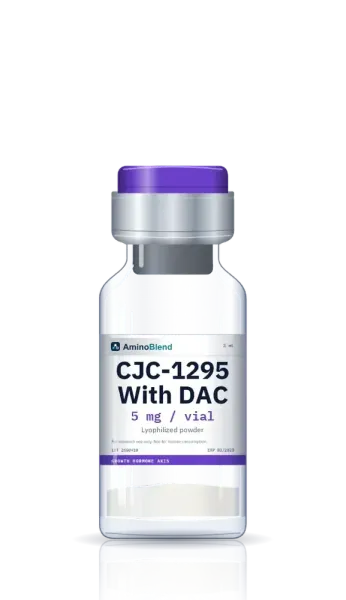
Pick by time scale when deciding on CJC 1295 DAC or no DAC. Our CJC-1295 DAC vs No DAC guide covers the chemistry in depth. The No DAC form acts for roughly 30 minutes, preserving the natural pulse pattern and clearing between sampling points. CJC-1295 With DAC, a 5 mg vial at $79, binds albumin and extends activity to several days, suiting designs that need a sustained rise.
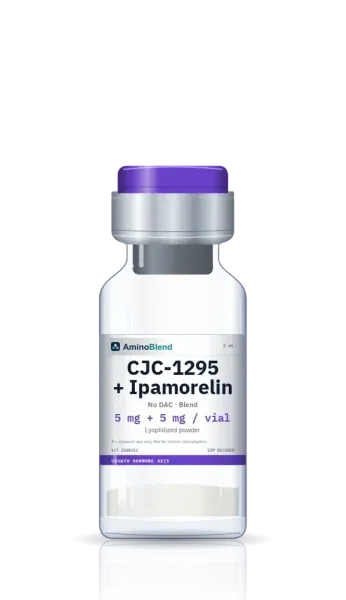
Shop ipamorelin as the best peptide to stack with CJC 1295 in ghrelin and GHRH synergy work. Ipamorelin CJC-1295 No DAC studies usually start from separate vials so each amount can be set, while the CJC-1295 No DAC Ipamorelin blend suits a ratio already fixed at equal amounts.
CJC-1295 No DAC copies the first 29 residues of the hormone that tells the pituitary to release growth hormone. Four swapped amino acids make it tougher than the original.
Order one sealed vial holding 10 mg of white powder, in stock for online purchase. Bacteriostatic water is not supplied and is ordered separately.
It is used to study bursts of growth hormone release and their interplay with the ghrelin pathway, in cells or animals. Laboratory research only.
CJC-1295 With DAC stays active for days by binding albumin. The No DAC form acts for about 30 minutes, like a short signal.
Freeze the sealed vial and refrigerate the solution in small portions. Dissolve by slow rotation rather than shaking.
Mass spectrometry on each lot confirms the No DAC molecule, and HPLC records purity. The certificate is open before purchase.
Order the 10 mg vial at $79 by adding it to the cart and paying on this page. Our Australian warehouse sends it out with tracking that same afternoon for any order made by 3pm on a business day. Diluent is not supplied, so add bacteriostatic water, and declare at checkout that you are an adult.
Buy it online from AminoBlend, as there is no physical store and this page serves every city and town. All orders ship from one Australian stock, each vial with its lot certificate already published, and tracked delivery reaches regional addresses as well as capitals.
Yes. Each lot goes to an outside laboratory, where a measured mass of about 3367.9 g/mol proves the vial holds No DAC rather than DAC material, and HPLC reports purity. Look the report up by the lot code on your label in our COA library before or after you order.
Choose No DAC for studies of discrete growth hormone pulses or for pairing with a ghrelin agonist such as ipamorelin, since its activity clears within about 30 minutes. Choose With DAC, a 5 mg vial at $79, only when the design needs a sustained rise lasting several days.
Because the number most often quoted, 863288-34-0, belongs to the DAC version, and we prefer to omit a row rather than show an incorrect figure. Identity is established by the measured mass of about 3367.9 g/mol and by the sequence reported on each lot certificate.
It pairs a short-acting GHRH receptor agonist with a ghrelin receptor agonist to study how the two pathways combine to shape growth hormone pulses in pituitary cells and animal models. Both peptides are supplied solely for laboratory and in vitro research and are not for human or veterinary use.
10 mg vial
5 mg vial
10 mg vial
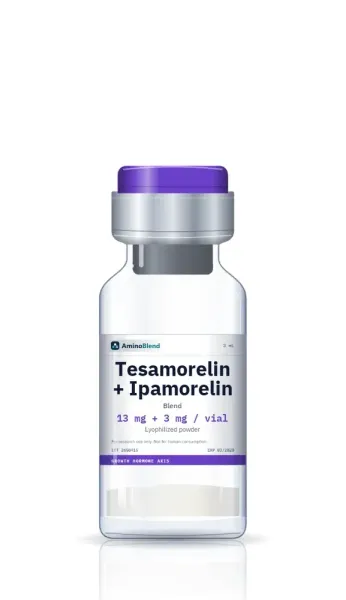
13 mg + 3 mg vial