
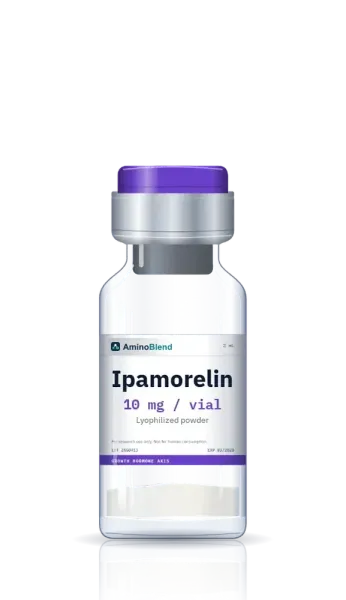
Ipamorelin
10 mg vial
$59
Research use only. AminoBlend supplies research compounds for laboratory and in-vitro use, not for human or animal consumption. By continuing you confirm you are 18 or older and buying for research.
In stock, ready to ship from Australia
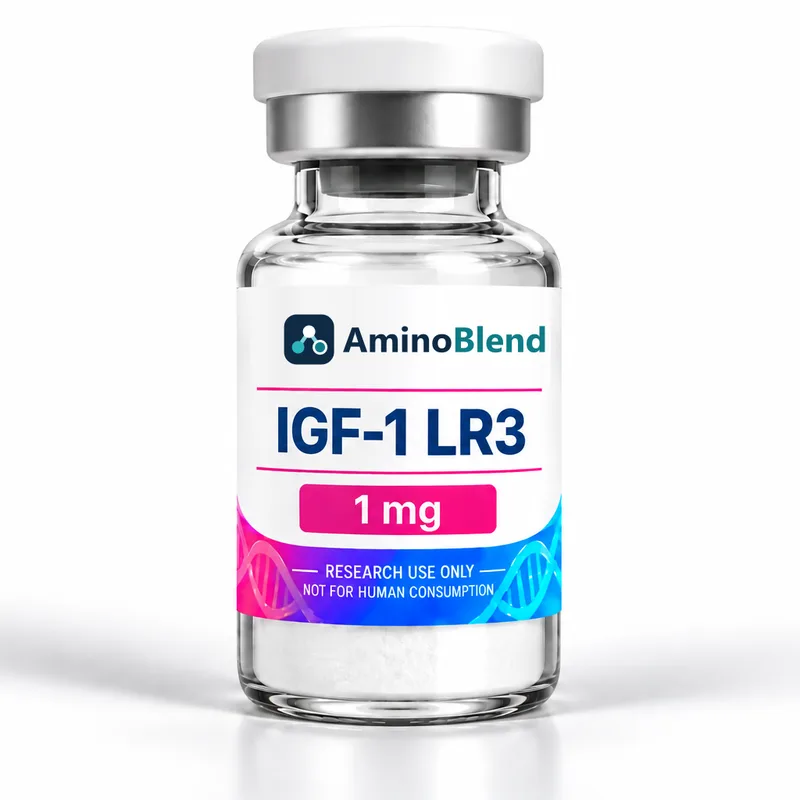
Size: 1 mg vial
Buy IGF-1 LR3 online in Australia as a 1 mg lyophilised vial of Long R3 IGF-1 for $99, packed and shipped from local stock. This 83 amino acid analogue of human insulin-like growth factor 1 carries a 13 residue N-terminal extension and an arginine in place of glutamic acid at position 3, changes that let it escape most IGF binding proteins and keep the IGF-1 receptor engaged in culture. Its identity data are C400H625N111O115S9, 9117.6 g/mol and CAS 946870-92-4. Order with the lot record open, because each batch is confirmed by mass spectrometry and measured by HPLC, with the certificate in the COA library before checkout. The peptide calculator sets up a stock solution from any volume. Shop the CJC-1295 and ipamorelin blend in the same order to compare a downstream receptor agonist with an upstream secretagogue. The vial ships as powder without diluent, so add 0.6% acetic acid or bacteriostatic water. Keep it sealed at -20 °C. A research reagent for in vitro and cell culture work, sold to adults aged 18 and over.
For laboratory research use only. Not for human or veterinary use. Not TGA approved. See our research use policy.
| Name | Long R3 IGF-1 (LR3) |
|---|---|
| Sizes and prices (AUD) | 1 mg vial, $99 |
| Sequence or structure | 13 residue extension MFPAMPLSSLFVN followed by human IGF-1 (1-70) with Arg3 in place of Glu3, and three disulfide bonds |
| Length | 83 amino acids |
| Molecular formula | C400H625N111O115S9 |
| Molar mass | 9117.6 g/mol |
| CAS number | 946870-92-4 |
| Form | Lyophilised powder in a sealed glass vial with white cap |
| Testing | Identity confirmed by mass spectrometry, purity measured by HPLC, certificate for each lot |
| Contents | One vial with 1 mg of the analogue, no diluent (0.6% acetic acid and bacteriostatic water sold separately) |
| Storage | Sealed at -20 °C, dry and dark, and in solution at 2 to 8 °C short term or as frozen aliquots |
| Availability | In stock |
| Use | Laboratory in vitro research and cell culture only |
Order this analogue when a culture or receptor study needs IGF-1 signalling that holds for days instead of fading as binding proteins take it up. The 1 mg vial is held in Australia and every lot has its own report.
IGF-1 LR3 is an engineered, longer version of insulin-like growth factor 1, the hormone that carries out much of growth hormone's work in tissue, altered so that the body's natural binding proteins can barely hold onto it. A larger share stays unbound, which is why it acts more strongly in cell culture than the natural hormone at the same concentration.
Native IGF-1 is a small protein of 70 amino acids, folded by three disulfide bridges into a shape closely related to proinsulin. The liver makes most of the circulating supply when growth hormone tells it to, though many tissues produce their own. It acts on the IGF-1 receptor, a tyrosine kinase that sits across the cell membrane as a paired unit. When IGF-1 binds, the receptor phosphorylates itself and recruits adaptor proteins, setting off two main cascades: PI3K and Akt, which favour cell survival and protein synthesis through mTOR, and Ras and MAPK, which push cells to divide.
In blood and in culture, though, very little IGF-1 floats free. Six binding proteins, IGFBP-1 to IGFBP-6, capture it, extend its life in circulation and decide when it can reach a receptor. Many cultured cell lines secrete these binding proteins into their own medium, quietly mopping up any IGF-1 that is added.
Two edits do the work. Swapping glutamic acid for arginine at position 3 disturbs one of the surfaces the binding proteins grip, and the 13-residue leader at the front adds further interference. The receptor still recognises the core, so signalling proceeds without the usual interception. When Francis and colleagues compared fusion analogues of this kind in 1992, their conclusion was that weaker capture by binding proteins, rather than tighter receptor binding, accounted for the extra potency in cell assays.
That leads to the point most people get backwards. The IGF-1 LR3 peptide is not a stronger receptor agonist than IGF-1. It is a harder one to intercept. In a serum-free system with cells that make few binding proteins, the gap between long R3 IGF-1 and the native hormone narrows considerably; in serum-supplemented medium, or with cell lines that secrete plenty of IGFBPs, it widens. Our advice is to run native IGF-1 alongside the analogue for any experiment where binding protein levels might change between conditions, otherwise a shift in IGFBP secretion can masquerade as a change in receptor response. Terms such as IGFBP and IGF-1R are defined in our peptide glossary for lab work.
The analogue came out of Adelaide in the early 1990s, from the research group that had earlier described des(1-3) IGF-1. The aim was a growth factor that was easier to produce and more stable in use, and the result became a standard supplement for serum-free media, notably for Chinese hamster ovary cells in bioproduction.
Its appeal is durability. Because it binds the six IGF binding proteins only weakly, more of it stays free to reach the receptor, and it degrades slowly in medium, so a single addition can carry a multi-day culture. Buy it as a laboratory reagent, not a therapeutic, from our GH axis and IGF peptides range.
Expect a small vial containing 1 mg of Long R3 IGF-1 as a freeze-dried film or pellet, white and easy to overlook, with no carrier protein or buffer added by us. This is the one compound in our growth hormone range with a genuinely Australian commercial story. Beyond the Adelaide laboratory work described above, the protein was manufactured by GroPep Limited in Adelaide as a cell culture raw material, and from 2000 a distribution agreement put it into industrial bioprocessing supply worldwide.
Its cell culture pedigree does not change how the Poisons Standard treats it. Checked against the June 2026 Poisons Standard in October 2026, insulin-like growth factor I appears in Schedule 4 alongside a broader entry, insulin-like growth factors except when separately specified, which captures analogues such as LR3; both entries are marked for Appendix D, clause 5, so possessing it without authority is illegal. The registered relative is mecasermin, recombinant native IGF-1, which has a TGA product information document under the Increlex brand. Long R3 IGF-1 itself has never been approved as a medicine anywhere, so it has no ARTG registration as a medicine and no pharmacy route.
WADA's 2026 Prohibited List names insulin-like growth factor 1 and its analogues among the growth factors in class S2, prohibited at all times, and Sport Integrity Australia applies the same list.
When labs ask where to buy IGF 1 LR3 in Australia with the identity documented, the answer here is a 1 mg vial kept on Australian shelves for in vitro and culture work, which we sell only to adults of 18 or more and which must never be given to a person or an animal. Our peptide storage guide covers freezer and fridge handling for the sealed and mixed vial.
We supply one fill, a 1 mg vial at $99. That looks expensive per milligram beside 10 mg secretagogue vials, but working amounts here are measured in nanograms per mL of medium, so one milligram (1,000 micrograms) supplements a large volume. Cost per experiment is the fairer comparison. The fill is small because this is a folded 83 residue protein with three disulfide bonds, far harder to make than a short peptide.
A 1 mg pellet is tiny and can look like an empty vial, and the certificate confirms what is inside. Order two or three vials at once if you run several culture lines, and they will come from the same lot wherever stock allows so the project keeps one certificate. Only adults aged 18 and over can complete checkout.
The construct has three parts, the 13 residue extension Met-Phe-Pro-Ala-Met-Pro-Leu-Ser-Ser-Leu-Phe-Val-Asn, then the 70 residues of human IGF-1 with arginine at position 3. A mass close to 9.1 kDa, against about 7.6 kDa for native IGF-1, is the first sign that the vial holds the long analogue rather than the natural hormone.
The certificate should match the formula and CAS in the table and report an HPLC result for your lot. Find it in the COA library, where the COA reading guide shows why the measured mass matters as much as the purity figure.
No shop or collection point is needed. The online store supplies labs in every state from one Australian stock, and orders paid before 3pm on a business day are dispatched the same afternoon. Groups after research peptides in Adelaide, where the analogue was first made, order the same way. Progress shows on the order tracking page.
Data sheets for IGF analogues often dissolve the stock in a dilute acid, and 0.6% acetic acid is the usual choice here, while bacteriostatic water suits solutions drawn from several times. Add the diluent slowly and swirl rather than shake. With 1 mL, the vial gives 1 mg/mL, which is 1,000 micrograms per mL, and the peptide calculator handles further dilution into working stock.
Keep the sealed LR3 vial at -20 °C, dry and dark. A carrier protein such as 0.1% bovine serum albumin in the diluted stock limits losses to plastic surfaces. In solution, hold it at 2 to 8 °C for short periods, or freeze single-use aliquots for longer runs. Avoid repeated freeze-thaw cycles, which encourage aggregation of the folded protein.
This analogue is listed as LR3 IGF-1, Long R3 IGF-I, Long Arg3 IGF-1 or simply LR3. The roman numeral form, IGF-I, is common in older journals. All refer to the same 83 residue chain registered under CAS 946870-92-4.
Receptor vocabulary centres on IGF-1R, the insulin-like growth factor 1 receptor, a tyrosine kinase, and on the IGFBPs, the six binding proteins that normally hold native IGF-1 in reserve. Low IGFBP affinity is the defining property of the long analogue.
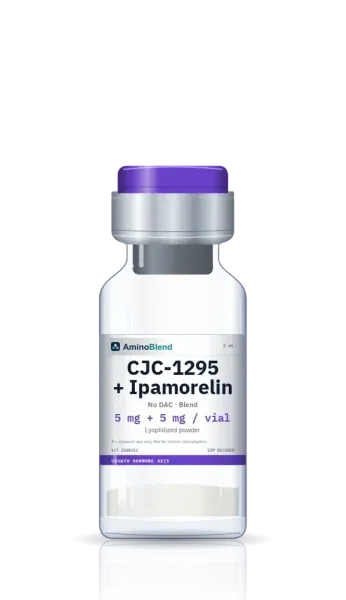
These sit at opposite ends of the growth hormone axis. The CJC-1295 and ipamorelin blend, $65 for 10 mg, acts upstream at the pituitary to trigger growth hormone release, while LR3 skips those steps and acts directly on the receptor that IGF-1 normally reaches last. Pick by the point in the axis your study examines.
Shop LR3 for multi-day cell culture and receptor signalling work. For pituitary secretion studies, a secretagogue is the better purchase, and both can sit in one cart when a project spans the whole axis.
Long R3 IGF-1 is an 83 residue analogue of IGF-1 with an N-terminal extension and an arginine at position 3. Both changes cut its binding to IGF binding proteins.
One sealed 1 mg vial costs $99 from Australian stock. No diluent is supplied, so add 0.6% acetic acid or bacteriostatic water.
Used as a serum-free media supplement and in IGF-1 receptor signalling work. For in vitro and laboratory research only.
The CJC-1295 and ipamorelin blend acts at the pituitary. LR3 acts directly at the IGF-1 receptor, at the far end of the axis.
Store the sealed vial at -20 °C. In solution, keep it cold for short periods or freeze single-use aliquots.
Mass spectrometry looks for about 9.1 kDa, ruling out native IGF-1, and HPLC measures purity. Certificates are in the COA library.
Add the 1 mg vial to your cart from this page and pay. It costs $99 and ships from Australian stock to every state and territory, with dispatch that afternoon when payment arrives before 3pm on a business day. The vial has no diluent, so add 0.6% acetic acid or bacteriostatic water, and review the lot certificate first.
Yes. Mass spectrometry on every lot should read close to 9.1 kDa, which separates the long analogue from native IGF-1 at about 7.6 kDa, and HPLC records purity. The certificate shares the lot number on your vial and is available in the COA library.
Choose LR3 when the study works directly at the IGF-1 receptor, for example in multi-day cell culture. Choose the CJC-1295 and ipamorelin blend, $65 for 10 mg, when the research concerns growth hormone release from the pituitary, further up the same axis.
One milligram of freeze-dried protein forms only a thin film or a very small pellet, so the vial can look nearly bare. That is normal for this fill. The certificate for your lot confirms identity by mass and purity by HPLC, and you can open it in the COA library.
For axis-level comparisons, labs often add the CJC-1295 and ipamorelin blend to contrast pituitary secretagogues with direct receptor activation. For culture work, the more useful companion is 0.6% acetic acid as the diluent. Each item is a research reagent shipped from the same Australian stock with its own lot documentation.
It is a research reagent used to supplement serum-free cell culture media and to study IGF-1 receptor signalling, protein synthesis and cell proliferation in vitro. It is not a medicine, has no TGA approval and is sold for laboratory work only, to buyers aged 18 and over.
10 mg vial
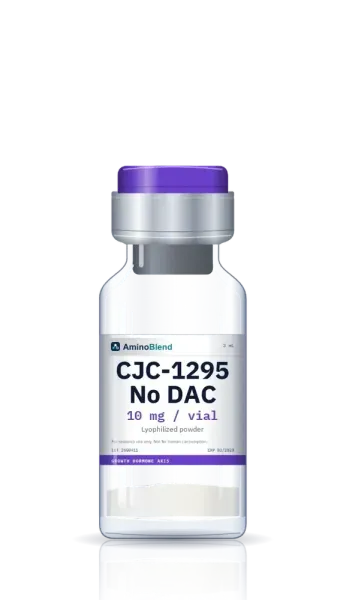
10 mg vial
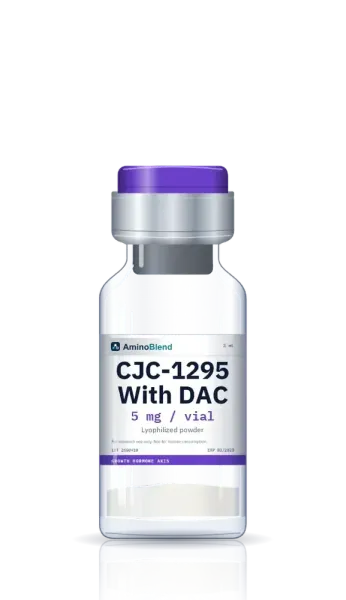
5 mg vial
10 mg vial