
BPC-157
From $69
Research use only. AminoBlend supplies research compounds for laboratory and in-vitro use, not for human or animal consumption. By continuing you confirm you are 18 or older and buying for research.
What is BPC 157? It is a synthetic peptide of 15 amino acids copied from a protein in human gastric juice, first described by Professor Predrag Sikiric's group in Zagreb in the early 1990s. Its research record is large but almost entirely animal work, centred on tendon, gut and blood vessel repair.
BPC stands for body protection compound. The Zagreb group, working at the University of Zagreb medical school, isolated a protective protein fraction from human gastric juice and went on to synthesise a 15 amino acid section of it, numbered 157. The result is a pentadecapeptide that does not occur on its own in nature: it is a lab-made fragment, which is why it is called synthetic.
It has picked up other names along the way. Pharmaceutical development under the Croatian company Pliva used the codes PL 14736, PL-10 and PLD-116, and it is sometimes called bepecin. Research suppliers simply sell it as BPC-157 or BPC 157.
In one-letter code the sequence reads GEPPPGKPADDAGLV: fifteen residues with a molecular weight of about 1419 Da. That run of three prolines near the start gives the chain an unusually rigid shape, and it is part of the reason the Zagreb papers describe BPC-157 as a "stable gastric pentadecapeptide": it resists breakdown in gastric juice for far longer than most peptides.
That stability is the practical property that sets it apart. It is why BPC-157 is one of very few peptides studied in oral form as well as in solution, and why it is sold in capsules at all.
No human mechanism has been established, so "what does BPC 157 do" is best answered as "what has it done in models". Four threads run through the literature:
You can read the papers themselves, with PubMed links, in our BPC-157 citation library.
The reported BPC 157 benefits are real findings in rodents: better tendon biomechanics, faster ulcer and fistula closure, protection of blood vessel lining. The 2025 HSS Journal systematic review by Vasireddi and colleagues summarised it fairly: promising preclinical results in muscle, tendon, ligament and bone injury, but only level IV and V evidence, and no clinical safety data.
In people, the evidence is three small reports from one clinician: a 2021 knee pain chart review of 16 patients, a 2024 interstitial cystitis series of 12, and a 2025 intravenous safety pilot in two healthy adults. None had a placebo group. Our opinion, for what it is worth: BPC-157 is one of the most interesting peptides in tissue repair research precisely because the animal data are so consistent, and one of the most oversold because that consistency has never been tested in a proper trial. Side effects are covered in our BPC-157 side effects evidence review.
Does BPC 157 work? In rat models, repeatedly, yes, by the measures those studies chose. In humans the question is simply unanswered, because nobody has run the trial that could answer it.
The same applies to timing. In animal models, outcomes are usually measured over days to a few weeks after an induced injury, which reflects the healing window of a rat rather than a person. In the 2021 knee chart review, patients were looked at six months to a year after treatment, but without controls that says nothing reliable about onset. There is no evidence-based answer to how long BPC-157 takes to work in people.
AminoBlend supplies BPC-157 in two formats, and the choice follows the research design:
| 10 mg vial | 500 mcg capsules | |
|---|---|---|
| Form | Lyophilized powder, reconstituted before use | Pre-measured solid, 60 per bottle |
| Concentration | Set by you | Fixed per capsule |
| Storage | Minus 20 °C long term; 2 to 8 °C once reconstituted | Closed bottle, below 25 °C, dry and dark |
| Suits | Work in solution | Oral-format study designs |
The vial is reconstituted with bacteriostatic water for peptide vials; the BPC-157 concentration calculator works out the strength per mL for the volume you add. Many labs also pair it with TB-500, and our BPC-157 and TB-500 comparison explains the difference between the two.
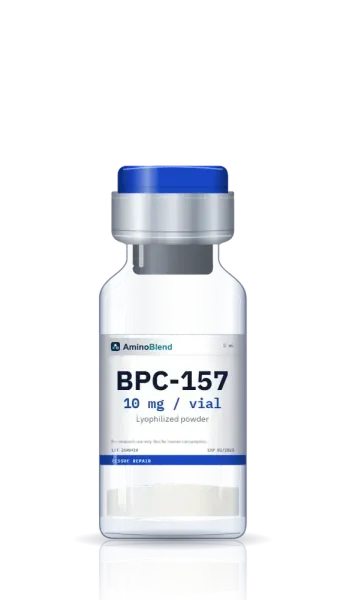
Most labs buy the BPC-157 10 mg vial at $69, because powder lets you set the working concentration yourself. The 60-capsule bottle ($79, 500 mcg per capsule) is the one to buy for oral-format study designs. If your work pairs it with TB-500, we recommend separate vials of each so either compound can be tracked on its own; the Wolverine Blend at $69 suits designs that only ever test the two together, and it comes in $5 under the price of half a BPC-157 vial plus half a TB-500 vial. Shop online from Australian stock, add bacteriostatic water for the vial, and check the lot certificate before you order.
BPC-157 is not an approved medicine in Australia and is not on the ARTG. AminoBlend offers it to laboratories for research alone; it is not for people or animals, and we give no dosing advice. See our research use only terms, and for the regulatory detail read where BPC-157 stands under Australian law. The full tissue repair research catalogue includes TB-500, the Wolverine blend and KLOW.
BPC-157 is a synthetic peptide of 15 amino acids (GEPPPGKPADDAGLV) copied from a protein in human gastric juice. The name means body protection compound. It came out of the University of Zagreb, where the group led by Professor Predrag Sikiric has studied it since the early 1990s, mostly in rat models of tendon and gut injury.
In animal and cell studies it has been linked to faster tendon healing, protection of the stomach and gut lining, nitric oxide signalling and VEGFR2-driven blood vessel growth. Its mechanism in humans has not been established, and it is not approved to treat anything.
The reported benefits come from preclinical research: stronger tendon repair in rats, faster ulcer and fistula healing, and endothelial protection. Human evidence is limited to three small uncontrolled reports. A 2025 systematic review in HSS Journal called the preclinical data promising but found no clinical safety data.
There is no human answer. In animal models, effects are measured over days to a few weeks after an induced injury, matching the rodent healing timeline. No controlled human study has measured how quickly, or whether, BPC-157 has an effect in people.
In rat models of tendon, gut and vascular injury, the published studies report consistent positive results, most of them from one research group in Zagreb. Whether it works in people is unknown, because no randomised, placebo-controlled human trial has been published, and independent replication of the animal findings remains limited.
Buy it from AminoBlend, which keeps BPC-157 in Australian stock as a 10 mg lyophilised vial ($69) or a bottle of 60 capsules ($79). Results from independent identity and purity testing for each lot are published in the COA library. Buy the vial for solution work and the capsules for oral-format designs; neither is for human or veterinary use.
10 mg vial
